



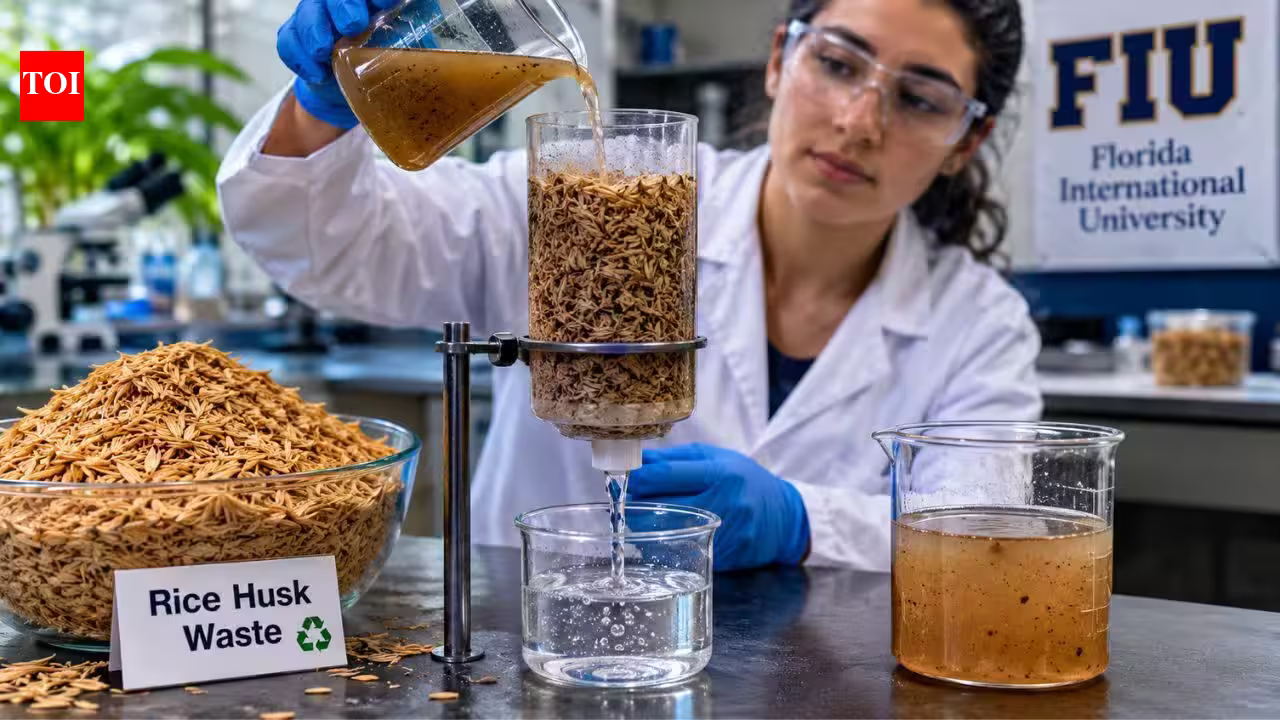
Rice leaves behind more than a meal. After the grain has been processed, the tough outer husk is usually treated as an unwanted agricultural residue, with enormous quantities accumulating every year. Much of it has little obvious use and can become an environmental burden when it is burned or dumped. At Florida International University, chemistry researcher Islam Ibrahim Hussein is looking at that discarded material differently. His work explores whether rice husks can be converted into a porous substance that helps pull industrial pollutants out of water. The idea brings two problems together: what to do with a plentiful waste product, and how to deal with contaminants that are difficult to remove once they enter waterways.
How discarded rice husks become a water-cleaning material
Rice husks are heated under conditions where oxygen is limited, changing the agricultural residue into biochar. Rather than being a simple powder or charred waste, the resulting material has a large internal surface area, giving contaminants plenty of places to attach. Hussein and his collaborators then modify the biochar with magnesium and aluminium. The metals become part of a composite designed to improve its ability to collect unwanted compounds from water.A material with a large surface area can provide many sites where pollutants can become trapped, which is part of what makes biochar attractive for water treatment. In this case, the researchers were interested in whether a substance made from something ordinarily discarded could perform that job without creating a different environmental problem in the process.
Why industrial dyes are a difficult water problem
The team tested the composite against brilliant green and malachite green, synthetic dyes that are commonly used when assessing materials intended for water purification. These chemicals have practical relevance beyond a laboratory experiment. Synthetic dyes are used across several industries, including textile production, leather processing, paper manufacturing and aquaculture. Once they reach wastewater, they can be persistent and difficult to deal with. Some have also raised concerns over toxicity and possible carcinogenic effects.The scale of the problem varies between regions, but dye-bearing wastewater is a particular concern in parts of Asia where textile manufacturing is extensive. The research paper published in Sustainable Chemistry and Pharmacy, titled ‘Waste-to-resource approach: Sustainable synthesis and life cycle assessment of rice husk char-supported Mg–Al layered double hydroxide for dye biosorption‘ reveals that the work points to the textile industry as accounting for an estimated 17–20% of industrial water pollution, placing dye removal within a much wider wastewater challenge. The rice-husk material performed well against the two dyes tested. But its usefulness was not limited to a single pass through contaminated water.
The rice-husk filter can be used more than once
After the first treatment, the researchers put the material through further tests. They reported that it retained its effectiveness after at least five uses. A filter that works only once would leave behind another stream of spent material to manage. Reusability changes that calculation, although it does not by itself establish that the technology is ready for industrial or community-scale treatment.There is another part of the experiment that is easy to miss. The researchers also considered the environmental cost of producing the material itself. Rice husk is produced in vast amounts. The sheer quantity means disposal can become a problem, particularly where the waste is burned. Burning the husks can release pollutants into the atmosphere, while simply accumulating large volumes of agricultural residue creates its own disposal difficulties.Turning some of that waste into a water-treatment material offers a different route. Instead of starting with a newly manufactured raw material, the process begins with something that already exists as a byproduct of food production.
The material still has to prove itself outside the laboratory
The early results do not mean rice-husk filters are ready to replace existing water-treatment systems. The experiments were carried out under controlled conditions, using selected synthetic dyes. Real wastewater is considerably messier. It can contain mixtures of chemicals, metals, organic compounds and other substances that may interact with one another or interfere with the material’s ability to capture a particular pollutant.Hussein and his collaborators want to see how the composite performs against a broader range of contaminants, including other dyes and heavy metals. Testing it with genuine water samples will also help establish how the material behaves when conditions are less predictable than those found in a laboratory.