



On 12 August 2026, a total solar eclipse will take place, which will cross the Northern Hemisphere from Siberia to the Mediterranean. This rare celestial event is expected to attract millions of observers from many continents. The path of totality (the narrow track or strip of land where the Moon completely blocks out the Sun during a total solar eclipse) will begin in northern Siberian Russia, then travel across the North Pole, after which it will move through eastern Greenland and western Iceland before finishing in northern Spain and a small portion of Portugal.Total eclipse is a narrow phenomenon, but a much larger area with parts of North America, Africa, and almost all of Europe will experience a partial eclipse. This particular event is going to be unique because it will contain a ‘sunset eclipse’ over the Mediterranean, which will offer a visual experience when the Sun dives into the horizon. Scientific bodies such as Nasa and the European Space Agency are already providing detailed maps and safety instructions to prepare the public.
Date and timings of the 2026 Solar eclipse
The eclipse is scheduled to take place on Wednesday, 12 August 2026. National Eclipse reports that this event is particularly unusual because it acts as a ‘time traveller.’ The path starts in the Eastern Hemisphere, crosses over the North Pole, and then drops back down into the Western Hemisphere, and that’s why the local clock time will actually go back by ‘eight hours’ as the shadow moves forward. Those people who are planning to travel, this date falls during the peak of the European summer, which means the weather for viewing will be warmer.The timing of the eclipse depends on the observer’s location. Nasa data shows that the eclipse will begin at sunrise on the Taymyr Peninsula in Siberia. Because of the ‘midnight sun’ of the Arctic summer, this ‘sunrise’ will technically occur at the unusual local time of 11:59 pm.The timing will become more conventional when the shadow moves south. In Iceland, the National Eclipse reports that totality will begin after 5:00 pm local time. For example, the town of Ísafjörður will see totality at approximately 5:44 pm GMT, while the capital, Reykjavík, will experience it at 5:48 pm GMT. By the time the shadow reaches Spain, it will be late evening. In A Coruña, totality starts at about 8:27 pm CEST, and in Palma de Mallorca, it begins at 8:31 pm CEST, just minutes before the Sun sets.
What exactly is a solar eclipse
A solar eclipse is a natural event that occurs when the Moon passes directly from between the Earth and the Sun, blocking the sunlight for a temporary amount of time. According to the European Space Agency (ESA), the Moon completely covers the Sun’s bright face during a total eclipse, which triggers a period of daytime darkness. This moment reveals the Sun’s corona, which is the faintly glowing outer atmosphere that is usually not visible to the naked eye.Nasa explains that the Moon’s shadow is divided into two different parts known as the ‘umbra’ and the ‘penumbra’. The umbra is a very narrow path where the Sun is completely blocked and anyone standing in this zone will experience ‘totality.’ The penumbra is a much broader shadow where the Sun is covered partially, which results in a partial eclipse for those standing outside the totality zone. Observers in this zone will see a crescent Sun.
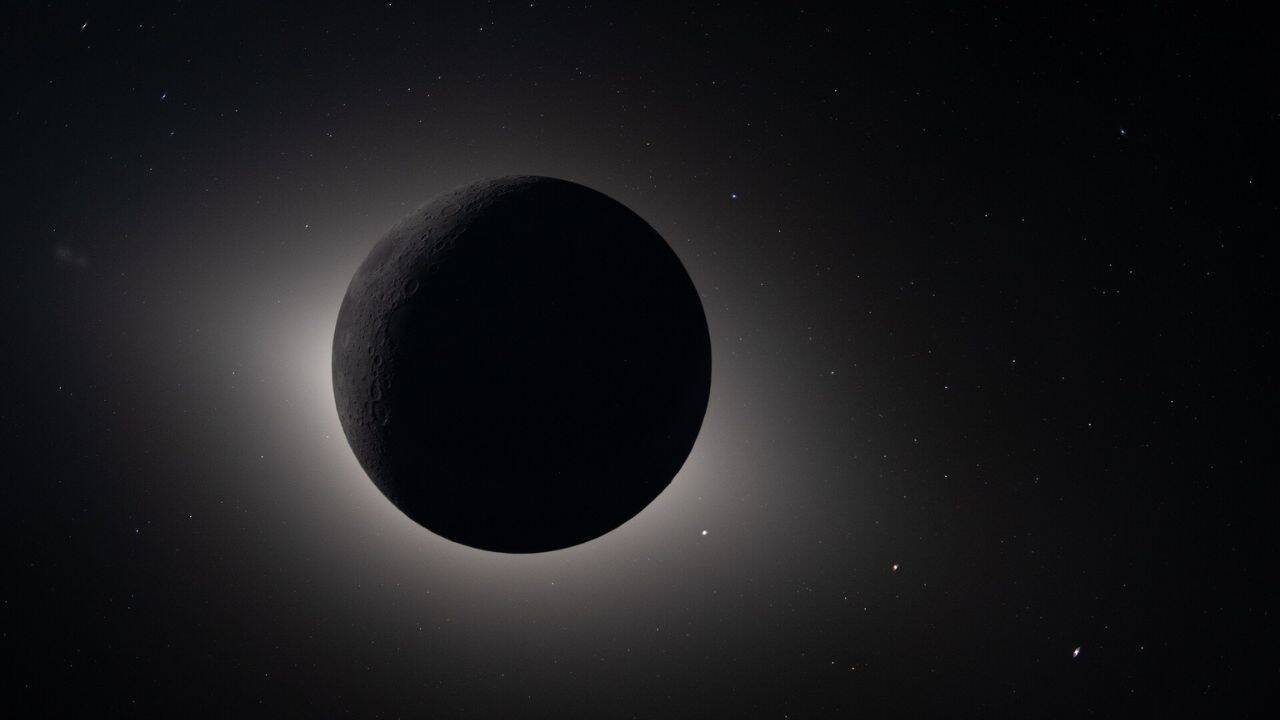
Captured by the Artemis II crew during their lunar flyby on April 6, 2026, this image shows the Moon fully eclipsing the Sun. Image Credit: Nasa
Most prominent locations to watch the 2026 solar eclipse
The path of totality is narrow, but it crosses several accessible regions. National Eclipse and Nasa highlight the following areas for the best views:•Greenland: The eclipse sweeps over the uninhabited eastern frozen wastelands and the fjords of Scoresby Sound.•Iceland: The western shores will see the eclipse, with the longest land-based durations found at the western tip of the Westfjords and the Snæfellsnes Peninsula.•Spain: A broad swath of northern and central Spain is in the path, including cities like Oviedo, Burgos, and Zaragoza.•Portugal: A tiny ten-mile-square area of northeastern Portugal will briefly experience totality.The ‘Greatest Duration’ of the eclipse(the point where totality happens for the longest) is located off the western coast of Iceland, lasting 2 minutes and 18.2 seconds.
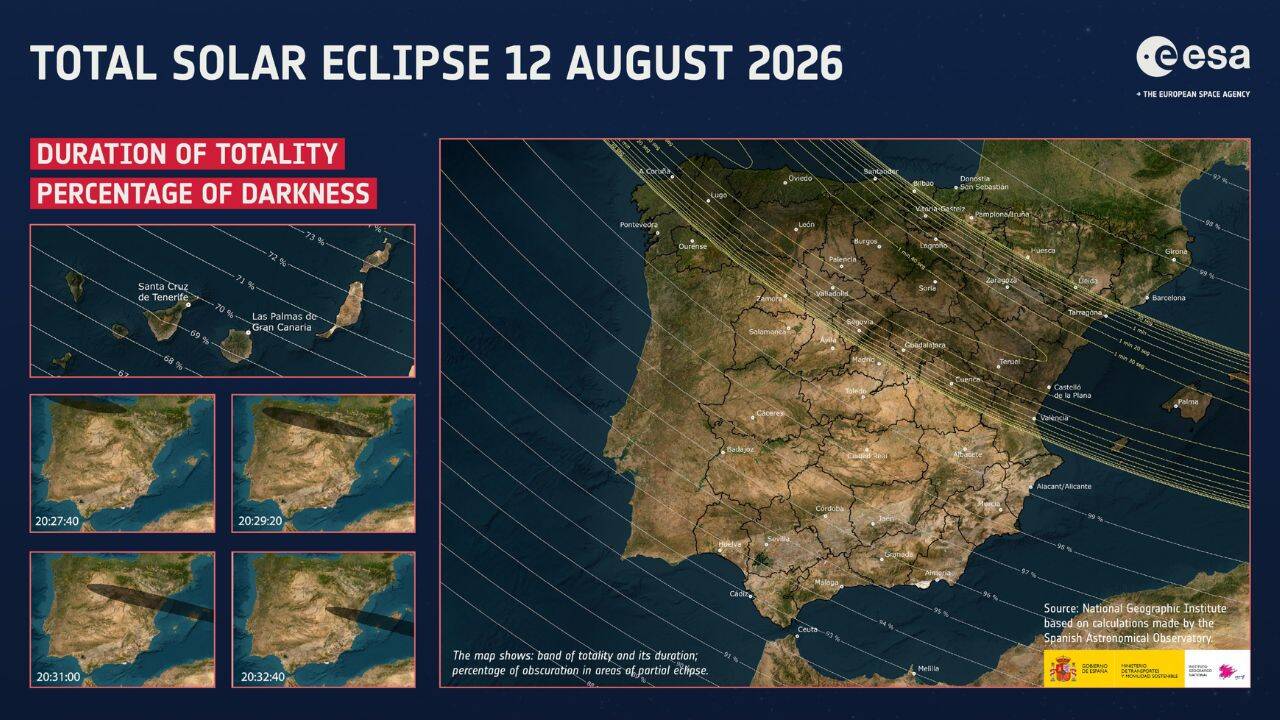
Image Credit: European Space Agency
Will the 2026 solar eclipse be visible in India
Based on the sources from Nasa and the ESA, there is no mention of the eclipse being visible in India. The maps provided by Nasa depict that the shadow path will stay strictly within the Northern Hemisphere, covering the Arctic, the North Atlantic, Europe, and parts of North America and northern Africa. Observers in the rest of Europe will see a partial eclipse, but the sources do not indicate that the penumbra (the partial shadow) will extend as far as South Asia.
Different ways to watch this solar eclipse
Whitman College describes an 11-day Arctic cruise aboard the Exploris One, which will position itself in Greenland’s ‘Scoresby Sound’ to ensure clear skies and an optimal backdrop of icebergs. For those on land, coastal areas in Spain or the volcanic landscapes of Iceland offer amazing settings.Regardless of the location, experts suggest monitoring weather forecasts closely. Nasa emphasizes that it is better to see a shorter eclipse under a clear sky than to see a longer one hidden by clouds. In Iceland, local guides suggest that if you do not like the weather, you should simply ‘wait five minutes,’ because conditions can change quickly.
What are the essential safety guidelines regarding the solar eclipse
Safety is the most critical aspect of viewing the eclipse. The ESA and National Eclipse provide strict warnings:•Never look directly at the Sun: You must not look at the Sun with the naked eye, even when it is partially eclipsed, as this can cause permanent eye damage.•Use certified protection: Only use special solar eclipse glasses or viewers that are certified as safe. Ordinary sunglasses are not sufficient.•Telescope safety: If using telescopes or binoculars, they must be fitted with professional solar filters.•Totality exception: The only time it is safe to look without filters is during the brief period of totality when the Sun is 100% covered, but filters must be replaced the moment the Sun begins to reappear.
Some common FAQs about the solar eclipse
Why does the shadow move from west to east?
Nasa explains that the Sun appears to move east to west, but the Moon’s orbital motion is actually twice as fast as the Earth’s rotation. This allows the Moon’s shadow to ‘race’ across the planet’s surface from west to east.
What makes a ‘sunset eclipse’ special?
In Spain, the Sun will be very low on the horizon during totality. National Eclipse explains that the Sun and Moon often appear larger near the horizon, and the setting Sun emits a reddish-orange light that may give the solar corona a unique colour shift.
When is the next eclipse after this one?
The ESA reports that this event will be followed by two more European eclipses including a total solar eclipse on 2 August 2027, and an annular eclipse on 26 January 2028.