



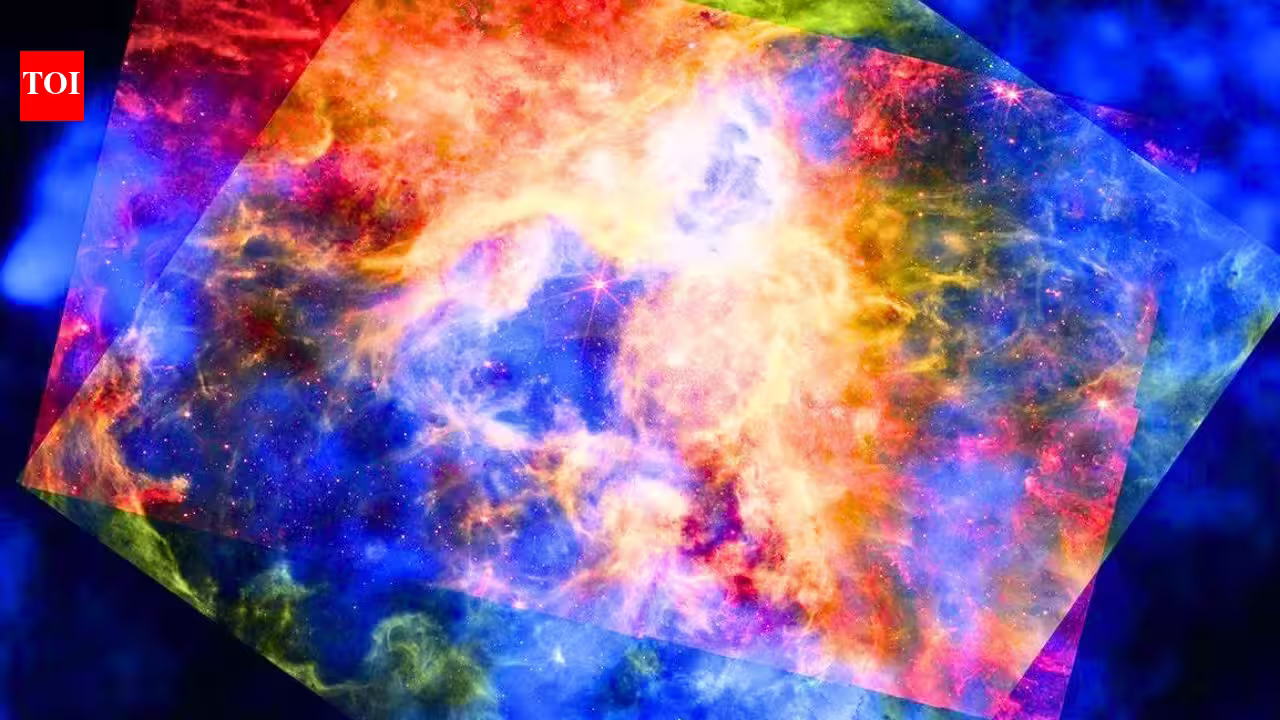

A dazzling new view of the Tarantula Nebula is revealing more than thousands of young stars. It is also helping astronomers investigate a puzzle about energy inside this vast stellar nursery. According to research published in the Astrophysical Journal, titled ‘Taming the Tarantula: How Stellar Wind Feedback Shapes Gas and Dust in 30 Doradus’, the nebula contains far less X-ray-emitting gas than scientists expected from the powerful winds of its young massive stars. The study brings together observations from Nasa’s Chandra X-ray Observatory, the James Webb Space Telescope, and the Hubble Space Telescope. The Tarantula Nebula, also known as 30 Doradus, lies in the Large Magellanic Cloud about 160,000 light-years from Earth. The new observations suggest that several processes may be carrying energy away from the region.
Tarantula Nebula image reveals young stars, hot gas, and cool dust
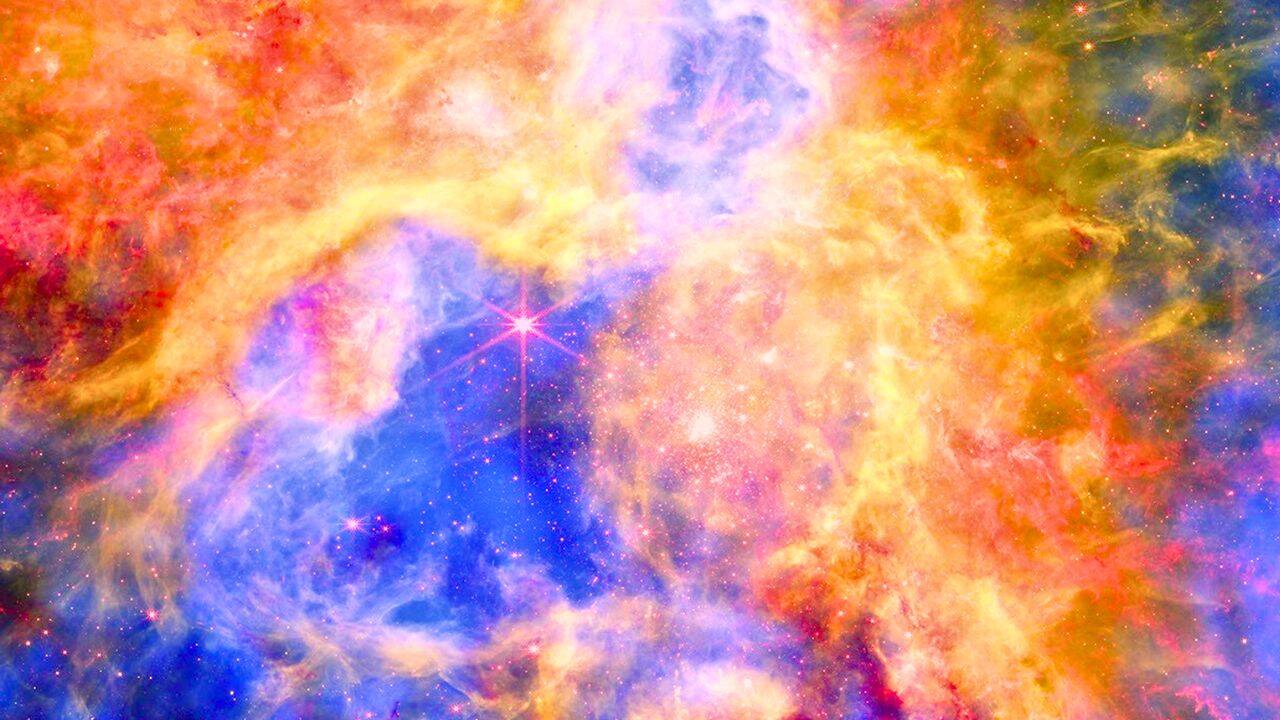
The composite image combines three views of 30 Doradus. Chandra’s blue X-ray data reveals gas heated to millions of degrees by shock waves linked to winds from young massive stars. Webb’s red infrared view shows thousands of young stars and large areas of cool dust that contain ingredients for future stars and planets. Hubble’s green optical data reveals warmer hydrogen gas and individual stars where the three layers overlap and create a vivid mix of red, orange, yellow, green, and blue.
PC: Nasa
Why the Nebula had less X-ray-emitting gas than scientists expected
Astronomers expected much of the energy produced by winds from young massive stars to heat surrounding gas and produce X-rays. But the study found considerably less X-ray-emitting gas than expected. Researchers examined Chandra, Hubble, and Webb observations alongside data from Nasa’s retired Spitzer Space Telescope. Their findings suggest that the Tarantula may be losing energy in several ways. Up to half of the hot gas may leak through the walls of its gas and dust shells and escape the nebula. This suggests that some of the energy may be leaving the nebula instead of remaining in its extremely hot gas.
Why is the star-forming region losing energy in various ways
The researchers identified three possible channels for the energy loss. Hot gas can escape through the shell walls. Cold gas near those walls can also stir and mix with some of the hot gas, lowering the overall temperature. Finally, comparisons with computer simulations suggest that thermal conduction may transfer heat between hot and cooler material through direct contact. This may be particularly important in the densest regions. Together, these processes could help explain why the Tarantula has less X-ray-emitting gas than expected.
Why the lower-than-expected hot gas matters to the astronomers
For astronomers, this provides a closer look at stellar feedback, the process through which young stars influence their surrounding environment. Newly formed stars, particularly massive ones, release intense ultraviolet radiation and powerful stellar winds. This energy can heat and ionise nearby gas, push material away, and carve cavities through clouds of gas and dust where stars are born.The process can also affect what happens next in a stellar nursery. While intense radiation and stellar winds can disperse material and limit further star formation, they can also compress nearby clouds of gas and potentially trigger the birth of new stars. Understanding how this energy moves through the surrounding material therefore helps astronomers determine how young stars reshape their environments and influence subsequent generations of stars.