



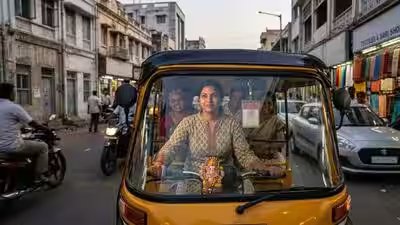
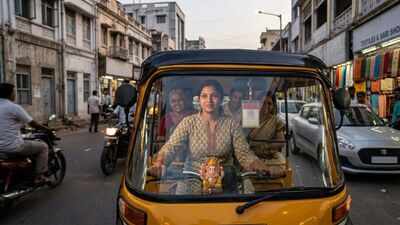
For many professionals, leaving an IT job to become an auto-rickshaw driver might seem like an unexpected career move. But for one Bengaluru woman, the decision was less about stepping away from a conventional career and more about finding work that suited her health, family responsibilities and need for control over her time. The woman, who spoke to Bengaluru-based influencer Tanvi Shetty during an auto ride, explained why she eventually left her IT job and chose to drive an auto instead. Her decision was influenced by changing work shifts, night duties, her mother’s needs and health challenges, including PCOD. According to her, the new profession has not only given her greater flexibility but has also helped her earn more than she did in her previous job.
When work stopped fitting into her life
The woman told Shetty that her IT job increasingly involved night shifts. After her father died, she was living with her mother and became uncomfortable with the idea of leaving her alone at night. She explained that she would have preferred to continue working in IT, but the changing schedule made it increasingly difficult to manage her responsibilities at home. Her shifts were not fixed either. Instead, they changed from week to week, making it difficult to establish a predictable routine. She described how her routine had been “completely changed” because of the constant shift changes.The commute added another layer of difficulty. She said employees could sometimes be picked up by a company cab one or even two hours before their shift, something she described as a “headache”. For her, the issue was therefore not simply whether she liked her job. It was whether the job allowed her to manage the rest of her life. Her health also became a concern. She said she developed PCOD while dealing with the demanding routine, adding another reason for her to reconsider her career. Eventually, she reached a point where she decided she needed to take charge of the situation herself. “I don’t know. I will do it. And it is possible. I will take care,” she said, describing the mindset that pushed her towards a different career.
Why driving an auto gave her something IT could not
Leaving an IT job did not necessarily mean choosing an easier profession. Driving an auto comes with its own challenges, including long hours, traffic, safety concerns and dealing with strangers. But what the woman gained was control over her schedule. She explained that she could decide when she wanted to work and, importantly, could adjust her schedule when her family needed her. She gave the example of a Sunday when she chose not to drive because she wanted to stay home and help her mother rest. According to her, this kind of flexibility was something she did not have in her previous job. “That I won’t get in IT,” she said while explaining the difference.The decision was not immediately supported by everyone around her. Her mother and other family members initially questioned whether she would be able to manage driving an auto, particularly because she was a woman. But she went ahead with the decision. The move also turned out to be financially beneficial. During the conversation, Shetty asked whether she was earning more as an auto driver than she had earned in IT. The woman confirmed that she was. For her, earning more while having greater control over her time made the decision even more meaningful.
“Being educated does not mean you should only work in IT”
The woman’s experience also made her question some of the assumptions surrounding women’s careers. She said female auto drivers sometimes face trolling and people may assume that they are driving simply “for some show”. She pushed back against the idea that education should determine the kind of work a woman is expected to do. She pointed out that women can have families and responsibilities too and that being educated does not mean they “should only work in IT.” Her decision, therefore, was not about rejecting education or ambition. Instead, it was about finding a profession that worked better for her circumstances. At the same time, she said that not everyone treats her negatively. Some passengers are supportive and respectfully address her as “madam” or “sister”.Her story drew attention online after Shetty shared the conversation. Several users praised the woman for choosing financial independence and a work schedule that better suited her life. Some called her decision inspiring and described her as a “rockstar”. Others said the story showed that success does not always have to mean staying in a conventional corporate job. Some commenters, however, questioned whether her previous role was actually an IT position, with a few suggesting it may have been customer-facing work. These comments highlight why the exact nature of her former employment should not be assumed beyond what she herself described. For the woman, however, the central issue appears to be simpler. A career is valuable when it allows a person to support themselves while also making room for their health, family and personal responsibilities. Her journey from an IT job to an auto-rickshaw is therefore less about choosing one profession over another and more about choosing a way of working that she believes fits her life better.