



A simple sugar delivered to the young Earth by meteorites may have played a more complicated role in the emergence of life than scientists once thought. Ribose, a five-carbon sugar, is best known today as the sugar that forms part of RNA, one of biology’s most important molecules. But ribose is chemically fragile and can break down relatively easily, creating a problem for theories about how it could have survived long enough to participate in prebiotic chemistry. A new study, ‘The influence of ribose on borate mineral solubility,’ published in Scientific Reports, has now identified a possible two-way relationship between ribose and borate minerals. The researchers found that ribose can increase the amount of borate that dissolves in water, while borate can bind with ribose and help protect it from degradation.
Ribose was important, but difficult to preserve
The significance of ribose comes from its connection to RNA. RNA molecules contain ribose in their backbone, and the RNA-world hypothesis proposes that RNA-like molecules played an important role during an early stage in the evolution of life. For this chemistry to get started, ribose needed to exist in environments where it could persist and take part in further reactions.That is not straightforward. Ribose is prone to decomposition, particularly under conditions relevant to some prebiotic environments. Previous experiments have therefore focused on whether borate could stabilise the sugar. Borate can form complexes with ribose, producing structures that are more resistant to degradation under alkaline conditions.The problem was that many laboratory experiments used relatively high concentrations of borate from purified chemical reagents. Those concentrations do not necessarily represent the amount of borate that would have been available in natural environments on the early Earth, where boron-bearing minerals could be difficult to dissolve.
Scientists tested real borate minerals instead of only laboratory reagents
To investigate that gap, Steller, Chauhan, Van Kranendonk and Fahrenbach examined how ribose interacts with actual borate-bearing minerals. The research was conducted by scientists affiliated with the Australian Centre for Astrobiology and chemistry and Earth-science groups at the University of New South Wales, with Martin Van Kranendonk also affiliated with Curtin University.The researchers found that adding ribose to water could significantly increase the solubility of several borate-bearing minerals. This included calcium-containing borates, which are characteristically less soluble. In other words, ribose did not simply sit in water waiting for borate to become available. It could actively change the mineral-water chemistry and make more borate available in solution.The team also found that ribose-borate complexes could prevent borate from precipitating when calcium was present. That matters because precipitation removes dissolved borate from water by turning it back into a solid mineral. By inhibiting that process, the complexes could keep borate chemically available for subsequent reactions.

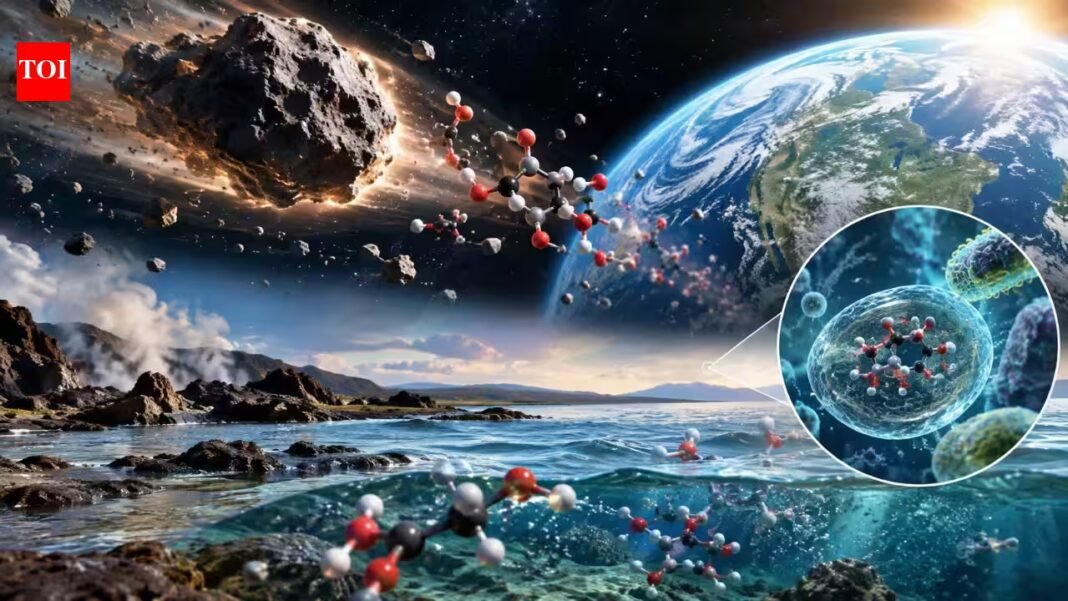
The team also found that ribose-borate complexes could prevent borate from precipitating when calcium was present (Image: AI-generated)
The sugar and borate may have helped each other
This produces an intriguing chemical feedback loop. Borate can help stabilise ribose, while ribose can help keep borate dissolved. That relationship could have mattered in environments on early Earth where water interacted with borate-rich minerals. Instead of imagining ribose as a molecule that simply arrived and needed to survive on its own, the findings suggest that its presence could have altered the surrounding mineral chemistry as well. The authors say this provides insight into how prebiotic organic molecules may have influenced geological systems before life existed.The idea is particularly relevant to places where borate minerals were naturally concentrated. The researchers point to Puga in the Indian Himalayas as a modern environment containing abundant boron, where borate salt crusts form around hot springs. Such settings are studied as possible analogues for some of the mineral-rich environments that may have existed on the early Earth.
Meteorites could have supplied some of the ingredients
The study does not claim that ribose itself definitely arrived on Earth from space. Rather, it fits into a broader body of research showing that organic molecules relevant to life can exist in extraterrestrial material.In 2025, analysis of samples returned from asteroid Bennu identified several bio-essential sugars, including ribose and glucose. The researchers described the discovery as completing an important part of the inventory of molecular ingredients known to be associated with life.That makes the broader picture more interesting. Meteorites and asteroids could have delivered organic molecules to the young Earth, while geological environments supplied minerals and water in which those molecules could react. The new Scientific Reports study also suggests that once ribose and borate encountered each other, their interaction may have changed the availability and stability of both.Still, the researchers are not presenting this as proof that life arrived from space. The findings concern one possible stage in prebiotic chemistry, how organic molecules and minerals could have interacted before biological systems existed.
Ribose may have influenced Earth’s minerals before life existed
The implications extend beyond the survival of one sugar molecule. If ribose can alter the solubility and precipitation behaviour of borate minerals, then organic molecules may have influenced geological processes even before organisms appeared.The researchers describe this as prebiotic organo-mineralisation, interactions between organic compounds and minerals in environments that existed before life. Such chemistry could have affected which elements remained dissolved in ancient waters and which became locked away in minerals.Ribose was probably not abundant across the entire early Earth, so the researchers caution against imagining a planet covered in dissolved sugar. Other organic molecules, including ethylene glycol and glycerol, can also bind with borate, and their effects on natural mineral deposits remain an area for further investigation.The broader possibility is that carbon-containing molecules may have interacted with common minerals such as silica and calcium as well. If so, prebiotic chemistry may have influenced Earth’s mineral environment in ways that are still being explored.
A small sugar points to a larger origin-of-life question
The importance of the new finding is therefore less about sugar in the familiar sense and more about chemistry before biology. Ribose eventually became a fundamental component of RNA, but its path from simple molecule to biological building block required an environment in which it could persist and react.The study by Steller and colleagues adds a possible piece to that puzzle. Their experiments show that ribose can increase the solubility of borate minerals and prevent dissolved borate from being removed through calcium-induced precipitation. At the same time, borate-ribose complexes can protect the sugar from degradation.That does not establish how life began. Instead, it gives scientists a more realistic chemical relationship to test in future origin-of-life experiments, one in which the organic molecules and minerals are not treated as separate ingredients, but as substances capable of changing each other’s behaviour. The result is a striking possibility, a fragile sugar that may have come from the wider Solar System could have helped reshape the mineral chemistry that allowed its own survival on the young Earth.