


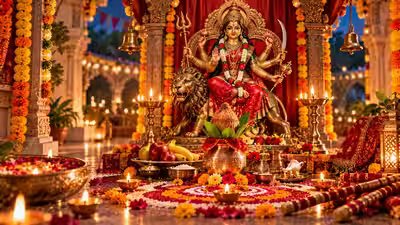
This year, Shardiya Navratri will start from Sunday, 11 October and will end on Monday, 19 October. Vijayadashami or Dussehra will be celebrated on Tuesday, 20 October.Pitru Paksha ends with Sarva Pitru Amavasya on 10 October. So families will offer tarpan to their ancestors one day and welcome Maa Durga home the very next morning.
Date and Tithi
Pratipada tithi begins at 9:19 PM on 10 October and ends at 9:30 PM on 11 October.Panchangs follow the Udaya Tithi rule, which means the tithi at sunrise decides the day. That makes 11 October the first day of Navratri. Setting up the Kalash on the night of the 10th would be incorrect.
Ghatasthapana Muhurat
Sunday, 11 October: 6:19 AM to 10:12 AMKalash Sthapana should ideally be done in the early part of the day, while Pratipada is running. We should avoid Chitra Nakshatra and Vaidhriti Yoga for this ritual.If the morning window slips away, Abhijit Muhurat around midday is the accepted alternative. Check your city’s panchang, since timings shift by a few minutes.
Maa Durga Arrives on an Elephant
Tradition ties the Goddess’s vahan to the weekday on which Navratri starts. When it begins on a Sunday or Monday, she is believed to arrive on an elephant. That’s seen as a lucky sign, linked with good rainfall and a prosperous year.
Day-wise Calendar with lucky colour
11 October, Sunday: Ghatasthapana and Maa Shailputri. Orange.12 October, Monday: Maa Brahmacharini. White.13 October, Tuesday: Maa Chandraghanta. Red.14 October, Wednesday: Maa Kushmanda. Royal blue.15 October, Thursday: Maa Skandamata. Yellow.16 October, Friday: Maa Katyayani, and Durga Puja begins in Bengal. Green.17 October, Saturday: Maa Kalaratri. Grey.18 October, Sunday: Maa Mahagauri. Purple.19 October, Monday: Durga Ashtami, Sandhi Puja, Maha Navami and Kanya Pujan. Peacock green.20 October, Tuesday: Vijayadashami and Durga Visarjan.
Ashtami and Navami on One Day
As per the Delhi panchang, Ashtami starts at 8:27 AM on 18 October. Sunrise that day still falls in Saptami, so Ashtami moves to Monday. It ends at 10:51 AM on 19 October, and Navami takes over until 12:50 PM the next day.So both are observed on 19 October. Sandhi Puja falls between 10:27 AM and 11:15 AM.Families keeping Ashtami should finish Kanya Pujan before 10:51 AM. Those keeping Navami can do it after. In Bengal and parts of Maharashtra, though, Maha Navami falls on 20 October.
Why This Festival Matters
The Devi Mahatmya tells how Maa Durga fought Mahishasura for nine days and defeated him on the tenth. Dussehra celebrates that win. Lord Rama is also believed to have worshipped the Goddess before facing Ravana.Each of the nine forms carries a lesson. Maa Shailputri stands for steadiness. By the ninth day, Maa Siddhidatri represents spiritual fulfilment.
A Few Simple Rules
Keep onion and garlic out of the kitchen. Avoid non-veg food and alcohol altogether. If you light an Akhand Jyoti, check the ghee before going to bed.And above all, speak kindly to the girls and women at home. During these nine days, they’re honoured as forms of the Goddess.Timings follow the New Delhi panchang. Confirm with your local panchang or family pandit.