





India’s GDP has surpassed estimates, clocking a 7.8% growth. The World Bank is betting on an even stronger year than it previously expected. Yet, Dalal Street is bleeding.So what’s happening? Why is the stock market crashing when the economy appears to be doing so well?Thursday brought another bruising session for Dalal Street, with benchmark indices falling more than 1% and investors losing a whopping Rs 12 lakh crore.BSE Sensex tumbled over 1,100 points, while NSE Nifty50 slipped near the 22,200 mark. The sell-off comes soon after the stock market posted its worst losing streak in 25 years, clocking an eighth consecutive weekly decline last week.Since the onset of 2026, Sensex has tumbled nearly 15% while Nifty50 is almost 13% down.The contrast looks even starker against global peers.South Korea’s Kospi has soared 63%, despite its economy being expected to grow just 1.9%. In the US, where growth is forecast at 2.3%, stocks are flirting with record highs.So, why is India’s economy racing ahead while its stock market seems to be struggling?The answer lies in a basic difference between the economy and the equity market: GDP tells us what has already happened, while the stock market is busy pricing what comes next.
Economy is growing, market is falling — what’s going on?
Strong GDP growth reflects economic activity that has already taken place. Share prices, however, are driven by what investors expect next: from future earnings and interest rates to liquidity and potential risks.And right now, a mix of foreign investor selling, weaker rupee, higher crude prices and elevated US bond yields is weighing on Indian equities.
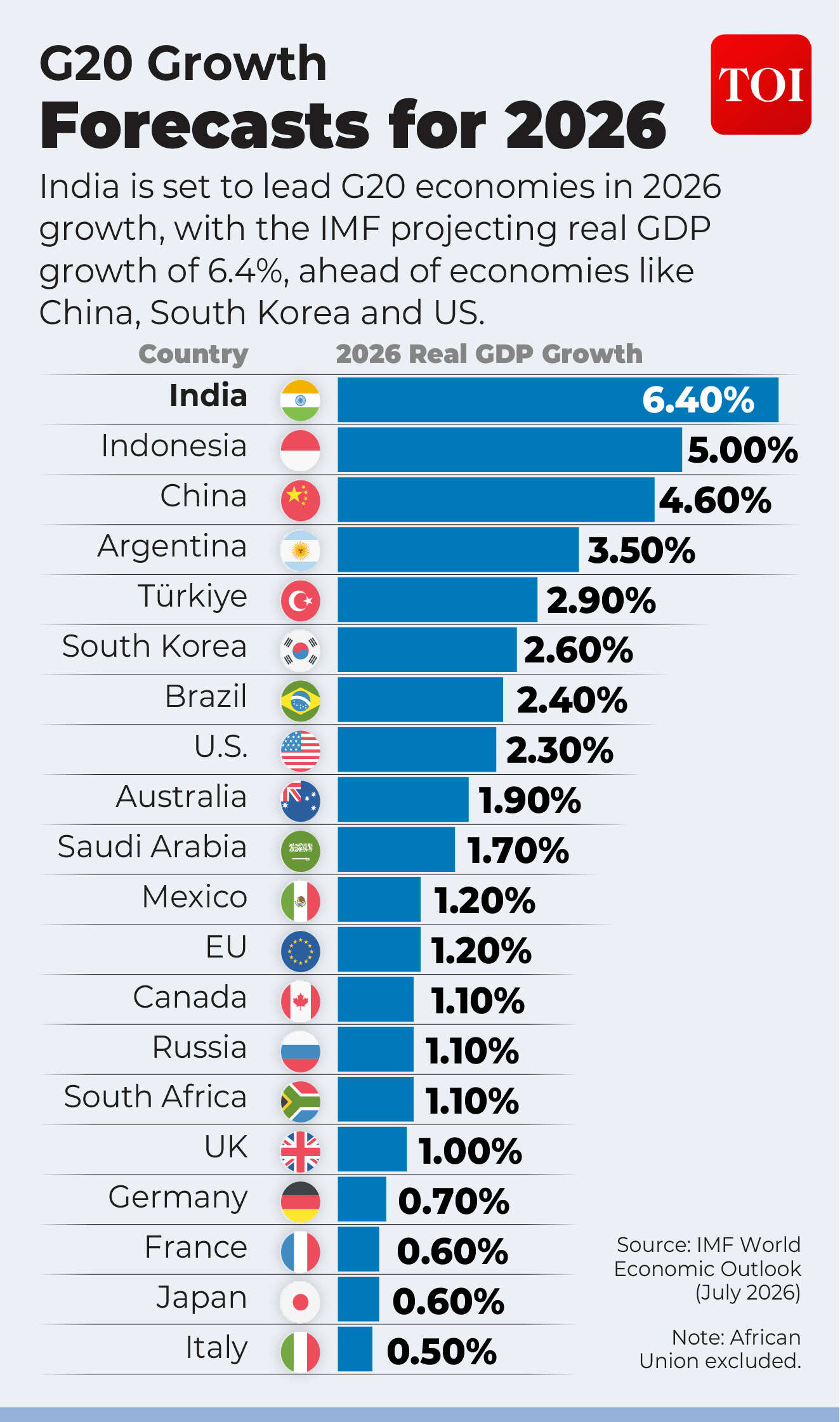
IMF’s outlook for G20 nations
Jyoti Prakash Gadia, managing director, Resurgent India Limited, explained the disconnect, “The GDP is based on past actual economic activity, while the market pricing is dependent on the future macro economic scenario, projected likely profitability and risks that the investors perceive which may emerge in future. It is thus possible to have good economic growth and at the same time falling share prices.”Shweta Rajani, associate director, Anand Rathi Wealth Limited, told TOI that the recent fall was more about short-term geopolitical uncertainty than any change in India’s long-term growth outlook.The recent correction, however, is not necessarily a reason for investors to panic.“Historically, the Nifty 50 has seen average drawdowns of around 18.7%, yet has delivered about 32% in the following one year and 20.1% CAGR over the next three years from the drawdown date. So, investors should not panic and should stay invested and stick to the long term allocation,” Rajani added.
Why Dalal Street is struggling
Dalal Street has plenty on its plate right now. Continued foreign fund selling, high US bond yields, fluctuating oil prices, a weaker rupee and the risk of tighter domestic monetary policy are all making investors more cautious.But not everyone is reading the market gloom the same way.Rajani explained that there are broadly two kinds of investors in a market like this: short-term investors and traders, who are more sensitive to the latest twists and turns, and long-term investors, who can afford to look beyond the current volatility.
The current fall is more about short term geopolitical uncertainty than any change in India’s long term growth outlook. Markets are reacting to higher global bond yield, elevated crude oil prices, uncertainty around the Strait of Hormuz, a weaker rupee and FII outflows, while strong GDP growth continues to reflect the underlying strength of the economy.
Jyoti Prakash Gadia, Manging Director, Resurgent India Limited
In fact, stronger buying by domestic institutional investors (DIIs) on weak market days suggests that long-term investors are using the correction to buy rather than head for the exit, Rajani said.“Therefore, long term investors should stay disciplined and remain invested,” she said.The fall, meanwhile, is coming from a range of domino effects with FPI outflows weighing rupee down, which in turn makes crude expensive and so on.
FPI selling puts pressure on equities
One of the biggest drags on Indian equities has been the return of foreign selling. Foreign portfolio investors ended a two-month buying streak in September, selling Indian equities worth Rs 2,56,620 crore ($2.7 billion), their highest monthly outflow in six months.The selling has taken FPI outflows for 2026 to $26.75 billion as of September 29, putting foreign investors on track for record annual withdrawals.The shift reflects a tougher global allocation environment. Higher returns on US assets can make emerging-market equities relatively less attractive, particularly when investors also have to factor in currency risk.FPIs have also been directing capital towards AI-heavy markets such as South Korea and Taiwan, adding another layer of competition for global investment flows.For India, the impact goes beyond the immediate pressure on share prices, resulting in a domino effect. Foreign outflows also weigh on rupee as demand for dollars rises when investors move money out of Indian assets.
Rupee loses ground
Rupee has also remained under pressure. The currency has traded near 96 against the US dollar, close to its weakest level since July. Back in May, it had hit a record low of 96.96.According to Union Bank of India, rupee had initially strengthened to Rs 94.26 against the dollar, helped by strong inflows under the RBI’s FCNR(B) deposit scheme and record-high foreign exchange reserves. However, a stronger dollar, rising oil prices and FPI outflows later weighed on the currency.“However, subsequent strength in Dollar Index due to Fed raising rates, oil prices moving from $90/barrel to $110/barrel levels in the first fortnight of September worried the FX market on BoP concerns, which led to Rupees depreciation towards 96.15 levels by the September end,” Union Bank of India noted.The currency effect also matters to foreign investors. A weaker rupee can reduce their dollar-denominated returns even if the underlying shares do not fall by the same proportion.That can make investors more cautious about maintaining exposure to Indian assets.“The depreciation of the currency decreases the dollar gains of foreign investors,” Gadia said.
Oil prices add to the pressure
The other major pressure point is oil. India is heavily dependent on crude imports, making the country particularly sensitive to a sharp rise in international oil prices.When crude becomes more expensive, the import bill rises and pressure builds on the current account and rupee. A weaker currency then makes every dollar of imported oil more expensive in rupee terms.That creates a double pressure: higher crude prices raise costs directly, while a weaker rupee adds to the import burden.Higher oil prices can also increase inflation risks and squeeze corporate margins, particularly for fuel-intensive businesses. This can make the outlook for corporate profitability less certain even when overall economic growth remains strong.
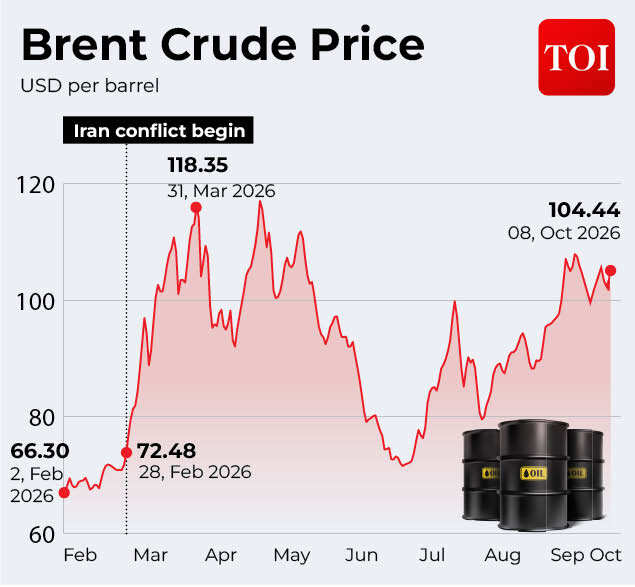
Brent crude soars to $104 per barrel (Info credit: Reuters)
Gadia said that investors are currently weighing “fluctuations in oil prices” along with foreign fund selling, high US bond yields, the depreciated rupee and the possibility of tighter domestic monetary policy.“Higher oil prices might have negative consequences in terms of worsening overall inflation and supply chain mechanism which will in turn affect corporate margins,” he told TOI.
US bond yields make Dalal Street work harder
The rise in US Treasury yields has added another challenge for emerging markets such as India.The 10-year US Treasury yield has climbed to 5.34% intraday, surpassing its 2007 peak and reaching its highest level since early 2002. The 30-year yield has also touched 5.6%, a level not seen since 2002.US government bonds are among the safest and most liquid assets globally. As their yields rise, investors can earn higher returns from dollar assets without taking the same risks associated with emerging-market equities. This raises the return hurdle for Indian stocks, which need to offer enough additional returns to compensate investors for currency and market risks.
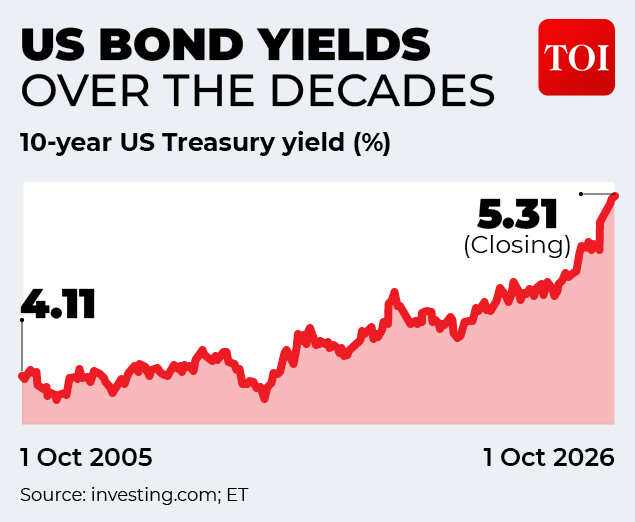
US bond yields continue to grow
Higher yields also reflect expectations that interest rates could stay higher for longer. The Federal Reserve raised its policy rate by 25 basis points in September to 3.75%-4%, while higher oil prices and stronger-than-expected US economic activity have kept inflation concerns alive. Expectations of increased US government borrowing to fund the fiscal deficit are also pushing yields higher.For India, the appeal of dollar assets has increased as Indian bond yields remain relatively stable, narrowing the India-US bond yield differential to historically low levels. This makes rupee-denominated assets less attractive after accounting for currency risk.“High bond yields reduce the cost-effectiveness of stocks when compared to relatively safe instruments,” said Gadia.Higher global yields can also raise funding costs, constrain liquidity and complicate RBI policy choices by influencing capital flows and the rupee.
Economic growth vs corporate earnings
Another reason the benchmarks can fall despite strong GDP growth is that faster economic growth does not automatically translate into higher corporate profits.Gadia said that strong GDP growth provides a “backstop support”, but its conversion into healthy future earnings is neither clear nor certain. As the economy expands, companies benefit from stronger demand, higher capacity utilisation and better pricing. However, these gains can be offset by rising raw material costs, wages and interest expenses, as well as price cuts, putting pressure on profitability.There is also a mismatch between economic growth and corporate revenues.
The existence of high GDP growth means that there is a backstop support available, although its conversion into future healthy earnings growth is neither clear nor certain .When the economy grows, corporates gain since demand, capacity utilization, and pricing are all enhanced.
Jyoti Prakash Gadia, Manging Director, Resurgent India Limited
Real GDP measures growth after adjusting for inflation, while corporate revenues are recorded in nominal terms. The industry and sector mix also matters, with domestic-facing companies likely to be affected differently from export-oriented businesses when foreign demand weakens.Rajani told TOI that strong GDP growth should support corporate earnings, although the impact may take time to show. India grew 7.7% in FY26, with GVA at 7.9%, while private consumption and fixed investment both grew more than 7.5%, providing companies with a healthy demand environment.This momentum continued into FY27, with Q1 GDP growth at 7.8% versus 6.9% a year earlier, while GVA grew 8.2% and manufacturing also recorded strong growth.“In the near term, higher crude prices and rupee weakness can put some pressure on margins, but with consumption, investment and manufacturing holding up well, a 7% plus growth environment should gradually translate into healthier revenues and earnings, particularly for domestic facing businesses,” Rajani said.
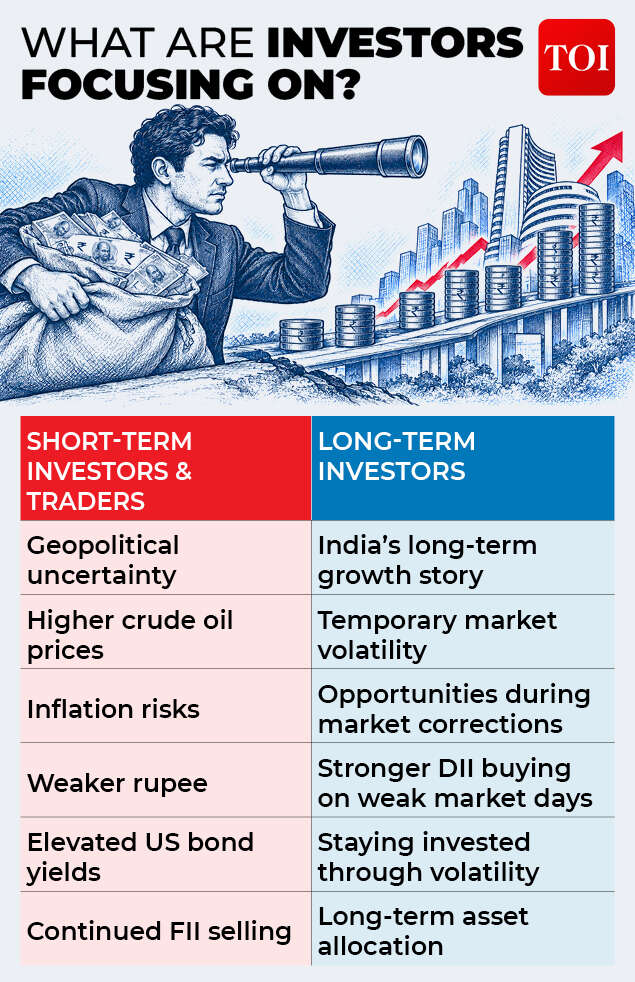
Investor concerns
What can bring investors back?
The pressure on Dalal Street could ease if some of the current external headwinds begin to recede.Rajani said that investor sentiment could improve quickly if several of the current pressures ease together. “De-escalation in the Middle East and lower crude oil prices would be the biggest positive, as that would reduce pressure on inflation, the rupee and corporate margins,” she added.A shift towards rate cuts by the US Federal Reserve could also make Indian assets more attractive to foreign investors and help reverse some of the FII outflows. A stable rupee, sensible RBI rate management and a strong earnings season could further strengthen investor confidence.Furthermore, “The support from steady inflows from DIIs in form of SIP flows is already there, so once the global environment turns a little more favourable, markets could respond positively.”Gadia, however, cautioned that strong GDP growth alone does not guarantee stronger corporate earnings. “The existence of high GDP growth means that there is a backstop support available, although its conversion into future healthy earnings growth is neither clear nor certain,” he said.While economic growth can boost demand, capacity utilisation and pricing, higher raw material costs, wages, interest expenses and price cuts can offset revenue growth and weigh on profitability. Gadia also pointed to the difference between real GDP, which is adjusted for inflation, and corporate revenues, which are measured at nominal levels.The impact can also vary across sectors, with domestic-oriented companies likely to fare differently from export-oriented firms when foreign demand weakens.
What’s next for Sensex and Nifty?
Near-term volatility is likely to continue as geopolitical tensions and crude oil concerns weigh on investor sentiment. However, the current correction could be temporary, with valuations across market caps becoming more reasonable.
Near term volatility may continue until some of the geopolitical and crude oil concerns settle, but the current correction looks temporary. Valuations across market caps have become reasonable, with no meaningful froth visible and the Nifty 50 itself showing negative froth of around 16%
Shweta Rajani, associate director, Anand Rathi Wealth Limited
She added that the environment could be favourable for investors to participate through diversified equity mutual funds, with roughly 50-55% in large caps, 20-25% in mid caps and the remainder in small caps.Gadia, however, expects the market to remain volatile and event-driven in the near term, with the RBI’s forthcoming announcement, corporate results, crude oil prices and capital flows likely to influence the direction of equities.“The immediate prospects are best described as volatile and event-driven, with room for rallies but not enough reasons to speak of a turnaround just yet,” he said.A better earnings picture, along with sustained participation across sectors, would be needed for a stronger recovery, while oil price concerns and high international interest rates could continue to keep markets on edge.“For the coming few weeks, the case for a balanced consolidation looks much more reasonable and appropriate than for a one-sided market call,” he said.(Disclaimer: Recommendations and views on the stock market, other asset classes or personal finance management tips given by experts are their own. These opinions do not represent the views of The Times of India)