



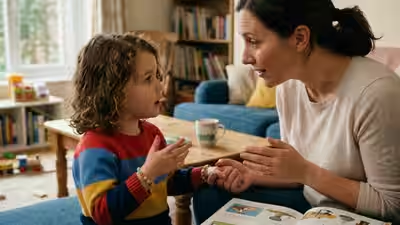
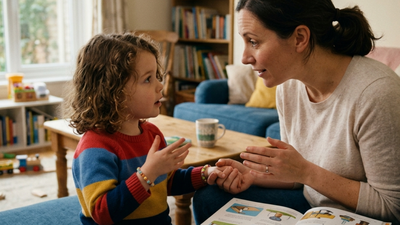
A child can ask “why?” several times in the space of a few minutes. The first answer may be met with a pause, followed by the same question again, sometimes with barely any change in wording. To an adult, that repetition can look like impatience, distraction or a refusal to accept what has already been explained. Research into young children’s conversations suggests a different possibility. For preschoolers, repeating a question can be part of working out an explanation rather than simply keeping an exchange going. Their follow-up questions, responses and attempts to offer their own answers give clues about what they are actually trying to learn.
What repeated questions reveal about children’s developing minds
5 Oct 2026 | 12:06
Parents, when your child refuses to greet relatives, do you make them say hello or respect their choice?
The research, published in Child Development in 2009, titled ‘Preschoolers’ Search for Explanatory Information Within Adult–Child Conversation’ examined the questions asked by children between the ages of 2 and 5. The focus was not simply on how often children said ‘why’ or ‘how’, but on what happened after an adult responded.A child who asks why the grass is wet, for instance, has received an answer when told that it rained. But if the child asks again, the first response may not have supplied the kind of explanation they were looking for. The repeated question can be a way of signalling that there is still something missing.The researchers described this as a search for an explanation. Rather than treating children’s questions as attempts to stretch out a conversation, they looked at the exchanges as part of the children’s effort to understand events around them.
What happened when children did not get the explanation they wanted
The first part of the research used transcripts from the everyday conversations of six children. Their conversations with parents, siblings and visitors were followed over time, covering the period from roughly age 2 to age 4. Because these were ordinary interactions rather than tightly controlled experiments, the material captured questions as they arose naturally. The researchers could see what children asked, what adults said in reply and what the children did next.Patterns in those exchanges suggested that explanations made a difference. When an adult supplied information that actually explained something, children were more likely to accept it or move on to a related question. When the response did not provide an explanation, children were more likely to return to the same question or put forward a possible answer of their own.

What preschoolers did when an answer failed to satisfy them
As per the study, researchers then examined conversations involving 42 preschool children between 3 and 5 years old. This time, the setting was a laboratory, where toys, books and videos were used to give the children things to talk about and opportunities to ask questions.The children again showed a tendency to respond differently depending on the kind of answer they received. Explanatory responses were more often followed by signs that the child was satisfied, such as agreeing with the answer or moving on to another question connected with it.When the response failed to explain the issue, the exchange could go in another direction. Children sometimes repeated the original question or suggested an explanation themselves. In that sense, repetition was not necessarily the end of the interaction. It could be evidence that the child was still trying to resolve the problem.The two studies were different in setting and method, but the pattern was similar enough for the researchers to argue that young children actively seek explanations through conversation.
What repeated questions reveal about children’s developing understanding
This helps explain why a child may appear to ignore an answer that seems perfectly clear to an adult. The answer may be factual without being explanatory from the child’s point of view. Young children are also still developing their understanding of how events fit together. Knowing that something happened is not always the same as understanding why it happened. A short answer can therefore leave another question underneath the first one.That may be why some repeated questions change subtly as the conversation continues. A child may return to the same wording, alter the question slightly or propose a possibility after an adult’s response. Each move gives the adult another indication of what the child is trying to make sense of. The researchers’ observations suggest that children are not passive recipients of whatever information an adult gives them. They take part in shaping the exchange, using questions and follow-ups to steer the conversation towards the information they want.