



Imagine standing at 9,500 feet in rugged mountains where, according to long-held scientific thinking, a thick cap of ice should have blocked almost all life thousands of years ago. Now imagine finding stone tools there, left by some of the earliest widespread people in the Americas. A Montana archaeologist and his team report exactly that, and the discovery has sparked excitement, caution, and a lot of questions. If confirmed, it could change how we understand ancient glaciers, hunting, and mountain life. Read on to learn what was found, why it surprised experts, what remains unproven, and why Indigenous voices matter.
How archaeologist Scott Dersam found Clovis stone tools at 9,500 feet
The story begins with archaeologist Scott Dersam, who, according to a Mountain Journal, has spent years searching the Beartooth Mountains near Yellowstone National Park. Dersam earned his doctorate in 2022 and runs the nonprofit Alpine Ecosystems Research Institute with his wife, Sari. His interest was sparked by Vern Waples, a former game warden whose collection of more than 2,000 artefacts from the Beartooth and Pryor Mountains was donated to the Custer Gallatin National Forest and is described as the largest and densest high-elevation stone tool collection in North America. Earlier archaeologists who retraced Waples’s steps found little, and Dersam says that failure drew him in. Working at about 9,500 feet, he now says he has found the highest, and potentially oldest, human habitation sites known anywhere in North America.
Why evidence of Clovis people in the Yellowstone high country defies the Pinedale glacier timeline
To see why scientists are surprised, it helps to know who the Clovis people were. The report explains that they persisted across the continent roughly 13,000 years ago, left the first consistent and widespread trace of human presence in the Americas, and specialised in hunting mammoths and other giant animals thought to roam mostly on the plains. Thousands of Clovis artefacts have been found, overwhelmingly at low elevations. The mountains, meanwhile, were believed to be locked under ice. The Pinedale Glacier blanketed nearly all of Yellowstone National Park and peaked about 20,000 years ago, so animals lacked forage and people likely stayed away. Yet Dersam reports soil tests showing sediment that saw sunlight between 17,000 and 22,000 years ago, when ice should have been deepest. That is why he says the sites should not exist under current understanding.
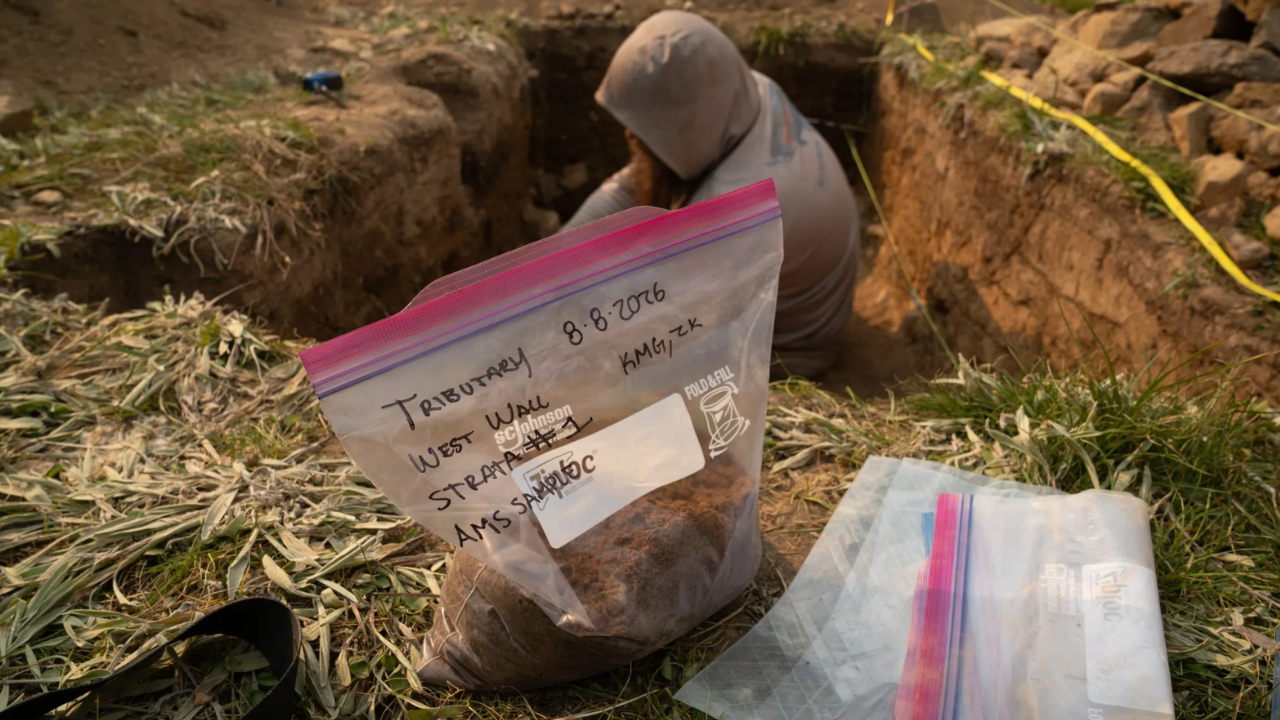
Image: Nick Mott
The intact ancient hearth and buried Clovis point base that excited the research team after four years
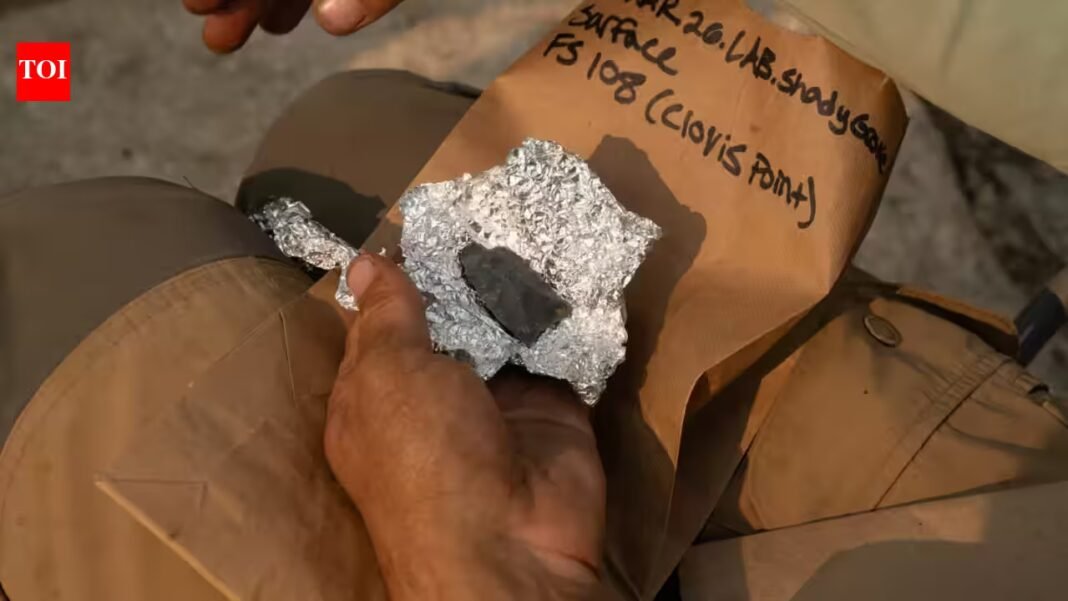
The most dramatic moment came this summer. While digging a small pit to collect soil, not artefacts, Dersam brushed away dark carbon that did not fit a forest fire and uncovered what appeared to be part of an ancient hearth. In the middle of it sat the base of a Clovis point. The team needed about an hour to calm down, according to the report. Dersam explains that a hunter likely tossed the broken stone into the fire about 13,000 years ago, pending testing, and that it probably never moved since. Other high-elevation Clovis points had all been scattered on the surface, so an intact buried example is unprecedented, he says. Over four years, he has found six more Clovis sites at high elevations, five in the Beartooths. Montana’s only widely accepted Clovis site remains Anzick.
How a 2022 flood, shifting glaciers, and narrow corridors in the ice may explain the discovery
Why now? A torrential rain-on-snow event in June 2022 blasted the remaining spring snowpack from the Beartooths and unleashed floods across Greater Yellowstone, churning sediment that had been buried for thousands of years. When Dersam returned that August, sites with hundreds of flakes suddenly had thousands, and he found two clearly identifiable Clovis points. He offers possible explanations for how people reached such heights. Perhaps scientific understanding of glaciation paints with too broad a stroke, and this basin never iced up, or narrow corridors in the ice let animals and their human pursuers pass. He also theorises that melting glaciers and permafrost allowed meat storage, and that mammoths followed the spring green wave upward, as Yellowstone bison do today. These ideas remain hypotheses until laboratory testing and peer review are complete.
Why Indigenous tribes, off-site archaeology, and peer review matter before the claims are confirmed
Responsible research matters as much as the discovery itself. Dersam practises what he calls off-site archaeology, leaving most findings in place and recording notes, photographs, and coordinates, removing only points that passersby might otherwise take. The report notes that seven to ten tribal historic preservation officers and elders voiced support at a Forest Service meeting this year. The history is delicate. A Clovis boy known as Anzick-1, buried about 12,600 years ago and found near Wilsall in the late 1960s, was reburied in June 2014 with help from Shane Doyle of the Crow Tribe. Dean Nicolai of the Confederated Salish and Kootenai Tribes says artefacts are alive and removing them can disturb a spiritual context. Dersam hopes to submit his findings for publication, and the results will depend on lengthy laboratory work.