





India may have slipped to the sixth spot in the list of the world’s largest economies, but its GDP growth continues to defy estimates by both domestic and global institutions. At 7% plus, India is the world’s fastest growing major economy and what stands out in the current phase is the resilience amid multiple, persistent, and emerging global uncertainties.Kyunghoon Kim, Head of India & South Asia Team at Korea Institute for International Economic Policy (KIEP) has said that India’s growth has set to surpass 7% for the fifth consecutive year.“India’s economy rebounded by 9.7% in 2021, then grew by more than 7% in each of the next four years. That makes five consecutive years of growth above 7%, matching the 2003–2007 run, when India attracted global attention as one of the BRIC economies,” he says in a thread on X (formerly Twitter).In the post, Kim noted that India’s average annual economic growth between 2021 and 2025 was 7.83%. This was the second-highest five-year average in data going back to 1960, just behind the 7.89% recorded between 2003 and 2007.India’s economy contracted by 5.8% in 2020 during the pandemic before rebounding with growth of 9.7% in 2021. It then expanded by more than 7% in each of the following four years, according to Kim.Kim said that if current forecasts hold, India could surpass that record.He also pointed to how economists, including himself, have repeatedly revised their growth projections upwards as quarterly GDP figures came in stronger than expected.The point of his comparison was not simply the sharp rebound after the pandemic, but the economy’s ability to sustain rapid growth over several subsequent years.Several things stand out in this growth: for one, the economy is now operating on a completely different scale.As Kim notes, India’s GDP was just over $1 trillion in 2007; now it is nearly $4 trillion. “The same 7% growth rate therefore represents a much larger expansion,” he says.
The post pandemic era
In 2020, when the Covid pandemic dealt a major blow to the global economy, India too took a major hit to its economy and GDP contracted sharply. Since then, the economy’s bounceback has been stronger than expected, consistently beating estimates by the International Monetary Fund (IMF).At the end of FY2021, the size of the Indian economy by nominal GDP was $2.6 trillion. At the end of FY2027, it is projected to be $4.15 trillion – that’s an almost 60% rise in just six years despite the pandemic, Russia-Ukraine war, Trump’s trade policies and 50% tariffs, and now the ongoing US-Iran war.
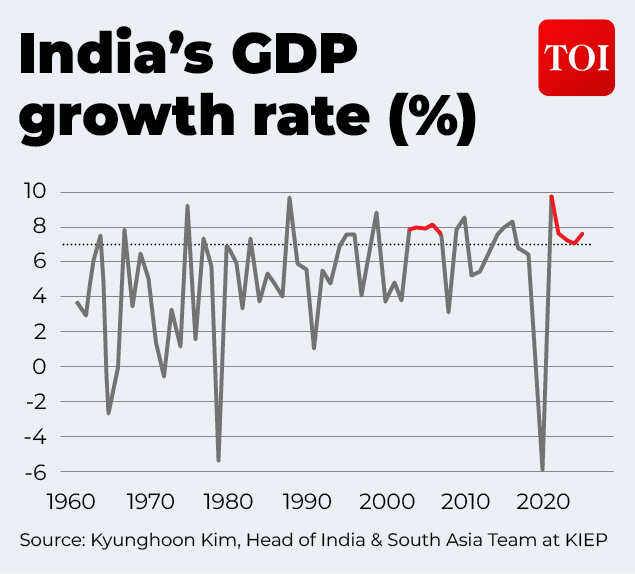
Five consecutive years of growth above 7%
What’s also noteworthy is that India depends on the world for 90% of its crude oil needs and the US-Iran conflict choked a crucial oil supply passage for the country – the Strait of Hormuz. Economists around the world warned that the Indian economy would see a notable hit from the war. Yet, the first quarter estimates of 7.8% have beaten all estimates. Inflation has risen, but it is still within RBI’s target range.So what’s working for India?It’s the size of its domestic market and a demographic dividend that is paying off along with key reforms by the government and a proactive monetary policy management by the RBI. The country has been pushing for self-sufficiency and schemes like the Production Linked Incentive (PLI) scheme have made it into a key export hub, especially for electronics.Kim acknowledged that India continues to face challenges, while arguing that its economic performance deserves attention given the country’s population of around 1.4 billion.
GDP Growth Forecasts See Sharp Upward Revisions
Kim also highlighted recent upward revisions to India’s growth outlook by major institutions. According to him the upgrades are particularly notable when viewed against India’s growth record since the pandemic.The International Monetary Fund (IMF) has raised its growth projection for India in the current year from 6.4% to 7%. The revision follows similar upgrades by several other institutions, including the World Bank, Asian Development Bank (ADB), S&P and Moody’s.These changes came after official figures put India’s GDP growth in the first quarter at 7.8%. Most international agencies now expect the economy to expand by 6.9% to 7% in the current fiscal year.
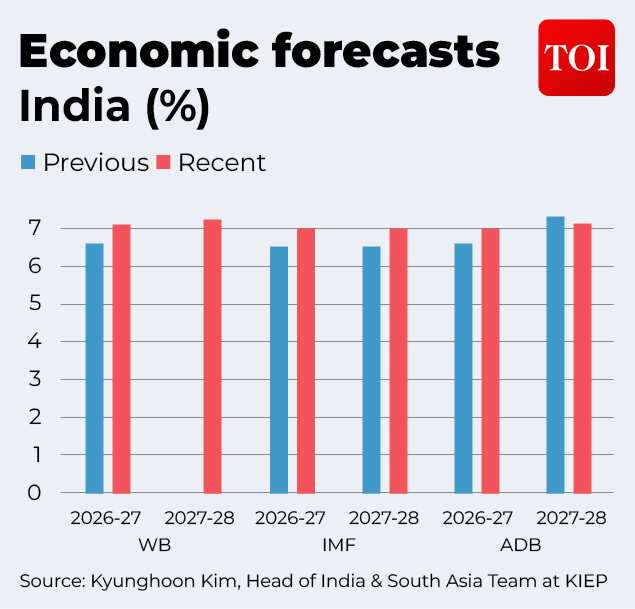
India’s GDP Growth Forecasts See Upward Revisions
IMF has endorsed India’s revised approach to calculating gross domestic product, saying the new methodology conforms to sound statistical practices and recommendations made by the international financial institution.Krishna Srinivasan, director of the IMF’s Asia and Pacific Department, called the change a “welcome development”. He said India’s updated method of measuring GDP was consistent with the guidance issued by the IMF’s statistics department.In its latest World Economic Outlook, the IMF said that the global economy has remained resilient despite several shocks in recent years, projecting worldwide growth of 3.4% in 2026.India remains among the fastest-growing major economies, with growth in 2026 projected at 7%. This reflects stronger-than-expected momentum, supported by resilient domestic demand and robust services activity,” the IMF said.India and Germany have recorded the largest upward revisions to their growth forecasts. In contrast, Saudi Arabia’s economy is projected to contract by 3.3% this year, following a five-percentage-point reduction in its growth outlook.Explaining India’s improved prospects, the IMF said: “India stands out with upward revisions, reflecting sustained momentum and growing evidence of stronger growth potential supported by favorable demographic dynamics, a large and expanding domestic market, and continued structural reforms.”The report also drew attention to India’s efforts to broaden its trade relationships. It cited the country’s trade agreements with the UK and the European Union, which are expected to reduce tariffs and ease restrictions on services trade. These arrangements could also “facilitate adjustments to recent trade policy changes”.US tariff measures have prompted countries around the world to pursue a series of trade agreements. India, too, has advanced free trade agreements (FTAs) that had remained under negotiation for years.The Indian economy continues to surprise on the upside, and despite the sharp rupee depreciation which led to its nominal GDP not rising as much in dollar terms, the economy continues to hold strong. As per latest IMF projections, India is expected to become the third largest economy after the US and China by 2031.