



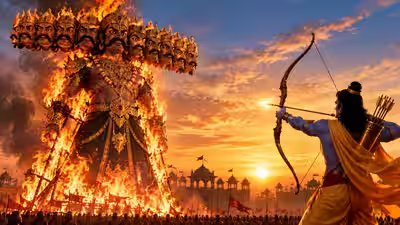
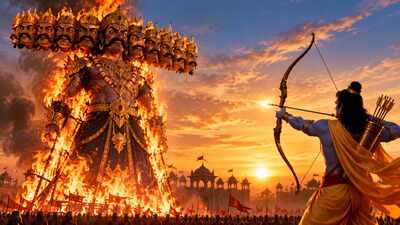
Dussehra eve sees crowds flock to open grounds in North India. Children sit on their fathers’ shoulders. A towering effigy of Ravana stands against the darkening sky, packed with firecrackers. Then an arrow is lit; the effigy bursts into flames, and the crowd cheers. It’s a joyful moment. Yet behind the noise sits a quieter message. Ravana wasn’t defeated by a stronger warrior alone. His own ego undid him, and Rama won through self-control.
Why Dussehra Falls on October 20 This Year
Dussehra, also called Vijayadashami, is celebrated on the tenth day of the bright half of the Ashwin month. In 2026, it falls on Tuesday, October 20. The festival falls later than usual this year because the calendar includes an extra lunar month, Adhik Maas.Vijayadashami is also counted among the sade teen muhurat, the three and a half days of the year considered auspicious without the need for a separate muhurat. Many families buy vehicles, start new businesses or begin a child’s education on this day.In Bengal and parts of eastern India, the same day marks Durga’s return to her home, with idol immersions closing Durga Puja.
Ravana’s Ten Heads and the Weaknesses They Represent
Ravana is often shown with ten heads. Many spiritual teachers explain them as ten human weaknesses. A commonly cited list includes lust, anger, attachment, greed, pride, jealousy, selfishness, injustice, cruelty and ego.What makes Ravana’s story unsettling is how gifted he was. He was a great scholar of the Vedas and a devoted follower of Lord Shiva. Tradition credits him with mastery of music and astrology. He ruled the golden kingdom of Lanka, rich and powerful.But none of that saved him. His desire for Sita, and his refusal to return her even when warned by his own brother Vibhishana and his wife Mandodari, led to the destruction of his family and kingdom. Knowledge without humility didn’t protect him.So the burning effigy is about more than a villain. It reminds us that talent and status can fall apart when ego takes control.
Rama’s Strength Was Restraint
Lord Rama is called Maryada Purushottam, the ideal man who lives within the limits of righteousness. His greatest moments in the Ramayana aren’t only on the battlefield.He accepted fourteen years of exile without complaint, to honour a promise his father had made. He could have claimed the throne by force. He chose duty instead.Even in war, Rama was held back. He gave Ravana chances to return Sita and spare the bloodshed. He welcomed Vibhishana, Ravana’s own brother, as an ally, judging him by his values instead of his family.A well-known folk tradition says that as Ravana lay dying, Rama sent Lakshmana to learn from him. Lakshmana first stood near Ravana’s head, and Ravana stayed silent. Only when Lakshmana moved to his feet in respect did Ravana share his wisdom. Whether historical or not, the story makes a clear point. Even the victor stayed humble enough to learn from the defeated.
Bringing the Lesson Home
The festival works best when we practise its inner meaning, not just remember it. A simple exercise is to pick one personal weakness this Dussehra and work on it for the coming year. It could be quick anger in traffic, harsh words with family or an inability to admit mistakes at work.Some families write the habit they want to drop on a slip of paper and quietly burn it along with a small diya. It’s a private, symbolic version of the Ravana Dahan.The day also includes the tradition of Shami puja, where people exchange Shami leaves as a symbol of gold and goodwill. In Maharashtra, people offer Apta leaves to friends and elders while touching their feet.