



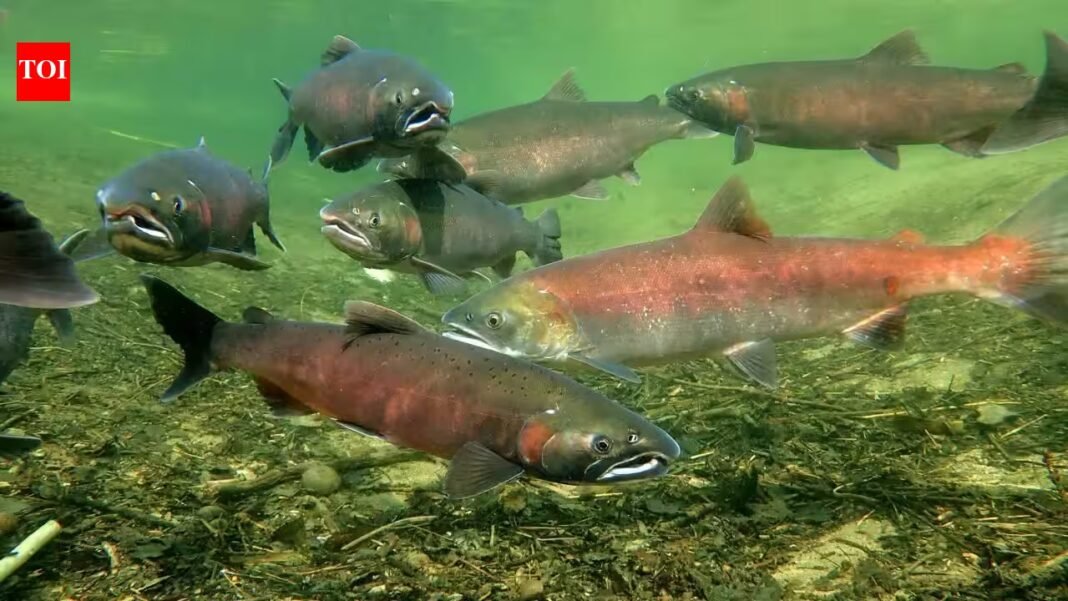
California restoration crews rebuilt a damaged stretch of the Lower Tuolumne River with more than 24,000 cubic yards of gravel, 49 trees, and 80 large boulders, creating 4.78 acres of new habitat for salmon and other native species. The results arrived remarkably quickly: FISHBIO reported that scientists documented Chinook salmon spawning on the newly built riffles within days of the project’s completion.The work, known as the 2026 Powerhouse Riffle Restoration Project, was carried out below Don Pedro Reservoir near the historic La Grange Diversion Dam. It was led by the Turlock Irrigation District, Modesto Irrigation District, and San Francisco Public Utilities Commission, with support from partners including FISHBIO, the U.S. Fish and Wildlife Service, River Partners, Applied River Sciences, Ford Construction, and Stantec, as per the report.
Why the Tuolumne needed repair
The Lower Tuolumne River has lost important spawning habitat because of high-flow events in 1997, 2011, and 2017. The Modesto Irrigation District said those floods altered the river channel and damaged the gravel beds and riffles that salmon depend on for reproduction, prompting the partners to launch the restoration effort.Riffles are shallow, fast-moving sections of a river where water flows over gravel and cobble. They matter because the churning water adds oxygen, the rocks support aquatic insects, and salmon use the clean gravel to lay their eggs. Juvenile fish also gather in riffles to feed, making these areas essential for both spawning and early life stages.The Powerhouse project was designed to restore about 2,400 feet of the Lower Tuolumne River. It aimed to rebuild the physical complexity of the channel, replacing uniform or damaged sections with varied gravel bars, riffles, boulders, and woody cover that fish can use throughout their life cycle.
Building habitat by hand and machine
Construction began in July 2026 and was expected to finish in October. The project carried an approximate cost of $4.7 million and was self-funded by the water agency partners, according to the Modesto Irrigation District.Crews placed more than 24,000 cubic yards of carefully selected gravel to create seven high-velocity riffles and five gravel bars. FISHBIO explained that gravel size was matched to the needs of Chinook salmon, which typically use material ranging from 25 to 100 millimetres to move across the riverbed and dig their nests, called redds.The restoration was not limited to gravel. Workers added 49 trees, 100 cubic yards of woody slash, 80 large boulders, and 294 willow cuttings. These features create shelter for young fish, slow water in useful places, support insects and other food sources, and give the river more natural variation after years of simplified or damaged habitat.The Modesto Irrigation District described the boulders as strategically placed near the downstream ends of selected riffles to improve feeding areas for fish. The woody debris was intended to increase channel complexity, improve sediment sorting, and provide juvenile salmon with refuge from predators.
Salmon responded almost immediately
The most encouraging sign came soon after construction ended. FISHBIO reported that spawning was documented on the new riffles within days of completion, showing that salmon were willing to use the rebuilt habitat almost immediately.That rapid response matters because restoration projects can take years to prove their value. Salmon need the right combination of clean gravel, oxygen-rich water, cover, and food to spawn successfully. The early spawning observations suggest that the project recreated conditions close enough to what the fish naturally seek.FISHBIO noted that the project was expected to support fall-run Chinook salmon, recently observed spring-run Chinook salmon, rainbow trout, and juvenile rainbow trout rearing. The restored habitat may also benefit western pond turtles, mammals, and other wildlife that rely on a healthier river system.
Monitoring during and after construction
Restoration on this scale required close oversight. During in-water construction, teams conducted daily water quality monitoring to keep turbidity at levels considered safe for fish. Flagging tape marked areas that equipment operators needed to avoid, protecting natural and cultural resources while heavy machinery reshaped the riverbed.The project also relied on biological monitors, engineers, operators, and cultural resource specialists working together. Tribal monitors from the Chicken Ranch Rancheria of Me-Wuk Indians of California and the Northern Valley Yokuts/Ohlone tribe were given the opportunity to inspect ground-disturbing work and help protect sites of tribal significance.Long-term evaluation will continue well beyond the construction phase. FISHBIO said future monitoring will include redd mapping, seine surveys, rotary screw trapping, and drone surveys to assess whether the new habitat continues to attract spawning adults and support juvenile fish.
An unexpected spring-run arrival
The project also took on added importance after an unusual salmon migration in spring 2025. High-flow events brought spring-run Chinook salmon into the Tuolumne River, where they are not typically observed. FISHBIO reported that more than 1,200 adult salmon migrated into the lower river that spring.Many of those fish were part of an experimental release in the San Joaquin River, and more than 90 percent strayed into rivers without hatchery presence, including the Tuolumne. When more than 400 spring-run salmon became stranded in a pool below La Grange Dam, FISHBIO worked with MID, the California Department of Fish and Wildlife, the U.S. Fish and Wildlife Service, NOAA, and other partners to relocate them downstream.That episode highlighted why habitat restoration cannot rely on a single fixed plan. The river’s conditions, fish movements, and climate-driven flows can change quickly, and agencies need monitoring systems capable of responding to unexpected events as well as long-term goals.
A larger restoration commitment
The Powerhouse project is part of a broader commitment by the Tuolumne River Partners to restore the Lower Tuolumne River. The Modesto Irrigation District said the partners have committed $80 million to a collaborative habitat restoration programme under the Healthy Rivers and Landscapes Program and a memorandum of understanding with the U.S. Fish and Wildlife Service.By 2030, the partners aim to develop 77 acres of suitable salmon floodplain rearing habitat and add approximately 100,000 tons of gravel in targeted reaches of the river. The goal is to create a river system that can support salmon spawning, juvenile growth, and broader biodiversity over the long term.The early salmon spawning on the new riffles offers a promising sign that this approach is working. In a river where floods, dams, and altered sediment flows have reduced habitat, the return of fish to freshly rebuilt gravel shows that restoration can produce tangible ecological results when science, engineering, and long-term investment come together.