



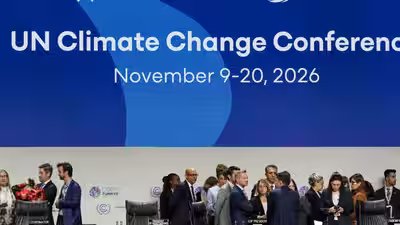
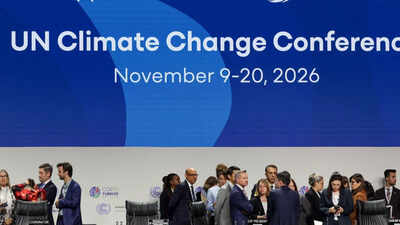
United Nations climate talks in Antalya, Turkey, ended without an overarching agreement on Sunday after countries failed to reach a consensus on whether to explicitly mention fossil fuels in the final text. The two-week negotiations, which ran nearly 48 hours overtime, also remained divided over climate finance and other issues. The proposed agreement was rejected by several countries and the European Union because it did not include a reference to fossil fuels.Ireland’s climate minister Darragh O’Brien, speaking on behalf of the EU, said: “It’s unconscionable that we would have a climate act that makes no reference to fossil fuels,”The failure to reach a consensus came despite a larger number of countries being willing to accept the proposal, even reluctantly, on the grounds that an agreement was better than none. Russia and Saudi Arabia had sought to keep fossil fuels out of the document.
Why fossil fuels became the sticking point
The joint Turkish-Australian leadership’s final proposal did not mention fossil fuels. This became the central point of disagreement, with several countries and climate groups arguing that any meaningful climate agreement must address the use of coal, oil and natural gas, which drive global warming.Fossil fuels had remained unmentioned in final COP decisions for more than 25 years, according to Alden Meyer of the think tank E3G. That changed three years ago at COP28 in the United Arab Emirates, when countries agreed to “transitioning away from fossil fuels”. The Turkish-Australian proposal reproduced that language, but it failed to satisfy several nations and environmental groups.Another point of contention was the draft’s reference to carbon capture and storage, along with a goal for the technology to be used by industrial polluters. Several countries and activists argued that this could weaken efforts to reduce overall emissions.As the proposed agreement fell apart during the plenary session, Turkey’s Environment Minister Murat Kurum, who presided over COP31, was absent. Elchin Allahverdiyev of Azerbaijan announced that the talks had failed to reach a deal.“Unfortunately, we were unable to reach agreement on a cover decision. And that’s disappointing, very disappointing,” said Australia’s Chris Bowen, COP31’s president of negotiations.Bowen maintained that the commitment made at COP28 remained in force. “Transition away from fossil fuels in the real world is happening. It’s happening. It’s happening at speed and it’s irreversible.”
What else remained unresolved
The failure to reach an overarching agreement also left several other climate issues unsettled. These included details on transitioning away from fossil fuels, financial support for poorer countries to adapt to climate change, and action on gender and climate. Many of these issues were deferred to next year’s negotiations in Ethiopia.Turkey had made global electrification its signature issue at this year’s talks. A separate proposal called for countries to increase electricity’s share in total final energy consumption from around 21% currently to 35% by 2035.Achieving this would require countries to shift transport, including cars, trucks and planes, from fossil fuels to electricity. It would also involve using electricity instead of coal in industrial production. Nearly 100 countries signed up to the separate pledge.The negotiations over the main agreement also faced criticism over the way the final draft was handled. The proposal was circulated after 3am, leaving negotiators little time to register objections. Several observers and countries blamed the joint Turkish-Australian leadership for the failure.Earlier in the week, Panama’s Environment Minister Juan Carlos Navarro had accused a “petroleum mafia” of holding the talks hostage and called for reforms.
The wider climate challenge
The deadlock came at a time when the effects of global warming are intensifying, with increasingly severe heatwaves, floods, storms and droughts. The UN has warned that the world is set to exceed the 1.5-degree Celsius warming threshold set under the 2015 Paris Agreement.Earlier this year, the United Nations Environment Programme said crossing the threshold had become inevitable. The focus, UN officials said, should now be on limiting how far temperatures rise beyond it and eventually bringing them down through measures such as removing carbon dioxide from the atmosphere.Scientists estimate that the world is on track for warming of between 2.7 and 3 degrees Celsius by the end of the century. October 2026 recorded the largest temperature increase above pre-industrial levels of any month, at 1.8 degrees Celsius, according to Berkeley Earth. The organisation also estimated a 97% chance that 2026 would be the warmest year on record.The climate negotiations were further complicated by a global energy shock linked to the war in Iran and a strong El Niño, which amplifies human-caused warming and contributes to extreme weather events.