



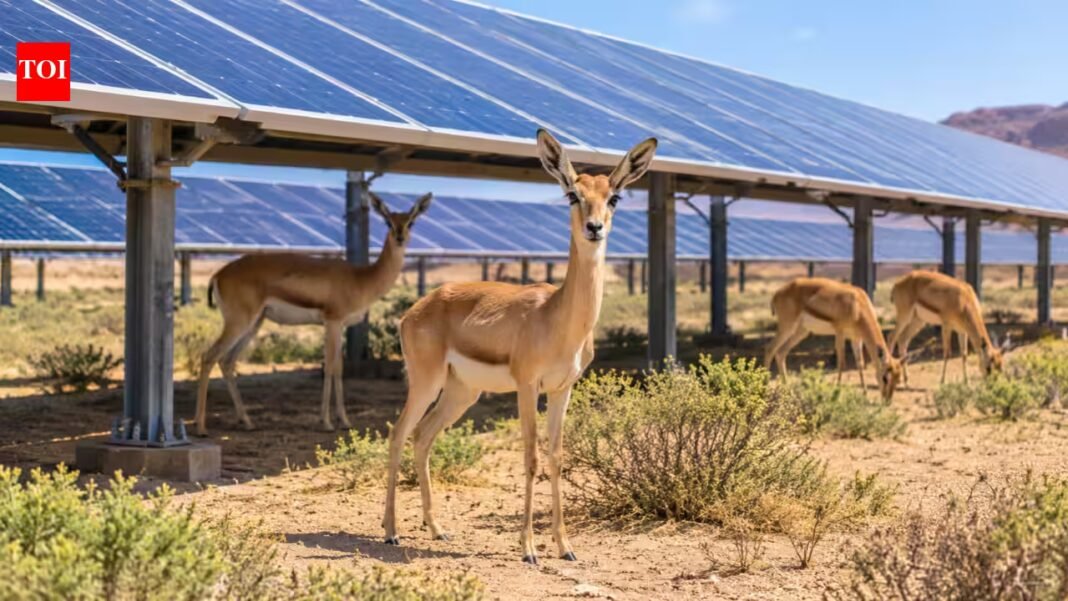
Saudi Arabia is giving a 250-megawatt solar park an unusual second purpose: breeding vulnerable desert wildlife. The country’s Prince Mohammed bin Salman Royal Reserve has launched a conservation programme that uses the land beneath and around solar panels to provide a protected habitat for sand gazelles, a species native to the Arabian Peninsula. Under the initiative, called ReWildingVoltaics, 38 gazelles (33 females and five males) were introduced into the operational solar facility serving the AMAALA tourism destination on the Red Sea coast. The programme aims to grow the population to approximately 600 animals by 2031, creating a sufficiently large breeding population for eventual reintroduction into the reserve’s wider protected landscape.
How a solar park became a wildlife breeding ground
The initiative is being implemented at a 250MW solar installation covering approximately 505 hectares in northwestern Saudi Arabia. Rather than setting aside a separate conservation area, the project uses the existing solar infrastructure to create an environment where renewable electricity generation and wildlife breeding can operate together.The programme, known as ReWildingVoltaics, is a collaboration between the Prince Mohammed bin Salman Royal Reserve and Amaala Sustainable Company for Energy (ASCE), the company responsible for the solar facility.The reserve estimates that approximately 73% of the solar park’s land, equivalent to around 369 hectares, can be used for wildlife husbandry. This includes the ground beneath the solar panels and surrounding open spaces, allowing the animals to move around the facility while remaining within a protected environment.The reserve describes the initiative as a global first, demonstrating how large-scale renewable energy infrastructure could also contribute to biodiversity conservation.
Why solar panels are helping the gazelles
The solar panels are providing an unexpected environmental advantage in an extremely hot desert landscape. Their structures create shaded areas beneath them, offering the animals places to rest and escape direct sunlight during the hottest parts of the day.According to the Royal Reserve, temperatures beneath the panels can be approximately 5°C to 10°C lower than in exposed areas. This cooler microclimate makes parts of the installation more suitable for wildlife husbandry.The facility also has a predator-proof perimeter, which helps protect the animals from potential threats while they adapt to their surroundings. Its open spaces allow them to move freely rather than remain restricted to conventional small breeding enclosures.The gazelles also contribute to the surrounding ecosystem through grazing, browsing and seed dispersal. Their presence could therefore help support vegetation management and broader ecological restoration within the facility.
38 gazelles introduced after a seven-month trial
The breeding programme followed a seven-month proof-of-concept exercise that began in October 2025. During the initial phase, researchers assessed whether the solar installation could support three native species: sand gazelles, mountain gazelles and Arabian hares.The trial examined the suitability of the habitat, the animals’ behaviour and the possibility of managing wildlife within an operational renewable-energy facility.Following the trial, the project entered its breeding phase in May 2026 with the introduction of 38 sand gazelles. The initial group consists of 33 females and five males, creating a breeding population that the reserve intends to expand over the coming years.The first offspring were expected in December 2026. The reserve is also monitoring the animals’ health, reproductive behaviour and adaptation to the facility as the programme develops.
Why the reserve wants a herd of 600 by 2031
The target of approximately 600 gazelles is connected to the reserve’s larger wildlife restoration ambitions. According to the conservation programme, population modelling indicates that a founder population of at least 500 animals is needed to support successful reintroduction into the wider protected landscape.The current group of 38 gazelles is therefore the starting point for a much larger breeding effort.Building a healthy population will require more than increasing the number of animals. Maintaining genetic diversity is another important consideration, particularly when breeding begins with a relatively small group.The reserve plans to manage breeding through careful monitoring, including screening and rotating males and introducing animals from outside the existing herd when necessary. These measures are intended to reduce the risk of inbreeding and maintain a genetically healthy population.The ultimate objective is to establish a self-sustaining herd that can eventually survive outside the protected breeding facility.
Sand gazelles are classified as vulnerable
The animals being bred are sand gazelles, scientifically known as Gazella marica, also called Arabian sand gazelles or reem. Native to the Arabian Peninsula, they are adapted to arid environments and are recognised by their slender bodies, long legs and sandy-coloured coats.The species is classified as Vulnerable on the International Union for Conservation of Nature’s Red List, reflecting its risk of extinction in the wild.Habitat degradation, hunting and other pressures have affected wild populations across parts of their range. Conservation breeding and reintroduction programmes are among the measures being used to support their recovery.The sand gazelle is also ecologically important as a native herbivore. By feeding on vegetation and dispersing seeds, it contributes to the functioning of desert ecosystems.
Gazelles will eventually return to the wider reserve
The long-term destination for the breeding programme is the Prince Mohammed bin Salman Royal Reserve, a protected landscape covering approximately 24,500 square kilometres in northwestern Saudi Arabia.The reserve encompasses a range of environments, including desert plains, volcanic landscapes and coastal ecosystems. It is part of a broader effort to restore native wildlife populations and rehabilitate habitats across the region.Its conservation programme covers 23 historically occurring native species, 14 of which had already been reintroduced by the time of the October 2026 announcement.These include Arabian oryx, Persian onagers, sand gazelles and mountain gazelles.The solar park’s breeding programme is expected to strengthen these efforts by providing a larger population of sand gazelles for eventual release into the reserve. The animals will need to demonstrate that they can adapt to natural conditions and survive independently for the reintroduction effort to succeed.
A new approach to combining renewable energy and conservation
The ReWildingVoltaics programme is part of a broader effort to connect Saudi Arabia’s renewable-energy expansion with its environmental restoration ambitions.The 250MW solar facility supplies renewable electricity to AMAALA, a tourism destination being developed by Red Sea Global along the country’s Red Sea coast. Its energy infrastructure also includes a 700MWh battery storage system.The project involves several energy companies through ASCE, including EDF Group, Masdar, SUEZ and Korea East-West Power.For the Royal Reserve, the initiative demonstrates how infrastructure designed for energy generation could also provide opportunities for wildlife conservation. Instead of treating solar installations solely as energy facilities, the project explores how their land, shade and protected boundaries can support native species.If the breeding programme reaches its 2031 target and the gazelles establish a successful population in the wider reserve, it could offer a model for integrating renewable-energy development with wildlife restoration in other arid regions.