



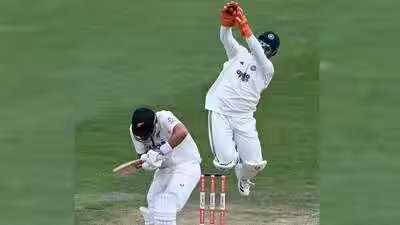

From Alex Carey standing up to Scott Boland in the Ashes to Tom Blundell doing it against Matt Henry in England and at the Basin Reserve last week and Rishabh Pant employing the ploy in the first Test, wicketkeepers are increasingly prepared to stand up even when the ball is arriving at 130-140kph.Beyond the obvious courage required, the keeper is increasingly becoming a thief of the batter’s space.Former India wicketkeeper Chandrakant Pandit believes it is a response to how batting has evolved in the post-T20 era. “Today’s batters, even in Tests, have the courage to step out against pace. There is no fear about coming out of the crease to counter movement,” Pandit told TOI from Mohali, where he is coaching Madhya Pradesh in the Syed Mushtaq Ali Trophy.“So the keeper standing up is basically an attempt to counter that and prevent the batter from advancing.”There is evidence that it works. Data from New Zealand’s 2026 series in England showed England averaging 25.36 against pace with Blundell back, but only 15.26 when he stood up.Henry explained why the Kiwis did it at the Basin for a long period of time. “The only mode of dismissal at the Basin was to bring the wickets into play and be prepared to look boring. Putting the ball outside off wasn’t going to help as there wasn’t a lot of carry.”India bowling coach Morne Morkel, though, remains unconvinced. “I’m old school. I like a bit of pace and bounce, balls carrying through to second and third slip, and getting your dismissals that way,” he said on Thursday.Pandit feels if a batter stands a yard outside his crease, he can alter the length at which the bowler wants to operate.“When the bowler alters his length, he can also compromise his swing,” he said. “If the wicketkeeper comes up, it puts the batter in two minds. He may want to play a delivery on the front foot, but with the keeper standing up, he might instead play it off the back foot.”That hesitation can bring bowled and lbw into play without the keeper ever touching the ball.At The Oval, Blundell stood up for most of Henry’s 24 overs despite the seamer operating around 135kph. All five wickets in Henry’s first-innings five-for came with Blundell up.For Pandit, that deserves admiration. “The wicketkeeper has to have a lot of courage to stand up at this sort of pace. It means he believes in his skills and is fearless.”Better protective equipment has helped. “You have helmets now. I don’t remember us wearing helmets while keeping, even on turning tracks or bad wickets. The quality of protective equipment is much better today. But equipment alone cannot give you courage. You still have to believe you can do it.”Pandit remembers Sunil Gavaskar once asking him to stand up to Raju Kulkarni in domestic cricket. “I started sweating,” he laughs. Gavaskar, he says, was employing some reverse psychology, possibly trying to suggest to the quick that he wasn’t bowling fast enough. Ramakant Desai would also ask Pandit to stand up in club cricket, hoping to create leg-side stumping opportunities off his inswingers.The tactic carries obvious risks: less reaction time and the possibility of conceding byes. But Pandit believes teams will accept the trade-off. “The idea is to disturb the batter. Tactically, you take that chance.”Learning the skill, however, requires sustained drills.“I would start with a tennis ball, hit with a racket from eight or 10 yards so the keeper can work on his reflexes,” he said. “The first thing is to get the fear out of his mind. Then progress to a hard ball with somebody throwing, and after that the bowling machine.”And repetition counts more than reputation.“No matter how good you are, you still need to practise. If Rishabh Pant is going to stand close to the stumps, he would definitely have practised it.”