



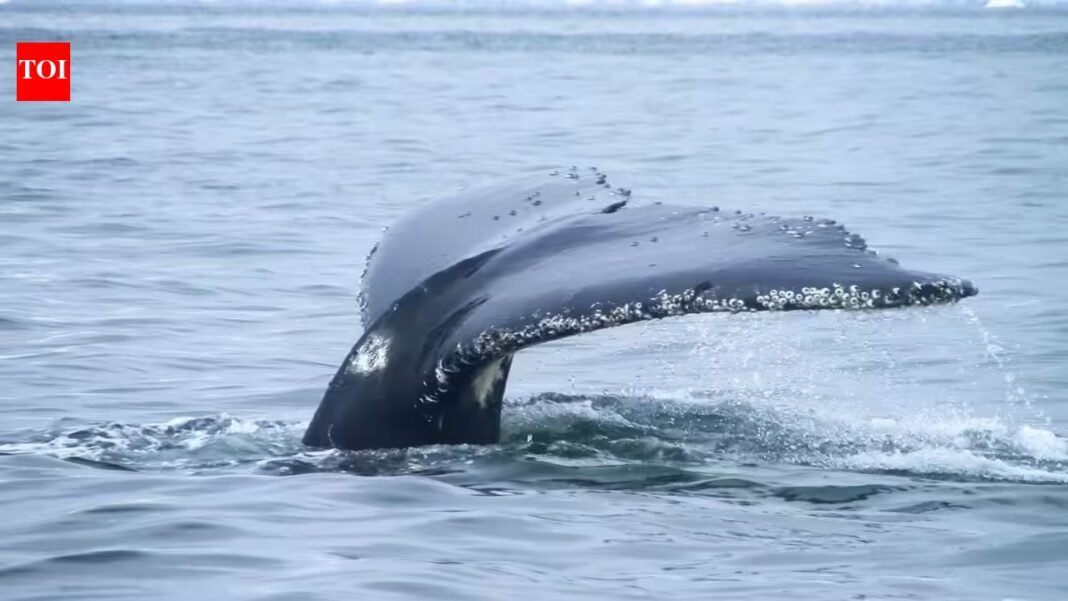
Conservation stories are heartwarming to read but they require patience. At some locations, for some creatures the effects of changes in Earth’s geography are immense and irreversible at times. However, conservation success stories make you realise how the efforts have to be continued without an expectation of results sometimes, and years later a creature might just become part of wildlife again. This is the story behind Anartic blue whales, of whom only 418 were left in 1973 when the last whale catch was reported. At the time, they were on the brink of extinction, yet, after 50 years of protection, in 2024 the whale’s population is estimated to be at 4,018.A study led by the University of Washington, titled ‘Critically Endangered Antarctic blue whales are increasing but still far from pre-whaling levels’ was published in Endangered Species Research on November 5 has revealed the latest numbers.
The challenge of counting
Though these whales are big enough to be spotted from space, counting them is not an easy task. This is because Antarctic blue whales do not surface often. Thus, researchers use a combination of photo identification and line transect surveys to estimate the whale population.Line transect surveying is a technique involving a lot of calculated estimation rather than an exact count. Here, a boat travels along a straight line and counts the number of whale sightings along the way. Researchers then use this data to calculate the density in the region which leads to an estimation of the species’ abundance.These approaches, however, are neither perfect nor cheap. The International Whaling Commission ran three expeditions to survey across the Southern Ocean from 1978 to 1984, 1985 to 1991, and 1991 to 2004. Those surveys produced the most recent estimate of how many whales live around Antarctica, and very few line-transect surveys have been carried out since.To fill that gap, researchers at the University of Washington built a model that compiles everything known, from historical catch records and counts from the line-transect surveys to photographs used to identify individual whales. According to the study, there were about 4,018 Antarctic blue whales in 2024. That’s just 1.9% of the number that existed before whaling began. Commercial whaling wiped out 99.8% of the population, but the good news is that the whales are now recovering, with numbers growing by an estimated 4.5% each year.
What led to the decline?
In the 20th century, no animal was hunted by commercial whalers more heavily than the Antarctic blue whale. A single whale can weigh over 400,000 pounds (180,000 kilograms), making it the largest animal known to have ever lived and a rich source of whale oil. The International Whaling Commission banned the killing of blue whales in 1964, but Soviet fleets kept hunting them illegally for another decade. By the time that stopped, the species had come dangerously close to disappearing.According to Zoe Rand, the study’s lead author and a postdoctoral scholar in the UW School of Marine and Environmental Affairs, no other whale species was hunted to the extent of the Antarctic blue whales.
Why is it crucial to save them?
These blue whales are crucial not just for the products they provide but because they shape the ecosystem they live in. Antarctic blue whales feed almost entirely on krill, consuming several tonnes a day during the feeding season. Their feces are rich in iron, a scarce nutrient in the Southern Ocean that limits phytoplankton growth.By releasing iron-laden plumes near the surface, whales help fuel phytoplankton blooms, which feed krill and, in turn, penguins, seals and the whales themselves. Phytoplankton also absorb carbon dioxide, linking healthy whale populations to the ocean’s capacity to store carbon, though scientists are still debating the size of this effect.The role continues after death. A dead whale sinks thousands of feet to the seafloor, creating a “whalefall.” Scavengers arrive first, followed by smaller organisms and specialized species, such as bone-eating worms, that can live off a skeleton for decades. A single whalefall can support hundreds of species, and the carbon in the carcass is buried in deep-sea sediments.Losing nearly the entire population therefore mattered far beyond the whales themselves. Their absence would weaken these nutrient and carbon sources across the Southern Ocean. As numbers recover, those functions may slowly return, though a species that reproduces this slowly will take a long time to get there.