





For many working parents, one of the biggest challenges after the birth of a child is balancing childcare responsibilities with professional commitments. While employer-provided childcare facilities have existed under labour laws for many years, the newly notified Labour Codes have brought renewed focus to workplace childcare by expanding the coverage of crèche-related obligations and introducing additional flexibility for employers.While the requirement to provide a crèche is not new for many employers, the Labour Codes introduce a more comprehensive framework governing how such benefits may be provided, administered and accessed by employees.
Crèche facilities: What the Labour Codes require
Under the Code on Social Security, 2020 (COSS), establishments employing 50 or more employees are required to provide access to a crèche facility for the use of children under the age of six years of such employees.The Labour Codes require employers to provide access to a crèche facility within one kilometre of the establishment. The facility may be maintained independently by the employer or through a shared arrangement with other establishments.The law also recognises that every organisation may not have the space or resources to establish an independent childcare centre. Accordingly, employers may utilise common crèche facilities operated by government agencies, municipalities, private providers, non-governmental organisations or through arrangements where multiple employers pool resources to establish a shared facility.The one-kilometre requirement may be relaxed in the case of establishments located in notified industrial parks or industrial areas where a common crèche facility is available and is easily accessible to employees. This flexibility may be particularly useful for organisations operating from large office parks, industrial zones and business complexes where common childcare facilities can serve employees working across multiple establishments.As organisations continue to adopt hybrid and flexible working models, shared childcare infrastructure could emerge as a practical solution that balances regulatory compliance with operational efficiency.
Is the benefit only for women employees?
One of the most interesting discussions arising from the new framework relates to the beneficiaries of the crèche facility.Historically, workplace childcare provisions have often been viewed as an extension of maternity-related benefits. However, the language used in the new framework increasingly refers to employees rather than only women employees.This has raised an important question: should crèche benefits be treated as a gender-neutral workplace facility available to all eligible employees with young children?The FAQs issued by the Ministry of Labour and Employment on 16 March 2026 clarified that the crèche facility under the Occupational Safety, Health and Working Conditions Code, 2020 is available to employees irrespective of gender. However, this clarification was provided only in the context of the OSHWC Code and a similar clarification has not specifically been issued under the Code on Social Security, 2020.At the same time, the Central Rules dealing with crèche allowance use terms such as “women”, “widower” and “single parent”. This has led to the view that certain aspects of the benefit may have been intended to apply specifically to women employees and male employees who are single parents.While some interpretational questions remain, there is a growing expectation that employers may adopt a more inclusive approach and make such facilities available irrespective of the employee’s gender. Such an approach would be consistent with evolving workplace realities where childcare responsibilities are increasingly shared by both parents.
Can employers provide a crèche allowance instead?
One of the practical features of the new framework is the recognition that organisations may not always be able to establish or access a physical crèche facility.In such cases, the law provides employers with the option of entering into an agreement with the majority of employees for payment of a monthly crèche allowance instead of providing a physical crèche facility. Employee consent therefore becomes an important element of this arrangement, and employers may not be able to unilaterally replace a crèche facility with an allowance.A statutory minimum amount has been prescribed at Rs 500 per month per child, although employers may choose to provide a higher amount based on business considerations and employee needs.The crèche allowance is generally admissible for up to two children. An exception has been provided for situations where the number of children exceeds two due to a second childbirth resulting in multiple births.This provision offers flexibility, particularly for organisations with geographically dispersed workforces or where employees are working in hybrid or remote work arrangements.However, employers should carefully evaluate whether a minimum statutory amount would adequately cover childcare expenses in practice. In many urban centres, childcare costs are significantly higher than the prescribed minimum level. As a result, organisations may need to assess whether a higher allowance would be more meaningful from an employee welfare and workforce participation perspective.
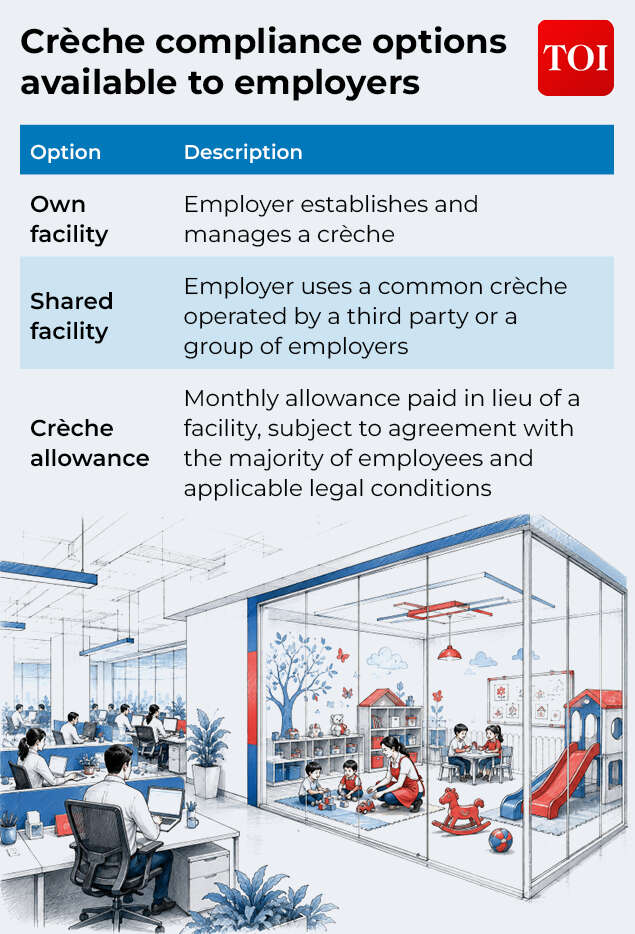
Crèche compliance options available to employers
Additional support for new mothers
The framework goes beyond merely providing a physical childcare facility.Women employees are entitled to visit the crèche four times during the day, including during rest intervals. In addition, women returning to work after childbirth are entitled to two nursing breaks for feeding their child until the child attains the age of 15 months.Under the Central Rules, each nursing break is required to be 15 minutes in duration. Women employees are also entitled to additional time for travel between the workplace and the crèche, which may extend up to 15 minutes.These provisions recognise that childcare support is not only about providing infrastructure but also about ensuring that employees can effectively utilise that support during the workday.Employers are also required to inform eligible employees about the availability of crèche benefits as part of their employment-related communications. Such awareness is important because a benefit can serve its intended purpose only when employees know that it exists and understand how it can be availed.
What does a compliant crèche look like?
The Labour Codes and the associated rules prescribe detailed standards for crèche facilities.A compliant crèche should be conveniently accessible to employees and designed to provide a safe, hygienic and child-friendly environment. The standards cover various aspects including space, sanitation, ventilation, staffing, feeding arrangements, first-aid support and childcare infrastructure.For certain sectors, particularly factories and similar establishments, the requirements become even more detailed. These may include provision of mobile crèche facilities wherever required, enhanced security measures including police verification of crèche staff, childcare supervision requirements, access controls, CCTV monitoring and other safeguards aimed at ensuring child safety.The facility is also expected to have suitable play areas, feeding arrangements, adequate hygiene standards and staffing support to ensure that children are cared for in a secure environment throughout the working day.The detailed nature of these requirements highlights the expectation that crèches should function as professionally managed childcare facilities rather than merely providing basic space within the workplace.
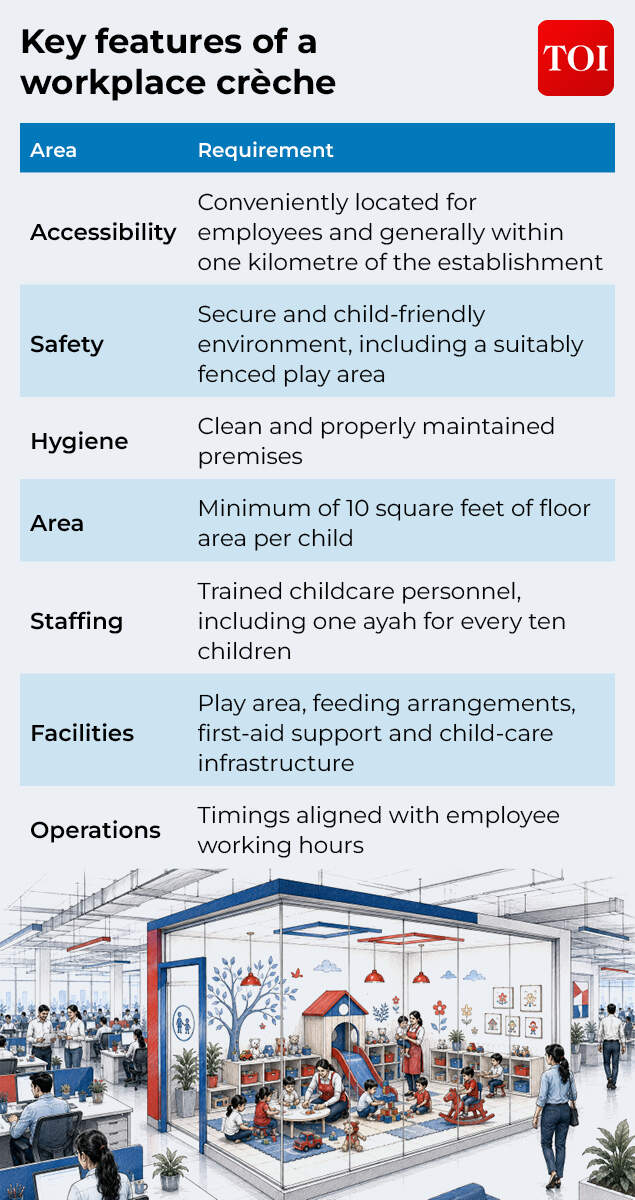
Key features of a workplace crèche
Areas where further clarity may be helpful
As with many new legislative reforms, some interpretational questions remain. For example, factories may face questions regarding the interaction of crèche-related provisions that exist under multiple Labour Codes. Employers may need greater clarity on how overlapping requirements are intended to operate in practice.Similarly, further clarification may emerge regarding the extent to which crèche benefits are intended to operate as a gender-neutral employee welfare measure. While the overall direction of the framework appears to support broader accessibility, additional guidance from regulators would help resolve remaining interpretational issues.As implementation progresses, regulatory guidance and practical experience are likely to provide greater clarity on these issues.
The bottom line
The crèche provisions under the Labour Codes represent an important step towards strengthening workplace support for working parents. They reflect a growing recognition that childcare challenges can directly influence workforce participation, employee retention and workplace inclusion.For employers, compliance should not be viewed merely as a statutory obligation. Organisations that proactively address childcare needs are likely to be better positioned to attract and retain talent, particularly at a time when employees increasingly value family-friendly workplace policies.For employees, the reforms signal a broader shift towards recognising childcare support as an integral workplace benefit rather than an optional perk. As the Labour Codes move closer to implementation with the rollout of rules, organisations may need to revisit their childcare policies, assess the suitability of existing arrangements and prepare for a framework that places greater emphasis on supporting working parents and young families.(The author, Puneet Gupta is Partner, People Advisory Services Tax at EY India)