



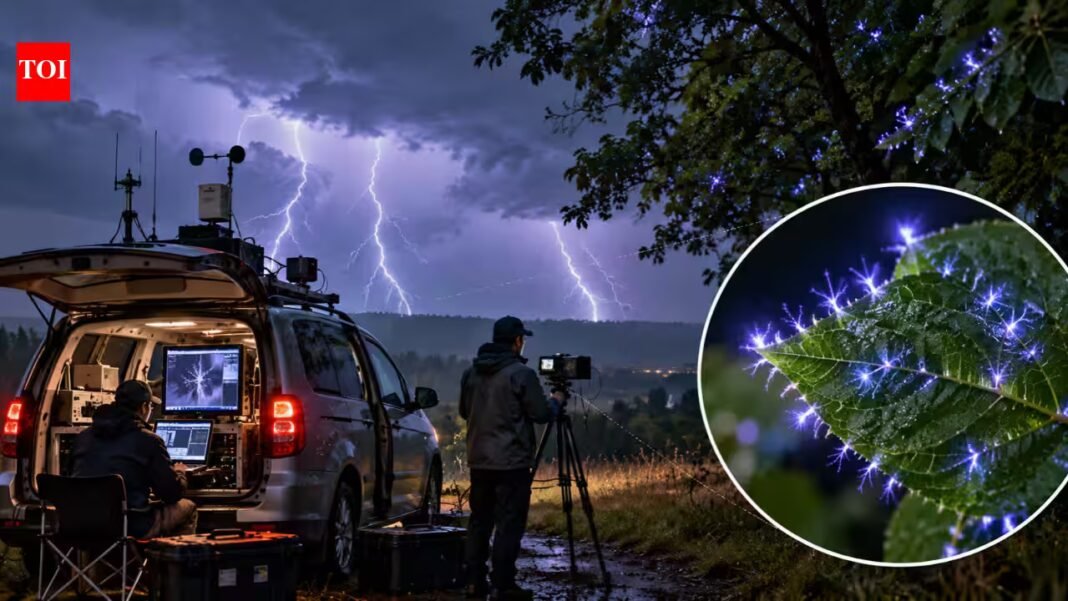
Scientists have directly observed tiny electrical discharges glowing and moving across tree leaves during thunderstorms, confirming a phenomenon suspected for more than 70 years. Using a specially equipped research vehicle fitted with an ultraviolet camera, researchers recorded 859 electrical signals on a sweetgum tree and another 93 on a loblolly pine in North Carolina. The discharges, known as coronae, moved between leaves and branches, sometimes following their movement in the wind. According to the study published in Geophysical Research Letters, titled ‘Corona Discharges Glow on Trees Under Thunderstorms’, provides the first direct measurements of these electrical emissions and examines their potential effects on forest ecosystems and atmospheric chemistry.
How scientists used a modified minivan to chase thunderstorms
The research team developed a mobile measurement system called the Corona Observing Telescope System (COTS) to detect the faint ultraviolet radiation produced by corona discharges. The equipment was mounted vertically inside a research vehicle, allowing the telescope to observe treetops through a periscope installed on the vehicle’s roof. The system included a specialised ultraviolet camera capable of detecting wavelengths between 255 and 273 nanometres.The research vehicle also carried a GPS receiver, an electric field mill, a weather station and a laser rangefinder. The equipment allowed the team to track the vehicle’s position, monitor electrical field changes during the storm, record weather conditions and measure the distance to nearby trees. By examining these readings alongside the camera footage, researchers could identify electrical activity on leaves and separate it from signals produced by lightning.
How researchers recorded 859 ultraviolet signals on a sweetgum tree
On 27 June 2024, researchers observed electrical discharges on two trees during a thunderstorm at the University of North Carolina Pembroke in North Carolina. Using a specially equipped research vehicle, they first monitored a sweetgum tree from approximately 32 metres away for around 1.5 hours before moving to a loblolly pine tree 28 metres away for another 20 minutes.During the sweetgum observations, the team recorded 859 ultraviolet signals across three branches, grouped into 41 corona clusters. Of these, 306 signals were attributed to corona discharges without lightning, while 553 occurred alongside lightning. The clusters lasted between 0.13 and 3.33 seconds, with the electrical activity appearing intermittently across the tree’s leaves and branches. The electrical activity appeared sporadically, moving from one leaf to another and sometimes returning to the same leaf.The observations continued on the loblolly pine, where the team recorded another 93 ultraviolet signals grouped into eight corona clusters. Researchers identified 68 signals and seven clusters as coronae occurring without lightning, while the remaining 25 signals and one cluster coincided with lightning. These clusters lasted between 1.3 and 2.6 seconds. The study reported that the discharges appeared at similar frequencies on both tree species, despite differences in their leaf structures and the intensity of the storms during the observations.
How corona discharges move across tree leaves and branches
The researchers found that corona discharges did not remain in one location on a tree. Instead, they appeared intermittently across different leaves and branches. Some ultraviolet signals followed the movement of leaves and branches as they swayed in the wind, helping the team confirm that the emissions were associated with the trees rather than unrelated sources of radiation.The study also established a relationship between the intensity of corona discharges and the electrical current flowing through trees. To investigate this connection, researchers conducted separate laboratory experiments using approximately one-metre-tall spruce and maple trees exposed to enhanced electrical fields. By measuring the electrical current through the trees and comparing it with the ultraviolet signals detected by the COTS camera, they developed a way to estimate the current associated with the observed discharges. The measurements from the field observations indicated current flows through individual tree branches on the order of one microampere.The research further found that individual corona discharges could emit between 100 million and one trillion ultraviolet photons per video frame. When the researchers considered the broader ultraviolet wavelength range below 300 nanometres, they estimated that leaves and surrounding air could be exposed to approximately 10 billion to 100 trillion energetic ultraviolet photons during a discharge lasting one second.
Why corona discharges move between leaves and branches
The North Carolina observations were not the only evidence collected during the research. According to the study, the team also recorded corona discharges under at least four additional thunderstorms, involving at least four other tree types, across locations stretching from Florida to Pennsylvania. In these observations, the discharges similarly moved between leaves and branches, with comparable photon emission rates and estimated electrical currents.The researchers identified several factors that could influence the formation and movement of coronae. Wind can change the orientation of leaves, affecting the electrical field around their pointed tips. The flow of water through a tree, known as hydraulic conductance, also influences the electrical current required to produce these discharges. The researchers noted that coronae could move between locations even under a constant electrical field in laboratory conditions.
How electrical discharges on trees could affect forest environments
The findings also raise questions about the effects of these electrical discharges on forest environments. Coronae and their ultraviolet radiation can produce hydroxyl radicals, known as OH, which play an important role in atmospheric chemistry. Previous research cited in the study estimated that coronae could produce approximately 10¹⁷ to 10¹⁸ hydroxyl radical molecules around a treetop during a thunderstorm.The study also highlighted potential damage to tree leaves. Earlier laboratory research cited by the authors found that the fine tips of leaves involved in corona formation could become visibly burnt within a few seconds under applied voltages of approximately 10 kilovolts. The researchers suggested that repeated electrical activity could affect upper branches, although the extent of such damage in natural forest conditions requires further investigation.The researchers concluded that their work provides the first direct observations of corona discharges on trees during thunderstorms, along with measurements of their ultraviolet emissions and estimated electrical currents. They also noted that further research is needed to establish a universal relationship between corona intensity, electrical current and the electric fields surrounding treetops across different tree species and forest environments.