


German researchers have tested what happens to grassland invertebrates when land use is reduced. The team worked at 45 sites across three regions of Germany, where plots were mown only once a year, late in the growing season, with no fertilisation or grazing. Invertebrate abundance rose by 41% after one year and by 99% after three years, compared with regularly managed control plots. According to the study published in ScienceDirect, titled ‘Experimental reduction of land use increases invertebrate abundance in grasslands’, species diversity did not differ between the two plot types. The authors add that the increase varied with how the surrounding grassland was managed.
How did reduced mowing boost insect populations by 99%
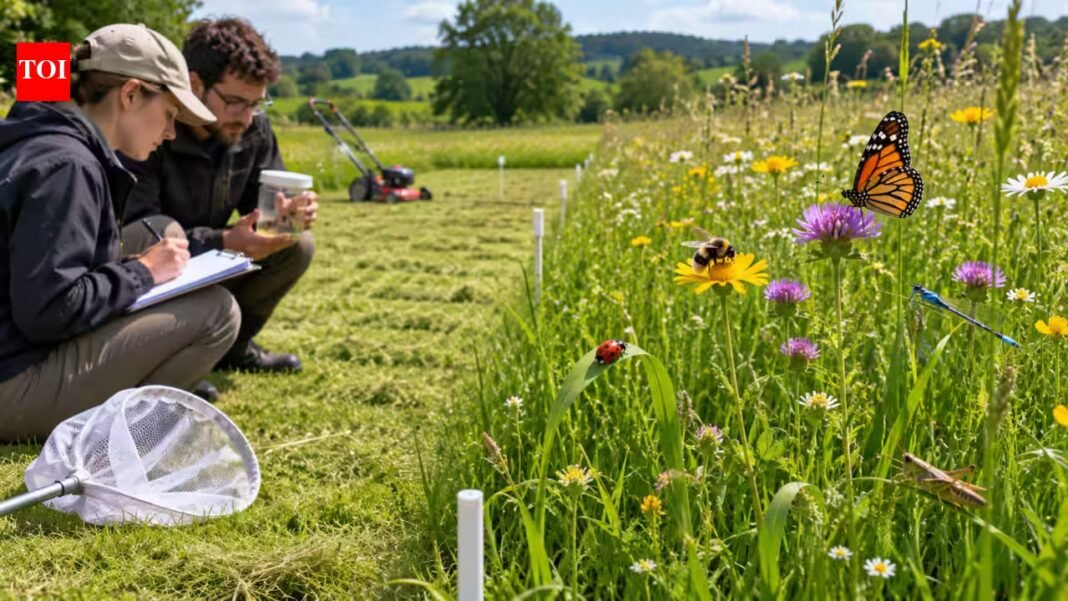
According to the paper, the study took place in the Schwäbische Alb, Hainich-Dün and Schorfheide-Chorin regions, within the Biodiversity Exploratories consortium. Land use was experimentally reduced at 15 grassland sites in each region, giving 45 sites in total. The paper states that this was done before the start of the 2020 vegetation period. Sites with medium to high land-use intensity were selected.The paper explains that a 30 m x 30 m plot with reduced land use was set up close to a long-term monitoring plot, which served as the control and kept its regular land use. The reduced plot was mown only once a year, late in the growing season, in August or September. According to the authors, it received no fertilisation, grazing or additional mowing.
Scientists measure invertebrate populations across 45 grassland sites
The researchers collected invertebrates with a custom-built suction sampler modified from a leaf vacuum, according to the paper. Sampling took place in May 2021, one year after the experiment began, and again in May 2023, three years after it began. The authors state that sampling was done before the first mowing or first intensive grazing at all control sites. They explain that this was necessary to ensure the reduced plots were not simply acting as refuges within an unfavourable surrounding area.According to the paper, two 1 m x 1 m subplots were sampled in each plot, with all invertebrates sucked from the 1 m² area for five minutes. In total, 176 samples were taken in 2021 from 44 sites, because one of the 45 experimental sites could not be sampled. All sites were sampled in 2023. The paper states that mites, springtails and ants were excluded from the abundance figures. Species were identified by DNA metabarcoding for the 2021 samples only, and the paper reports that 479 unique species were identified.
How did reduced mowing affect invertebrate numbers and diversity
According to the paper, abundance after one year rose from a mean of 786 individuals in the control plots to 1,108 in the reduced land-use plots. After three years, the means were 859 individuals in the control plots and 1,708 in the reduced plots. The table in the study states that these figures refer to a sampling area of 2 m². The paper reports that 83,343 invertebrates were collected in 2021 and 115,490 in 2023, excluding ants, mites and springtails. The authors write that large effect sizes for abundance were found across all three study regions.Species richness, Shannon diversity and Simpson diversity were almost identical between treatment and control after one year. Mean species richness was 35 in the reduced plots and 34 in the control plots. According to the paper, species composition did not systematically differ between the two plot types. The authors note that diversity could not be assessed for 2023 because the 2023 samples could not be meta-barcoded due to budget constraints.
What factors influenced the success of reduced grassland mowing
The size of the abundance increase depended on land use in the surrounding grassland. According to the authors, effects of land-use reduction were smaller where the surrounding area had been mown more often in previous years. Effects were larger on more fertilised sites. The paper also reports that after one year, effects were larger when the single late mowing was carried out at a greater cutting height. After three years, they were larger when the reduced plot and the surrounding area were not mown on the same day.The authors list limitations in the paper. They write that the lack of diversity data for 2023 is a key limitation, and that they have no biomass data. They state that in past research on the same grassland sites, arthropod abundance and biomass were strongly correlated. The paper concludes that it will be important to study how outcomes develop over time, as land-use reduction is likely more successful when implemented permanently.