



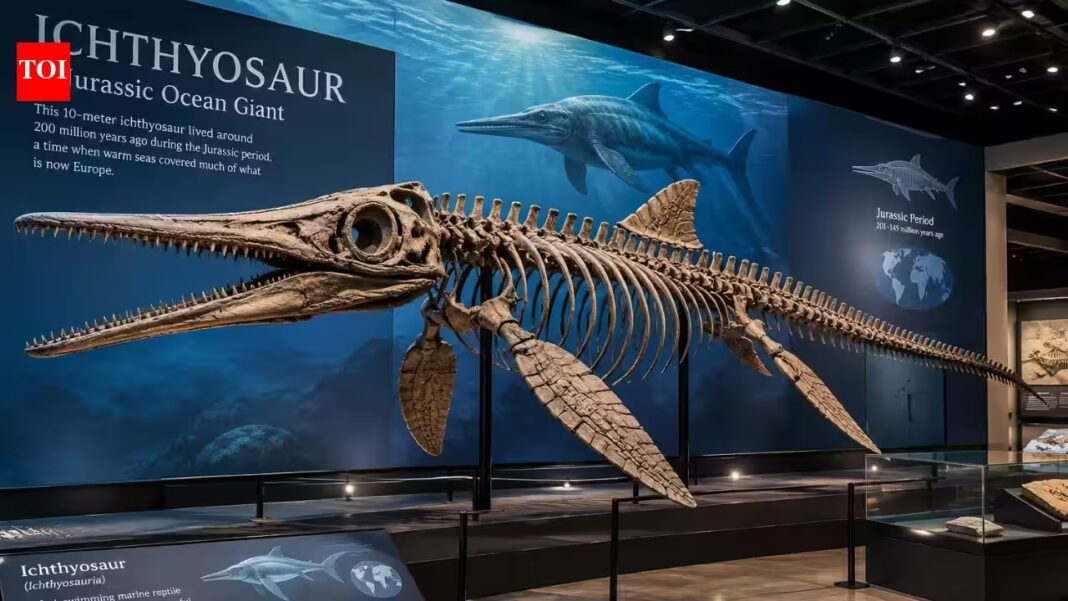
A 10-metre ichthyosaur discovered on a secluded beach near Bridport in Dorset has gone on display at Bridport Museum, bringing an unusual Jurassic fossil into public view. Belgian fossil hunters Michel Plissart and his partner Carine Christens spotted dark shapes in a sandstone bed and contacted the Charmouth Fossil Centre after recognising the find’s potential scientific importance. The fossil comes from the Bridport Sand Formation, a geological layer in which ichthyosaurs had not previously been recorded. Researchers at the University of Bristol estimate that the animal lived about 174 million years ago. Donated to the museum by the landowner, the specimen was prepared for study at Bristol, where researchers have examined it. The exhibition, Bridport’s Sea Dragon: Unexpected Survivor, opened on October 24, 2026, and is scheduled to run until April 2027.
How fossil hunters discovered the 10-metre ichthyosaur near Bridport
The discovery began when the Belgian visitors noticed unusual dark shapes in sandstone on a beach near Bridport. In an interview with the West Dorset Magazine, Michel Plissart said they recognised the potential scientific importance of the find and contacted the Charmouth Fossil Centre straight away. The fossil is remarkable for its size. At nearly 10 metres long, the animal was a large marine predator that lived in the seas covering parts of what is now southern England during the Jurassic Period. Ichthyosaurs were marine reptiles, not dinosaurs or mammals. Although their streamlined bodies and long snouts could make them resemble modern dolphins, they belonged to a distinct group of reptiles that evolved to live and hunt in the sea. Different ichthyosaur species occupied different ecological roles, with prey ranging from fish and squid to other marine animals.The landowner donated the fossil to Bridport Museum. Grant funding helped prepare the specimen for study at the University of Bristol, where researchers have examined it. A scientific paper based on the research is reportedly due to be published shortly. The discovery has drawn attention partly because of where it was found. The specimen came from the Bridport Sand Formation, a geological unit in which ichthyosaurs had not previously been recorded. Finding a large marine reptile in a formation without earlier ichthyosaur records can expand scientists’ understanding of the animals that inhabited the region and the environments in which they lived.
Why the ichthyosaur’s estimated age matters
Researchers at the University of Bristol estimate that the fossil is about 174 million years old. Other reports have given different ages, so the figure is best understood as an estimate rather than an exact date. Sam Scriven, principal officer for world heritage at Dorset Council, said the animal lived around 9 million years after volcanic activity caused oxygen levels in the oceans to fall, contributing to a major environmental crisis.The event associated with this period is known as the Toarcian Oceanic Anoxic Event, which occurred during the Early Jurassic, around 183 million years ago. It was marked by substantial environmental and climatic changes, including widespread oxygen depletion in marine environments. Such conditions placed pressure on marine ecosystems and contributed to major changes in the fossil record. The Bridport specimen’s estimated age places it millions of years after that crisis. Its presence raises questions about the longer-term survival and distribution of large marine reptiles, although one fossil cannot, by itself, establish how a particular lineage survived or recovered.
What research says about ichthyosaurs after the Jurassic environmental crisis
Research by Erin E. Maxwell and Peggy Vincent, published in Paleobiology in 2016, examined how ichthyosaurs responded to the Early Jurassic Toarcian crisis. The researchers found no species-level ichthyosaur extinction that coincided directly with the peak of the invertebrate extinction event they studied. However, large ichthyosaurs were absent from the fossil record during the extinction interval and became more abundant immediately afterwards. The study also found evidence that the ichthyosaur Stenopterygius quadriscissus increased in body size after the event. The researchers discussed greater mobility and opportunistic feeding as possible factors that could have helped some marine reptiles cope with environmental change.A 2024 review in Earth-Science Reviews, titled Impact of early Toarcian climatic changes on marine reptiles: Extinction and recovery, explored the effects of these environmental shifts across marine-reptile groups. It described changes in diversity and the disappearance of some groups under later episodes of warming. The review also highlighted a difficulty in interpreting the fossil record: changes in preservation conditions can affect which animals are found, potentially obscuring patterns of extinction and recovery. These studies provide context for the Bridport discovery, but they do not directly establish the evolutionary history of the newly displayed specimen. Its estimated age and geological setting may help researchers investigate how large marine predators persisted through changing ocean conditions. Further analysis and publication of the research on the fossil will be important for assessing what it adds to existing evidence.
Bridport Museum exhibition brings the fossil to the public
The specimen is now the centrepiece of Bridport’s Sea Dragon: Unexpected Survivor at Bridport Museum. The exhibition opened on October 24, 2026, and is scheduled to continue until April 2027. Visitors can learn about the discovery through a specially produced film, a virtual reality experience and planned expert talks. The exhibition also connects the fossil to the wider geological history of the Jurassic Coast, a stretch of southern England’s coastline known for its fossil-bearing rocks.Museum manager Michelle Caesar described the landowner’s donation as a generous gift and said the exhibition was intended to encourage local people and visitors to explore the region’s fossil history. The Bridport ichthyosaur is significant both as a striking specimen and as a new find from a geological formation where this group of marine reptiles had not previously been documented. Its estimated age also makes it relevant to questions about the effects of Jurassic environmental upheaval. Researchers will need to establish the details through further study, but displaying the fossil gives the public an opportunity to see an animal whose remains may help refine the scientific picture of ancient marine life.