


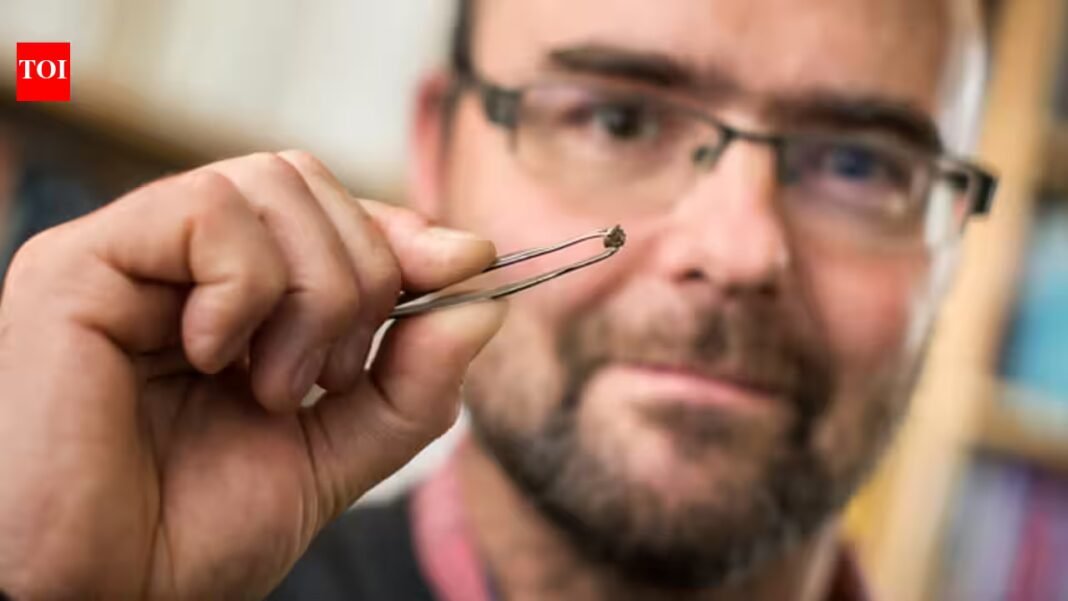
A common toothpaste abrasive has been recognised as a natural mineral for the first time. The International Mineralogical Association has designated the first natural occurrence of calcium pyrophosphate (Ca₂P₂O₇) as grahampearsonite, named after University of Alberta geochemist Graham Pearson. Researchers from Brazil, China and Italy found it trapped inside a diamond from the Juina region of Brazil, which formed 500 million years ago, roughly 400 kilometres beneath Mato Grosso State. Using X-ray diffraction, they confirmed the mineral matches the well-known synthetic compound without removing it from the diamond.
Calcium pyrophosphate gains recognition as a natural mineral
According to Folio, calcium pyrophosphate has been familiar to chemists and dentists for decades. Mineralogists, however, only recognise a substance once it has been found occurring naturally, so the compound had no geological name until this discovery. The article describes grahampearsonite as nature’s equivalent of a common abrasive found in most toothpastes. Pearson told Folio that half the planet brushes their teeth with it every morning, yet it had never been given a mineral name.Folio reports that the team did not extract the mineral from its diamond host. Instead, the researchers used X-ray diffraction while the mineral was still trapped inside the diamond. This confirmed that the natural mineral matches the well-known synthetic compound. According to the article, the team consisted of Brazilian, Chinese and Italian researchers, and Fabrizio Nestola, a mineralogy professor at the University of Padua in Italy, was one of the team leads on the discovery.
How a diamond preserved a rare mineral for 500 million years
The University of Alberta’s publication journey from formation to naming began 500 million years ago, roughly 400 kilometres beneath the Chapadão plateau in Mato Grosso State, Brazil. At that time, the area lay under the Gondwana supercontinent. According to the article, a diamond formed around a rare mineral there and began a slow ascent towards the surface, eventually emerging in a violent volcanic eruption.According to Pearson, as reported by Folio, grahampearsonite requires significant oxygen to form, so it is unlikely to form and survive in most deep-earth environments. The article says it survived the trip to the surface only because it was trapped inside a diamond. Pearson described the diamond as a remarkably good capsule, protecting the mineral from reacting with other minerals as it moved through shifting pressures and temperatures. Folio adds that the mineral was found alongside tuite, another phosphate mineral trapped in diamonds that also forms during meteorite collisions. According to the article, their presence together gives scientists new clues about how phosphorus is stored and recycled between Earth’s crust and mantle.
Grahampearsonite honours a scientist who uncovered Earth’s deep secrets
Folio reports that Pearson joined the University of Alberta in 2010 as a Canada Excellence Research Chair in Arctic Resources. There he established the Arctic Resources Geochemistry Laboratory, which the article describes as one of the largest and most advanced facilities of its kind in the world. According to Folio, he has also developed new techniques for geochemical analysis and pioneered methods for dating minute geological samples. He developed the first techniques for determining when a diamond was created, as well as its geographical origin. In 2023, the article notes, he was elected to the Fellowship of the Royal Society, UK, which Folio describes as the world’s oldest continuous scientific society.The article explains that the choice of name acknowledged Pearson’s eminent standing in the field and his history with the Juina region of Brazil, where the mineral was unearthed. Folio says Pearson and an international team published the discovery of ringwoodite, another mineral trapped in a Juina diamond, in 2014. According to the article, analysis showed the ringwoodite contained a significant amount of water, 1.5 per cent of its weight. This confirmed theories that vast volumes of water, perhaps as much as all the world’s oceans combined, are trapped 410 to 660 kilometres beneath Earth’s surface. Folio also notes that diamonds in engagement rings typically form 150 to 200 kilometres below the surface, whereas Juina diamonds, in Pearson’s words, are “absolute scientific treasure troves” originating from roughly 400 kilometres or more.
Why Graham Pearson was chosen for the new mineral’s name
According to Folio, IMA rules stipulate that an honoree cannot be part of the research team that discovers the mineral. Typically, the individual should have made a significant contribution to mineralogy, geology or a related science. Nestola told Folio that Pearson is among the most renowned experts on super-deep diamonds. He added that the recognition is well deserved, not only for Pearson’s scientific contributions but also for his ability to foster international collaborations and mentor the next generation of researchers.Pearson described the naming as a great honour, according to the article. He noted that the number of minerals left to be discovered is shrinking fast, and that there are estimates that in 20 or 30 years there will be no new minerals left to find. Folio quotes him as saying, “It’s nice to get one named after you while you still can.”