



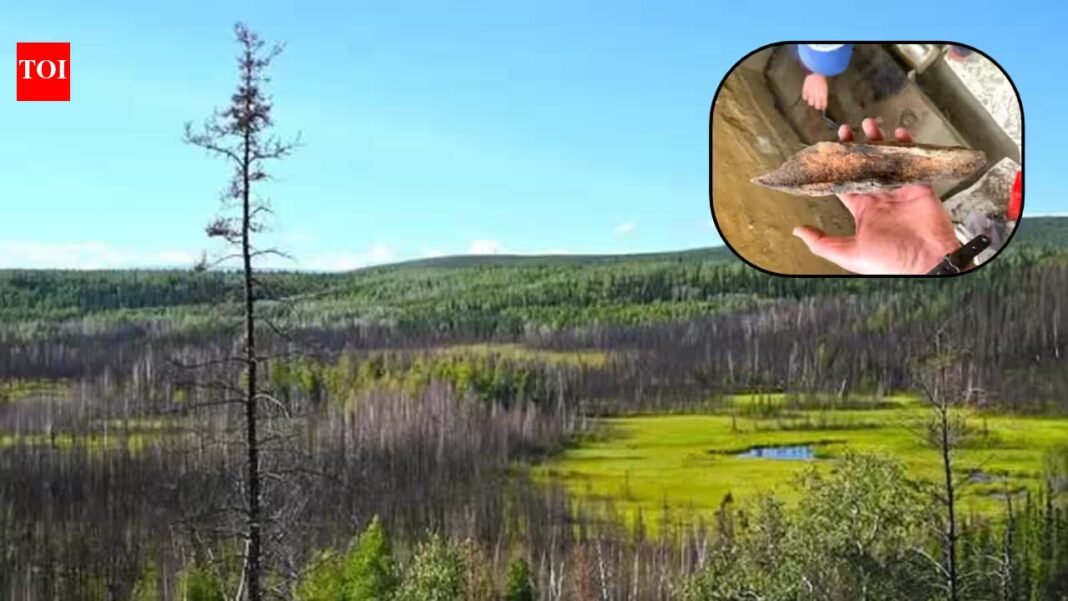
Thousands of years before permanent settlements became common across North America, small groups of people were already adapting to life in the continent’s far north. In interior Alaska, archaeologists have uncovered an exceptionally rich campsite dating back approximately 13,800 years, containing stone tools, bone implements, a hearth and traces of what may have been a shelter. Together, these remains offer a rare glimpse into the daily activities of some of the earliest people to inhabit the region.According to a study published in Science Advances, researchers investigated the Shég’ Xdaltth’í’ archaeological site in Alaska to understand how early populations moved through and settled in Beringia, the region that once connected northeastern Asia and northwestern North America. The findings reveal repeated human activity, sophisticated toolmaking, organised activity areas and a possible dwelling, helping scientists investigate how people adapted to the challenging environment during the Late Pleistocene.
A campsite preserving thousands of years of history
Shég’ Xdaltth’í’, a name meaning “They were there” in Alaska Native Athabaskan, is located in interior Alaska, about 55 kilometres south-southeast of Fairbanks. The site has been studied through a multidisciplinary research project since 2016. The research identified three archaeological occupation layers dating to approximately 13,800, 13,000 and 12,700 years ago. The oldest layer contained more than 80,000 archaeological specimens, including artefacts and remains of animals and other materials associated with past human activity.Researchers identified a wide range of stone tools, including bifacial knives, scrapers, an adze and a cobble plane. Some tools were repeatedly sharpened or modified, suggesting that people maintained and reused their equipment rather than simply discarding it after a single task. The diversity of stone materials also indicates that people brought resources from different locations, demonstrating their knowledge of the surrounding landscape and its available materials.The density and variety of discoveries make the site particularly valuable for understanding how early inhabitants organised their activities and used the landscape.
Hearth and posthole suggest a possible shelter
One of the most significant discoveries was evidence of a possible dwelling structure. Researchers identified charcoal-stained sediment associated with a hearth, a small pit and a post mould, a trace left by a wooden post that had once stood in the ground. Together, these features suggest that people may have constructed a partially covered lean-to or tent-like shelter. The proposed structure appears to have opened towards the south, although its exact design cannot be established from the surviving evidence.The researchers also found evidence of an earth oven containing charcoal, animal bones and stone artefacts. Such an oven could have been used to cook meat slowly, making it more tender and helping people obtain more fat from their food. Building an earth oven would have required considerable time and effort. Its presence, alongside other domestic features, suggests that the occupants expected to remain at the location for a meaningful period or return to it repeatedly.The evidence makes Shég’ Xdaltth’í’ an important candidate for one of the earliest known examples of a habitation structure in North America, although the shelter interpretation remains tentative.
Bone needles and animal remains reveal daily life
The artefacts provide further clues about the activities carried out at the campsite. Researchers recovered bone sewing implements, including fragments of eyed needles, which may have been used to stitch animal hides or other materials into clothing and coverings. The site also yielded an antler pendant and a variety of animal remains. These finds suggest that the occupants undertook several activities beyond hunting, including tool production, food processing and the manufacture of useful objects.The animal remains suggest a varied subsistence strategy. The researchers say further analysis is needed to determine the seasons in which different animals were obtained. Researchers also identified remains of wolf-like canids. These raise questions about the relationship between early people and dogs, but the evidence does not establish that the animals were domesticated.
What the discovery reveals about early migration
The campsite is significant because of its connections with archaeological sites on both sides of the former Bering Land Bridge. A distinctive type of hafted biface, a stone tool designed to be attached to a handle, has parallels at contemporary sites west of the bridge in Siberia. These similarities provide evidence of cultural connections between populations in northeastern Asia and Alaska, helping researchers investigate how technologies and practices spread across the region.However, the study does not establish that Shég’ Xdaltth’í’ was the oldest human settlement in the Americas. Instead, it documents the earliest known occupation associated with the Nenana Complex east of the Bering Land Bridge. The researchers infer that the oldest occupation phase involved periodic, repeated use over as much as two centuries, suggesting that the site served as a base camp rather than a brief hunting stop.By bringing together evidence of shelter, cooking, toolmaking and food gathering, Shég’ Xdaltth’í’ offers a detailed picture of early life in Alaska. Further analysis of its animal and plant remains may reveal more about the seasons people spent there and how they adapted to the northern landscape.