


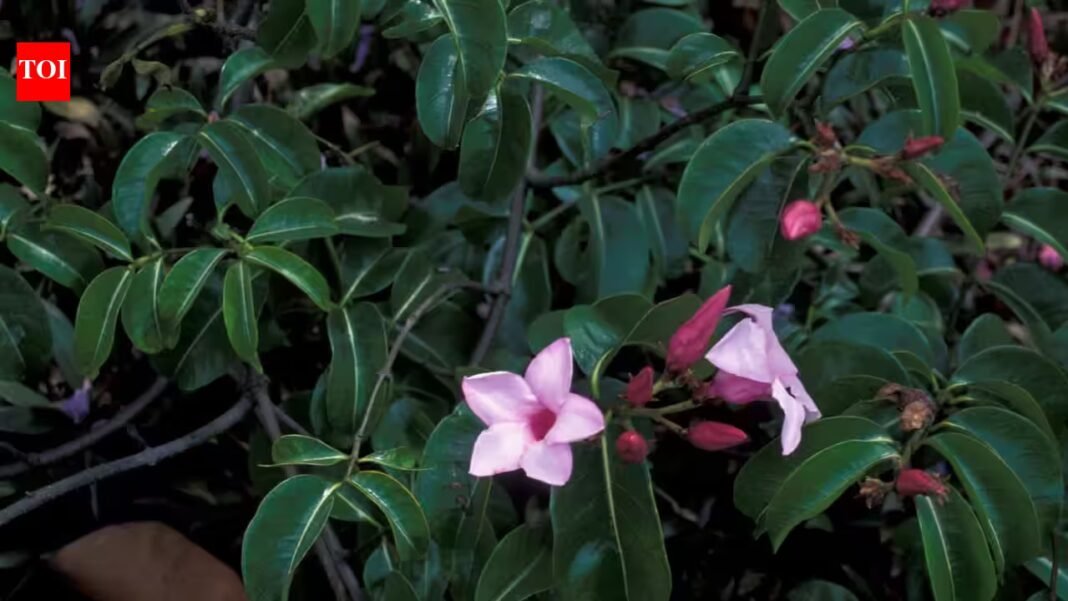
Rubber vine, a plant native to south-western Madagascar, was introduced to northern Queensland in the late 1860s as an ornamental before becoming a serious invasive weed. During the Second World War, Australia cultivated the vine as a potential source of rubber, helping it spread further. The plant later became one of Queensland’s most troublesome weeds, forming dense thickets, smothering native vegetation and invading waterways and pastures. Today, rubber vine remains a major environmental and agricultural concern, particularly across northern Queensland, where controlling its spread requires several methods used together.
How did the Madagascar vine become a wartime rubber crop
Rubber vine, scientifically known as Cryptostegia grandiflora, was first planted in the gardens of mining towns in northern Queensland during the late 1860s. According to the Australian Association of Bush Regenerators’ Weed Management Guide, infestations were already being reported by 1917, showing that the plant had escaped its ornamental role well before the war.The plant gained a new purpose during the Second World War, when it was cultivated as a potential source of rubber. The Weed Management Guide and Weeds Australia both state that these wartime efforts contributed to the vine’s spread. The attempt did not establish rubber vine as a successful commercial rubber crop, but the additional cultivation gave an already invasive plant more opportunities to move into the surrounding landscape.
What makes rubber vine so difficult to contain
Rubber vine is a vigorous woody climber that can grow as a shrub when it has no support or climb as high as 30 metres into trees. Queensland Government information describes its shoots as twining and whip-like, while its glossy leaves and large funnel-shaped flowers can make it appear attractive despite its invasive behaviour.Its ability to overwhelm other vegetation is the bigger problem. Rubber vine can form dense thickets along waterways and spread from riverbanks into open woodland and pastures. Weeds Australia notes that it threatens waterways, woodlands and rainforests across north-eastern Australia, including areas such as Cape York Peninsula and the Wet Tropics World Heritage Area.The Queensland Government says the vine smothers riparian vegetation, reduces biodiversity and can obstruct the movement of livestock and native animals. It can also make mustering difficult for farmers.
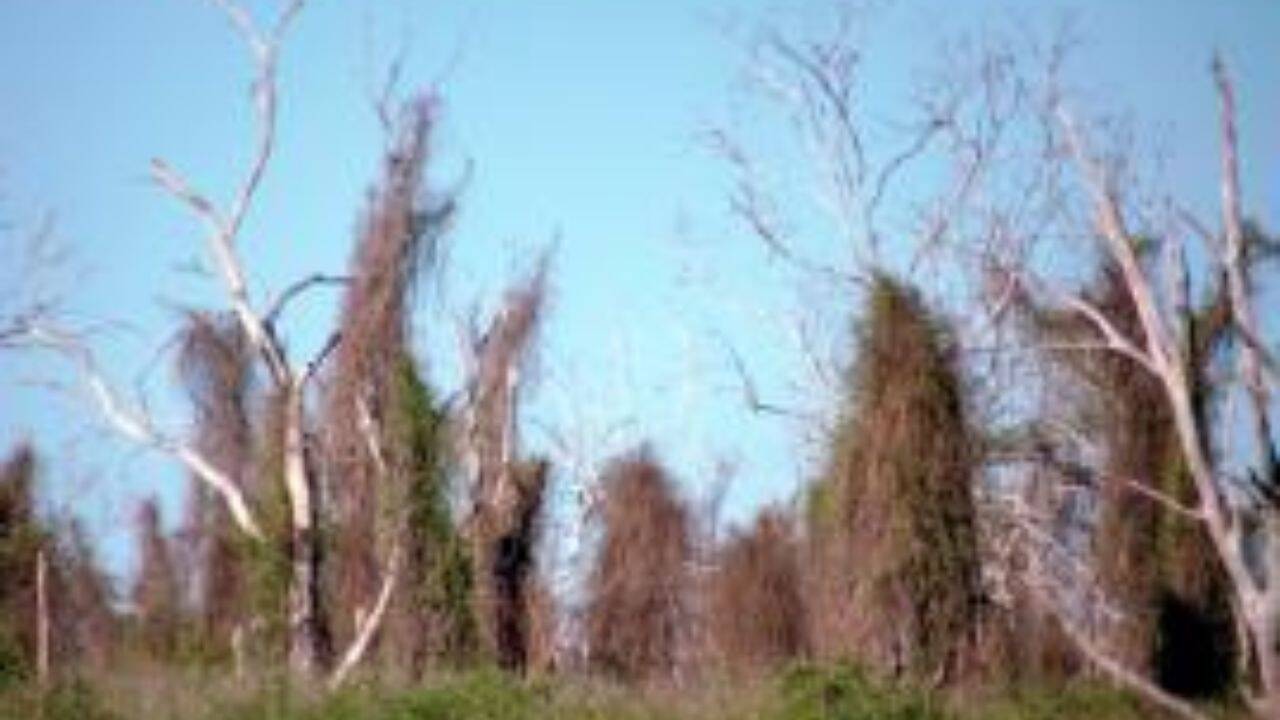
Invades pastures, waterways and natural areas. Image Credit: NSW WeedWise
How does the plant spread across the landscape
Rubber vine has an efficient way of producing and moving seeds. Each pod can contain hundreds of seeds, with the Weed Management Guide giving a range of 340 to 840 seeds per pod. Around 95% of the seeds are viable. Wind carries the seeds short distances using their silky tufts, while water can transport them much farther.Floodwater is particularly important because seed pods can float for extended periods. The Weed Management Guide reports that much of the seed can remain viable even after pods have floated in fresh or salt water for more than a month. Seeds may also be moved by birds or carried in mud attached to animals, vehicles and machinery.Moist areas provide particularly favourable conditions. The plant commonly establishes along waterways and areas receiving water runoff, while seeds germinate readily in moist soils. The Weed Management Guide says the plant generally occurs in regions receiving between 400 and 1,400 millimetres of mainly summer rainfall.
Rubber vine became a major Queensland weed
The scale of the invasion became substantial over time. The Weed Management Guide estimated that more than 700,000 hectares of tropical and subtropical Queensland were infested in 1991, while rubber vine was present across an area around 50 times larger.A review published by Australia’s Department of the Environment and Heritage described rubber vine as affecting about 20% of Queensland at the time and identified northern Australia as having a much larger potential area at risk.The impact is not limited to vegetation. NSW WeedWise states that rubber vine is poisonous to people and livestock, while its sap can irritate skin and cause burning, rashes and blisters. All parts of the plant are poisonous if eaten. Livestock can suffer serious effects because the plant contains cardiac glycosides that affect the heart, brain and gut.
What methods are being used to control it
No single control method provides the whole answer. The Weed Management Guide identifies four main approaches namely biological control, chemical treatment, fire and mechanical control. It recommends combining these methods according to the location and condition of an infestation.Fire can be particularly useful because it kills surface seeds, seedlings and established plants when conditions are suitable. Weeds Australia reports that an experiment west of Chillagoe in Queensland killed 80% of rubber vine in an initial fire, while a follow-up burn a year later achieved a 99% kill rate.Biological control has also played an important role. Two agents, rubber vine rust and the rubber vine moth, became established in Queensland after being released in the early 1990s. The rust causes leaves to yellow and fall, reducing the plant’s vigour, while moth caterpillars feed on its leaves. Their effectiveness varies with conditions, but the Queensland Government says both can reduce seed production by causing defoliation.
Preventing further spread of the weed remains important
The Weed Management Guide identifies prevention as the cheapest form of control and recommends stopping the plant from moving beyond established areas.Queensland now classifies rubber vine as a category 3 restricted invasive plant under its Biosecurity Act 2014. The Queensland Government states that it must not be given away, sold or released into the environment, while reasonable measures must be taken to minimise its biosecurity risks. The wartime rubber experiment is therefore only one chapter in the history of rubber vine.