



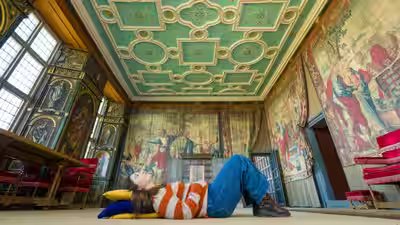
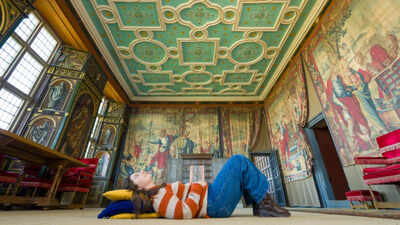
When you visit a historic place, your eyes usually go where you expect them to: the paintings at eye level, the carved doors and the glass cases full of relics. Few people ever think to tilt their heads back and take in what hangs overhead. That is a missed opportunity, because ceilings are where many builders and artists saved their boldest work, far from the crowds and the velvet ropes. Doubt it? Then you must certainly visit one of the sites featured in conservation charity English Heritage’s ‘Lie Down and Look Up’ campaign, which runs until November 1. At five of its sites, the charity has set out cushions so visitors can lie down and stare upwards for as long as they like. “Ceilings are often the crowning glory of a historic building. Designed to inspire awe, they can be wonderfully distinctive, with decoration that survives remarkably well,” Jeremy Ashbee, head curator of properties at English Heritage, said in a statement. “But when visiting a historic place, there’s not always the opportunity to enjoy a splendid ceiling to the fullest. We’re inviting visitors to put formality to one side, make themselves at home, linger, even lie down and enjoy the view up above.”Here’s what you can expect from the ‘Lie Down and Look Up’ campaign.
Bolsover Castle , Derbyshire
The Star Chamber at Bolsover Castle is unlike anything you have seen. Its blue ceiling is dotted with 254 gold-leaf stars, and once you lie back, the room starts to feel like a clear night sky. That’s not all. Biblical scenes are painted on the walls, panels and tapestries, playing out beneath the constellations. The castle was built for William Cavendish, whom English Heritage describes as a ‘horse-mad Cavalier playboy’.
Belsay Hall, Northumberland
Belsay Hall in Northumberland takes a different route. It is both a medieval castle and a Greek Revival mansion, the conservation charity said. Its New Hall, built in the early 19th century, was inspired by Greek marble temples. Its roof is made of glass, so the courtyard below feels open to the sky. Charlotte Woolley, the hall’s cluster manager, told the BBC that the building’s design was meant to be seen more than its decoration. “Obviously, our weather isn’t as kind as that of the Mediterranean,” she said, which explains the covered space. But looking up from the centre of the hall “creates a truly remarkable view, where the full scale and symmetry of the space can be appreciated”.
Osborne, Isle of Wight
Queen Victoria’s seaside retreat at Osborne has its own showstopper. Its ornate ceiling has nothing to do with stars, but something better. The Durbar Room was designed by Lockwood Kipling, father of the writer Rudyard Kipling, and its ornate plasterwork was shaped by Indian master carver Bhai Ram Singh. The room features intricate Indian-style plasterwork to reflect the Queen’s status as Empress of India. “The ceiling is the room’s pièce de résistance, made up of intricate floral plasterwork and honeycombed muqarnas vaulting,” English Heritage says.
Wrest Park, Bedfordshire
Built in the 1830s, the mansion was inspired by French châteaux. According to the conservation charity, there are “many gems to be found within the intricate wall and ceiling décor of this 19th-century ‘French château’-style mansion”. When you head to the drawing room, pause and look up. Take a moment to admire the ceiling painting of Venus and Cupid flying through the sky.
Eltham Palace , south-east London
Eltham Palace, in south-east London, mixes several centuries in one building. Its Great Hall dates to the 1470s, when Edward IV oversaw its construction, and its oak hammerbeam roof still stretches overhead. In the 1930s, the site was turned into what English Heritage calls an “Art Deco party palace”. Over the years, the hall has served as an indoor tennis court, a banquet room and a music hall.So, are you convinced to look up? Yes, the floor may be cold and your neck may complain, but the view is well worth it.