



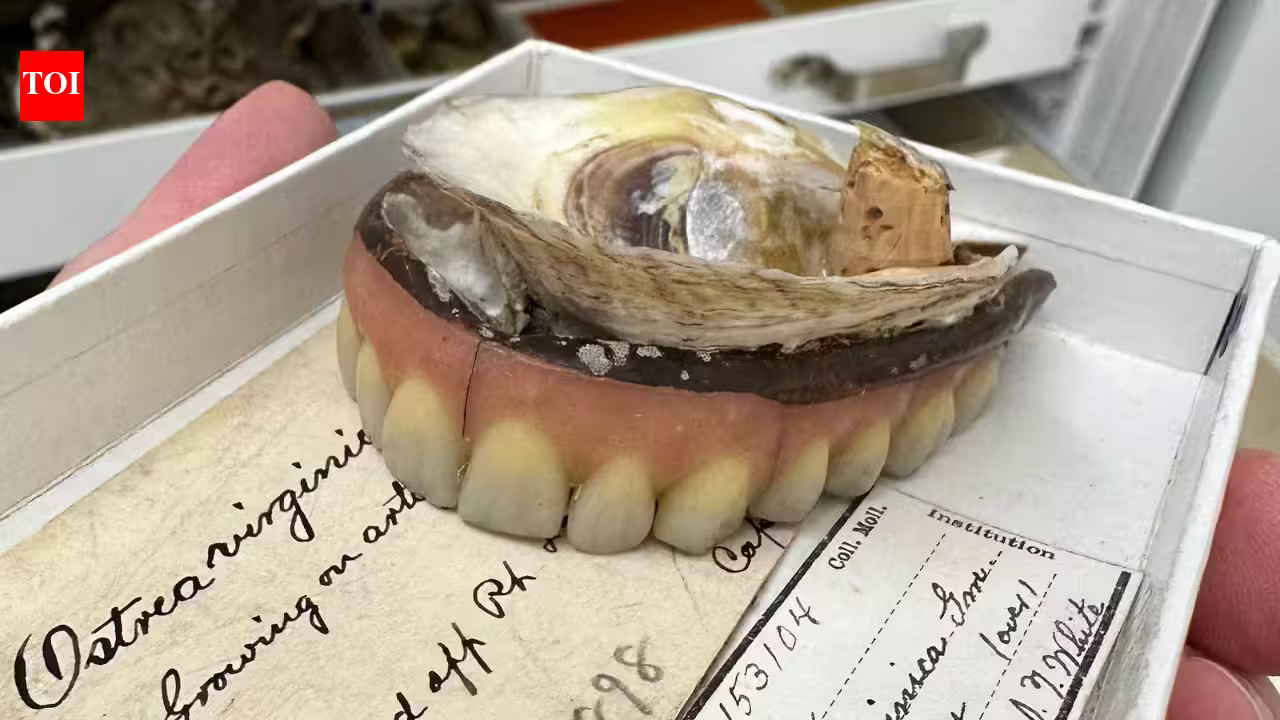
In 1898, a dredging boat pulling debris from the floor of the Chesapeake Bay made a discovery that looked like something from a biological nightmare: a set of human dentures with a live oyster firmly attached to them.The unusual specimen was sent to the Smithsonian Institution, where it has remained ever since, serving as a reminder of a very different time. When those false teeth fell into the water, the Chesapeake Bay held so many oysters that they attached themselves to almost any hard surface to survive. According to the Smithsonian, more than 99 per cent of the historic native oyster population has disappeared from the bay.The decline of the eastern oyster (Crassostrea virginica) is one of the most severe environmental collapses in American ecological history. Where huge, centuries-old oyster reefs once covered the seabed, overharvesting, destructive dredging, pollution, disease and habitat loss have left the bay without its natural water-filtering system.
An oddity of nature stuck to porcelain
The century-old specimen in the National Museum of Natural History tells a story of both human humour and biological survival. After the dentures arrived at the Smithsonian, several people tried to claim them. One man strongly insisted the false teeth belonged to him, even though official records showed they had been dredged up more than a decade before he was born.Despite its strange appearance, the specimen simply shows normal oyster biology. When young oysters hatch, they float freely through the water using tiny hairlike structures called cilia. After a few weeks, they develop a temporary foot that lets them crawl along the seabed in search of a hard surface, away from the soft mud below.Once a young oyster finds a hard surface, it releases a natural adhesive that permanently attaches it for the rest of its life. In a bay crowded with oysters, suitable places to settle were limited, so young oysters attached themselves to almost anything they found.“If an oyster finds a hard substrate, it will frequently just grow on it,” said John Pfeiffer, research zoologist and curator of bivalves at the National Museum of Natural History. “Whether it’s a pipe, a pair of dentures, bedrock or another oyster.”The Smithsonian also holds several other unusual bivalve specimens collected from the Chesapeake Bay around 1900, including an oyster attached inside a smoking pipe and another growing on a teapot lid.“It’s like a little bivalve freak show,” Pfeiffer said of the collection.
From ancient sustainability to rapid destruction
The unusual specimens come from a time when oysters were central to both the ecology and culture of the region. For more than 3,000 years, Indigenous peoples harvested oysters from the Chesapeake Bay in large numbers. Archaeological excavations of ancient shell mounds, known as middens, show that they mainly collected large, mature oysters by hand from shallow waters. By leaving deep-water reefs untouched, these early communities maintained a sustainable fishery for thousands of years without exhausting the ecosystem.The arrival of European settlers changed that balance dramatically. During the 19th century, intensive commercial harvesting spread across the estuary. Industrial dredging boats dragged heavy metal frames across the bay floor, destroying reef structures that had formed over thousands of years.By 1898, when the oyster-covered dentures were pulled from the mud, the population was already beginning a sharp decline. In the years that followed, industrial pollution, sediment runoff from deforestation, and deadly parasitic diseases such as MSX and Dermo caused even greater damage to weakened oyster beds.By the late 20th century, annual commercial harvests had fallen to only a small fraction of their historic levels, leaving behind a badly damaged marine ecosystem.
The cost of a vanished filter
The loss of more than 99 per cent of the Chesapeake’s oysters has affected far more than the fishing industry. It has had major impacts on the water quality of the entire estuary. Oysters are natural filter feeders, removing algae, plankton and organic matter from the water while trapping excess nutrients and sediment that would otherwise make the water cloudy and low in oxygen.In the late 1800s, the millions of oysters covering the bay floor could filter the entire volume of the Chesapeake Bay in just a few days. Today, because so few oysters remain, it takes nearly a full year to filter the same amount of water.Conservation groups, state agencies and scientists are now working on large-scale restoration projects across the Chesapeake watershed. By building artificial reefs from crushed stone and adding billions of hatchery-raised young oysters, researchers hope to rebuild protected oyster populations that are safe from commercial harvesting.Even so, progress is slow, and restoring the bay to its historic condition remains a distant goal. The unusual museum specimen with its oyster-covered dentures stands as a lasting reminder of what the estuary once looked like.“Oysters are an important part of our region’s natural and cultural history,” Pfeiffer said. “These specimens are bizarre, but they tell an ordinary story from the past—a time when oysters covered the Chesapeake Bay.”