



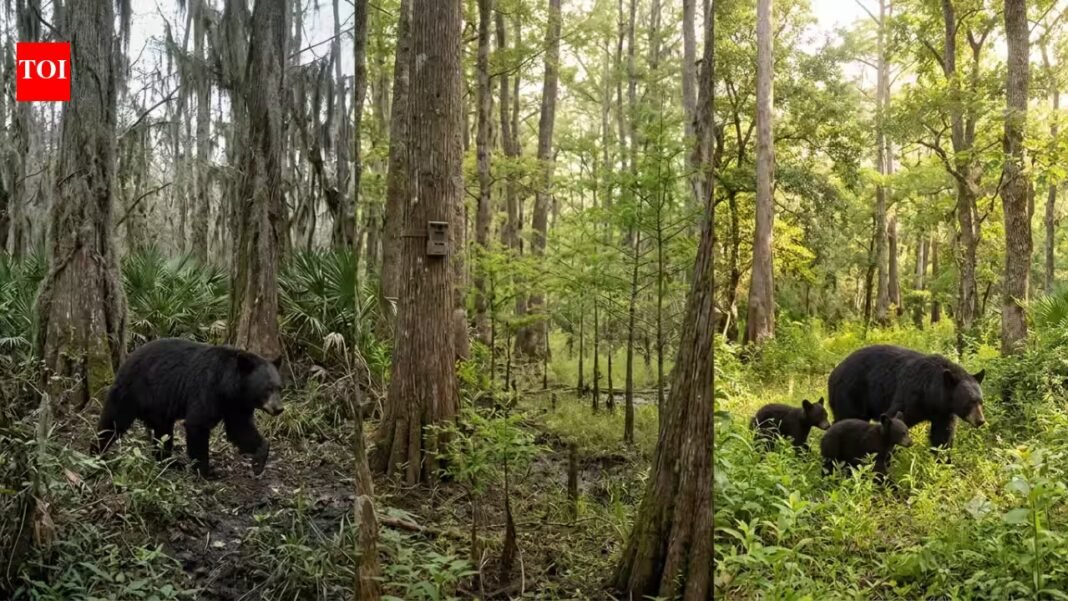
The Louisiana black bear, the animal associated with the origins of the teddy bear, was removed from the US federal list of endangered and threatened wildlife in 2016 after more than two decades of conservation work. When the bear received federal protection in 1992, habitat loss and human-related deaths had left its known breeding populations restricted to a few areas of Louisiana. By the time the recovery decision was announced, the US Fish and Wildlife Service estimated that between 500 and 750 bears lived across the species’ range. The recovery involved state and federal agencies, conservation organisations, universities and private landowners, many of whom helped restore forests on working agricultural land.
Why the Louisiana black bear was listed as endangered in 1992
The Louisiana black bear (Ursus americanus luteolus) was listed under the Endangered Species Act in 1992. Its decline had been linked to the loss and deterioration of suitable habitat, alongside mortality caused by human activity. The remaining known breeding populations were concentrated in bottomland hardwood forests in the Tensas and Upper and Lower Atchafalaya River basins of Louisiana.At the time, the US Fish and Wildlife Service estimated that the population in Louisiana habitat had fallen to as few as 150 bears. The fragmentation of forested areas made recovery more difficult because bears needed connected habitats in which they could move, find food and reproduce.
How forest restoration helped the bear population grow
Much of the Louisiana black bear’s habitat lies on privately owned land. That meant conservation efforts depended heavily on cooperation with farmers and other landowners, rather than relying exclusively on national wildlife refuges or other public property.The US Department of Agriculture and the Department of the Interior worked with Louisiana farmers to restore more than 485,000 acres of bottomland hardwood forest in priority areas. The Department of Agriculture’s Natural Resources Conservation Service used conservation easements and other Farm Bill programmes to help restore land that was difficult to farm. These arrangements allowed landowners to participate in habitat recovery while keeping conservation work connected to the realities of agricultural land use.By the time the bear was delisted, conservation partners had protected or restored more than 750,000 acres of habitat.
How new breeding populations strengthened the Louisiana black bear’s recovery
When the bear was first listed, three known breeding subpopulations remained in Louisiana, in the Tensas and Upper and Lower Atchafalaya River basins. Over the following years, those populations increased and their growth rates stabilised or moved upwards.Additional breeding subpopulations also began forming in Louisiana and Mississippi. Their emergence expanded the bear’s presence beyond its earlier strongholds and contributed to a more favourable assessment of its long-term prospects.The recovery programme combined habitat protection with research into the status of existing populations. Conservation partners worked to establish additional subpopulations and protect the areas connecting them.
Louisiana black bear was removed from the endangered species list in 2016
The US Fish and Wildlife Service proposed removing the Louisiana black bear from the endangered and threatened species lists in May 2015. The proposal followed an assessment that found the recovery criteria in the 1995 Louisiana Black Bear Recovery Plan had been met and that threats to the species had been reduced or eliminated to the required extent.On March 10, 2016, Interior Secretary Sally Jewell announced the decision at Tensas River National Wildlife Refuge in Louisiana. Officials from the Department of the Interior, the Department of Agriculture, Louisiana wildlife authorities and other conservation partners attended the announcement.The Service’s review concluded that the bear was no longer likely to become endangered in the foreseeable future. Its estimate placed the population at between 500 and 750 animals across the current range, compared with as few as 150 in Louisiana habitat when federal protection began in 1992.The delisting was accompanied by a post-delisting monitoring plan. Removing a species from the list does not mean that monitoring and conservation responsibilities end.
Private landowners played a major part in the recovery
The Louisiana black bear’s recovery depended on a broad network of participants. State wildlife agencies in Louisiana, Texas and Mississippi worked alongside federal departments, private landowners, universities and non-governmental organisations.Farmers were particularly important because large portions of the bear’s habitat were outside public reserves. Conservation easements and restoration programmes gave landowners ways to protect forested areas and reconnect habitat without requiring every parcel to become public land.The work also helped shape a wider conservation model. The partnership between the US Fish and Wildlife Service and the Natural Resources Conservation Service contributed to the development of Working Lands for Wildlife, an initiative intended to conserve wildlife habitat on agricultural land across the country.
Why the Louisiana black bear is linked to the teddy bear
The bear has a place in American cultural history because of an incident involving President Theodore Roosevelt during a hunting trip to Mississippi in 1902. Roosevelt refused to shoot a bear that members of his hunting party had trapped and tied to a tree.A cartoon depicting the episode appeared in The Washington Post. The story helped inspire a Brooklyn candy-store owner to create a toy bear known as the ‘Teddy’ bear, using the president’s nickname. The toy became widely associated with childhood, while the Louisiana black bear remained a distinct wild animal native to the American South.
What the bear’s recovery meant for endangered species protection
The US Fish and Wildlife Service described the Louisiana black bear’s return as a conservation success linked to the Endangered Species Act. The law provides federal protection for species at risk of extinction and supports efforts to protect or restore the habitats on which they depend.At the time of the 2016 announcement, the Obama administration said more species had been removed from the endangered species list because of recovery during its tenure than under any previous administration. Examples cited included the Oregon chub, the Virginia northern flying squirrel and the brown pelican.The Louisiana black bear’s case showed how recovery could involve several measures working together: restoring habitat, protecting connections between breeding populations, reducing threats and monitoring changes over time.