





The author is CEO of PaisabazaarRisk is unavoidable when investing in mutual funds. These risks may arise from market fluctuations, interest rate changes or the performance of the underlying assets held by the fund. While mutual funds carrying higher risk may experience greater short-term volatility, they also have the potential to generate higher long-term returns. In fact, funds carrying lower risk usually offer greater stability but may give relatively modest returns. Therefore, your aim as an investor should be to ensure that your portfolio is aligned with both your financial goals and your risk appetite.To help you with the same, here are some practical strategies that you can adopt to manage your mutual fund investment risk effectively:
1. Allocate Assets As Per Your Financial Goals & Risk Tolerance
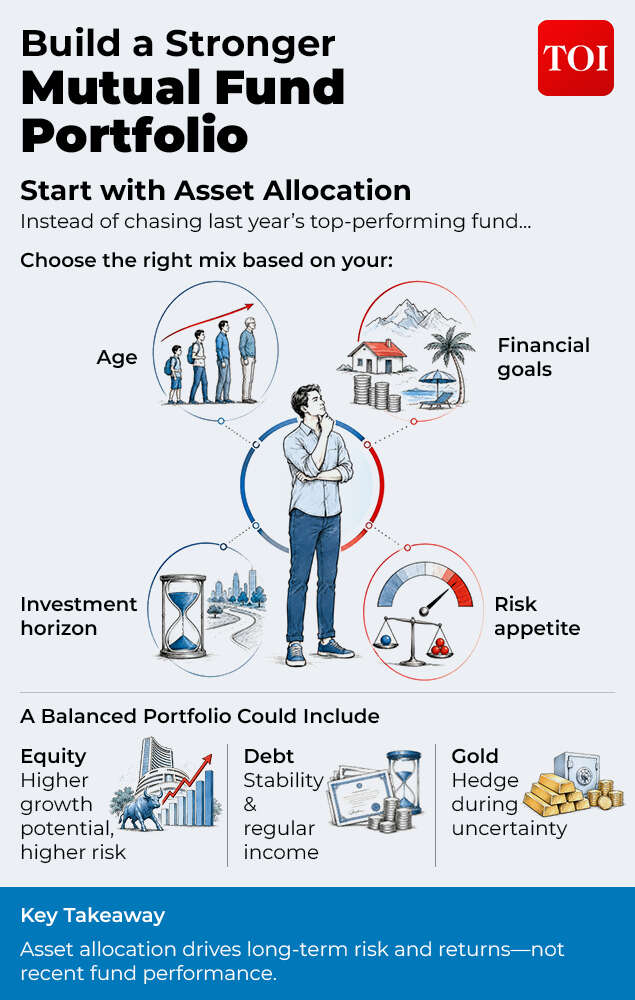
Many investors invest in a mutual fund scheme based on its recent performance. However, a mutual fund generating exceptional returns over the past year may not suit your financial objectives and may even increase your investment risk in the future. To avoid this, it is crucial that you build an investment portfolio based on asset allocation rather than a fund’s recent performance.Asset allocation is where you decide what percentage of your total corpus will be allocated among different asset classes such as equity, fixed income, commodities or cash and equivalents. It aims to balance risk and reward by proportioning an asset as per your financial goals.Moreover, each asset class behaves differently under different market and economic conditions. For instance, equity has potential to generate higher returns in the long-term but is also more volatile than other asset classes. Fixed income investments, on the other hand, exhibit more stability and can help reduce the impact of market fluctuations. Gold often does well during economic uncertainty and therefore, can act as a hedge. By determining the right proportion for each asset class, you can create a portfolio that balances growth opportunities with stability.
Build a Stronger Mutual Fund Portfolio
As there is no rule or formula to arrive at the right asset allocation, investors need to determine the proportion on their own depending on factors like their age, income, financial goals, risk tolerance and investment horizon.For instance, young investors saving for their retirement over the next 25 to 30 years may allocate a larger share or all of their portfolio to equity funds to maximise long-term growth. On the other hand, someone nearing retirement or those whose primary objective is capital protection and who do not want any risk may choose a higher allocation to debt funds and other relatively low-risk investments to preserve capital and generate stable but lower returns.Thus, instead of choosing mutual funds based on their recent performance, you should first determine an asset allocation that suits your needs. Once this allocation is decided, you can diversify by choosing mutual funds within each asset class to build a portfolio that is better positioned to withstand market risks while working toward your financial goals.
2. Diversify Across and Within Asset Classes
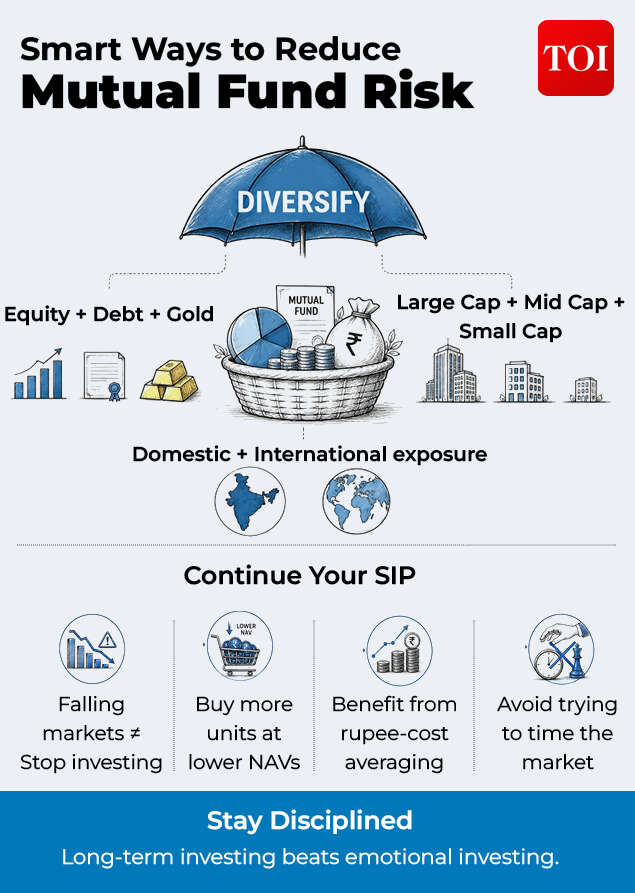
Once you have decided on asset allocation, diversify across and within an asset class as doing so will effectively reduce its dependence on the performance of a single asset class and can improve overall risk-adjusted returns over the long term. So, if your entire corpus is invested in equity funds, consider spreading it across different asset classes, including debt funds, hybrid funds and gold mutual funds or gold ETFs. Doing so is important because different asset classes often react differently to economic events. During periods of market volatility, debt funds may offer relative stability, while gold has historically acted as a hedge against economic uncertainty.Even within an asset class, diversifying across sectors, companies, geographies, etc. is equally important.For instance, within the equity asset class, avoid concentrating large proportions of your investments in a single sector, company or market capitalization. Instead, consider spreading investments across large cap funds, mid cap funds, small cap funds (within your risk tolerance), flexi funds, multi-asset etc. Large cap funds usually offer greater stability during market volatility, whereas mid cap and small cap funds have the potential to generate higher returns but with greater volatility. Maintaining a balanced mix can help reduce concentration risk while allowing participation in long-term market growth.Likewise, allocating part of your portfolio to international markets, especially if you are investing for your child’s higher education abroad, can help you hedge against currency depreciation and provide exposure to global markets, while potentially minimising the risk of a mismatch between your investment returns and future education prices denominated in foreign currencies.Similarly, avoid investing heavily in thematic or sectoral funds as they can be highly cyclical and may underperform for longer periods, unless you have very high conviction.
Smart ways to reduce Mutual Fund Risk
3. Continue SIPs Even During Market Volatility
Market corrections often tempt investors to stop their Systematic Investment Plans (SIPs). However, discontinuing SIPs during falling markets:
- prevents you from benefiting from rupee-cost averaging
- increases the risk of poor investment timing
- reduces the benefits of long-term and disciplined investing
Unlike a lump sum investment, your SIP investments are spread over time. Since you invest a fixed amount at regular intervals, you automatically buy more units when Net Asset Values (NAVs) are low and fewer units when they are high. This is called rupee cost averaging, which helps in reducing the impact of short-term market fluctuations on your purchase cost. While it does not eliminate market risk or guarantee positive returns, it reduces your need for timing the market at all times.Investors today can pick from daily, weekly or monthly SIPs. While monthly SIPs remain the preferred option for most investors, weekly or daily SIPs may suit those with more frequent or irregular cash flows. More frequent SIPs spread investments across a larger number of market levels, which can marginally reduce entry-point risk during volatile periods. However, the difference in long-term returns between daily, weekly and monthly SIPs is usually not significant.The real benefit lies in keeping your contributions consistent. Unless your financial situation has changed, continuing your SIP during a falling market allows you to buy more units at lower prices, positioning your portfolio to benefit when markets recover.
4. Review and Rebalance Your Portfolio Periodically
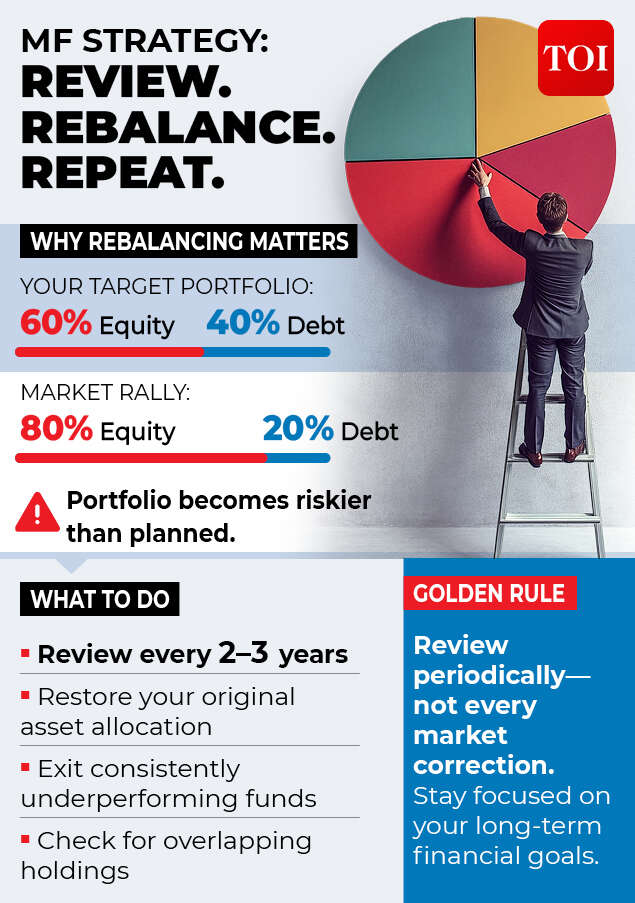
Market movements can change your mutual fund portfolio’s asset allocation, exposing you to a level of risk that may no longer align with your risk appetite and financial goals.Suppose your initial asset allocation was 60% equity and 40% debt based on your financial goals, investment horizon and risk appetite. If equity markets perform amazingly in the next few years, the value of your equity investments may grow much faster than the value of your debt investments, causing your corpus mix to shift to 80% equity and 20% debt without you making any additional investment decisions. While such a shift shows strong equity performance, it also means that your portfolio has become significantly more equity-dominant than originally planned. As a result, your portfolio gets exposed to greater market volatility and downside risk.
The Right MF Strategy
Moreover, with age, your income, risk appetite, financial commitments and goals may change, requiring portfolio adjustments. This is where periodic portfolio reviews and rebalancing become important in meeting financial goals and managing risk.While reviewing it, you check how your portfolio is doing and whether it still reflects your financial goals, risk tolerance and investment horizon. Rebalancing is a corrective step you take to restore your investment portfolio’s original asset allocation. This is done by minimising exposure to overweight asset classes and increasing investments in those that have become underweight over time. In the above example, you may redeem a portion of your equity investments and invest the proceeds into debt instruments to bring your asset allocation closer to the original mix of 60:40.Apart from restoring the desired asset allocation, periodic portfolio reviews also help in identifying funds that have underperformed consistently and unintentional overlap in holdings across funds. Therefore, one must review their portfolios at least every 2 to 3 years. However, avoid making frequent changes based on short-term market movements as doing so can do more harm than good to your portfolio.Mutual fund investments inherently carry risks, but with the help of the aforementioned strategies one can easily manage them. All you need to do is formulate a balanced investment strategy that can withstand market changes while staying aligned with your goals. To avoid investment risks, it is also important to stay invested for a long-term and resist emotion-driven investment decisions during market fluctuations.(Disclaimer: Recommendations and views on the stock market, or any other asset classes or personal finance management tips given by experts and analysts are their own. These opinions do not represent the views of The Times of India.)