



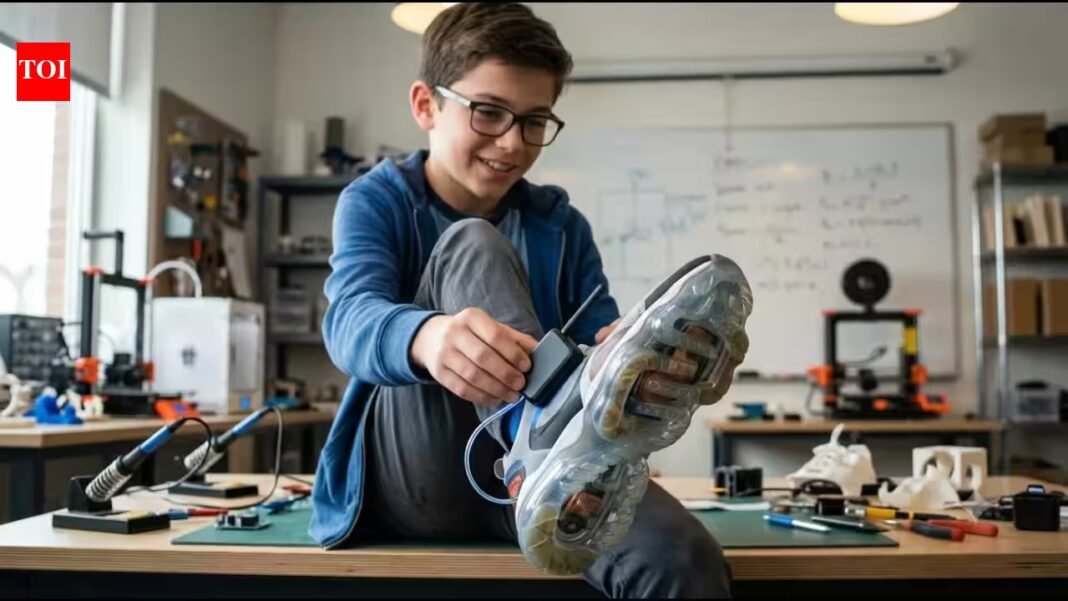
A family hike sparked an idea that has since taken 13-year-old Advaith Atulasimha into the world of engineering. Worried about how someone could be found after getting lost in an area without mobile phone reception, he began exploring a way to power a tracking device without relying on a conventional battery. With guidance from his father, a university engineering professor, and a specialist in piezoelectric technology, he is helping develop a shoe that generates electricity from the pressure of walking. The prototype aims to store enough energy to power a small GPS tracker and send location updates, potentially helping hikers and others who need to be located.
How a 10-year-old’s hiking concern led to an innovative GPS tracking shoe
Advaith was around 10 when the idea first occurred to him. During a hike with his family, the lack of mobile phone reception made him consider the difficulties someone might face if they strayed from the group and could not call for help. They turned back before darkness fell, but the experience left him thinking about how a person could be located in a remote area without a reliable mobile connection.His proposed solution was to build a tracking device that could operate independently of mobile phone networks and generate its own power. Rather than starting with a finished product in mind, he began exploring whether the movement of a person walking could supply enough electricity to run a small electronic device.His father, Jayasimha Atulasimha, was well placed to help him investigate the idea. A professor of mechanical and nuclear engineering at Virginia Commonwealth University (VCU), he has an academic background in engineering research, although his usual work focuses on nanoscale magnets and their potential applications in computing.The project became an opportunity for father and son to work together on a practical engineering problem. Jayasimha provided guidance, while Advaith took on experiments to find out whether the proposed system could work.
How the electricity-generating shoe works
The design uses piezoelectric devices, components that produce an electrical charge when mechanical pressure is applied. Walking provides a repeated source of that pressure, making footwear a possible place to capture small amounts of energy that would otherwise go unused. The principle has been explored by other researchers before. However, generating electricity is only part of the challenge. The amount produced must be sufficient for the intended application, and the energy needs to be stored until the electronic equipment requires it.The shoe does not need to power a phone or other energy-intensive device. It needs to supply enough electricity for a small GPS tracker to transmit occasional location information.Rather than trying to produce a continuous, substantial supply of electricity, the team is working towards a system that collects energy from walking and stores it for intermittent use. The tracker would then be able to send a location update without requiring the wearer to recharge a conventional battery. The work is still at the prototype stage. The concept has progressed beyond an initial idea, but further development is needed before the footwear can be treated as a finished tracking product.
How a young inventor is turning footsteps into electricity for GPS tracking
Advaith has been testing different arrangements and sizes of piezoelectric components to measure how much energy they can generate. These experiments help establish which configurations are suitable for use inside a shoe and whether the resulting electricity can meet the needs of the tracking equipment. He has also been learning how to store the energy produced. A capacitor, an electronic component that holds an electrical charge, forms part of the system. Advaith has been learning to solder the component onto the piezoelectric devices as he works on the circuit.Electricity generated by each step must be collected and retained rather than lost before the tracker can use it. The team is therefore investigating how to prevent the stored charge from leaking away over longer periods.Karla Mossi, a VCU professor and associate chair of mechanical and nuclear engineering, has helped guide the technical work. Her expertise in piezoelectric technology has complemented Jayasimha’s supervision, giving Advaith access to specialist knowledge while leaving him to carry out much of the experimentation himself.As reported by VCU News, Mossi said, “For someone who’s so young, he knows little details – like is this circuit in series? Is it in parallel?”“I thought it was very good to let him go and let him fly. It is his work, and that’s the impressive part because of his age.”Advaith’s work has involved more than assembling components. He has had to test alternatives, interpret what happens during experiments and work through setbacks when a particular arrangement does not perform as expected.
A tracker designed for places without mobile reception
The intended application is particularly relevant to remote areas, where a lost hiker might be beyond the reach of mobile phone towers. A tracking device that can transmit location information through a suitable GPS-based system could help others establish where its wearer is, even when a standard mobile connection is unavailable.GPS can establish a location, but a tracker also needs a way to send the information to an intended recipient. The project is aimed at combining the required electronics with a self-generating power source, although the precise communications system and its capabilities would determine where the finished device could operate.The team hopes the shoes will eventually be able to send location information approximately every 15 minutes, with the two shoes alternating their transmissions. Parents might use location-tracking footwear for young children, while relatives of people experiencing memory loss could use it to help monitor their whereabouts. In each case, the attraction would be a tracker built into something the person already wears, with movement helping to supply its power.
From a school science project towards a commercial product
Advaith’s work has already received recognition. He won an award at the Virginia Junior Academy of Science’s annual science fair, giving the project a platform beyond the university laboratory.The family has also taken steps towards protecting and developing the invention. With assistance from VCU TechTransfer and Ventures, they filed an invention disclosure the previous year. The disclosure gave them a period in which to develop a prototype and explore the technology’s potential.An invention disclosure is an early step in the process of bringing research towards the market.
Bringing the electricity-generating GPS shoe to market
For Jayasimha, the project has also been about teaching his son how research is carried out. His intention has been to offer support while allowing Advaith to take increasing responsibility for the work, from examining technical literature to testing the components and understanding the formal steps involved in disclosing an invention.The experience has introduced the student to tasks that extend beyond science itself. He has had to learn how to approach a technical question, assess different configurations and deal with experiments that do not deliver the expected result. Filing the invention disclosure has also shown him some of the administrative work involved in developing an idea beyond the laboratory.Advaith has spoken about the setbacks encountered during the project and the need to find ways around them. He has also said that working with his father and Mossi has been enjoyable, particularly because the process has given him a chance to learn about both electronics and research.