


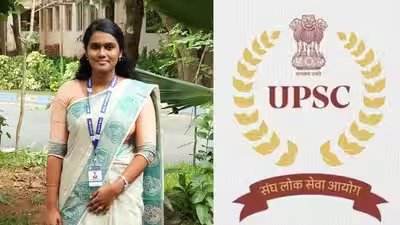
UPSC is not child’s play. It requires months of dedication, perseverance, and sacrifices. However, failure in the UPSC examination is not shocking. For months, an aspirant studies, revises, solves questions, writes answers, and imagines a place on the final merit list. And whenever it comes, it carries a particular kind of silence after an unsuccessful attempt. For Rajeshwari Suve M, that moment came more than once.But instead of allowing those results to close the door on her civil services dream, she returned to the examination table again and again. It took her five attempts to clear the UPSC preliminary examination.Years later, when the results of the UPSC Civil Services Examination 2025 were announced, the story had taken an extraordinary turn. Her name appeared among the country’s top performers.
Rajeshwari Suve M secured All India Rank 2
The journey from repeated setbacks to one of the highest ranks in the country is what makes her story more than another UPSC success story. It is a story about persistence, reinvention, and the courage to continue when success refuses to arrive on schedule.
A childhood in Vadipatti where education mattered
Rajeshwari comes from Vadipatti in Tamil Nadu‘s Madurai district. She grew up in a family where education was not simply something to be completed in school or college. It was part of everyday life. Her father runs a small business, while her mother works as an Associate Professor in a government institution.Conversations about education, society, and public issues were familiar to her. Perhaps that environment planted the first seeds of a larger ambition.The dream of entering the civil services did not emerge overnight. Like many young Indians, Rajeshwari first concentrated on building her academic foundation. She completed her schooling under the Tamil Nadu State Board and gradually developed an interest in how society and governance function.The idea of public service slowly became more than an abstract career choice. It became a possibility.But before she could walk into the world of civil services preparation, she took a very different academic route.
From electrical engineering to the UPSC battlefield
Rajeshwari moved to Chennai for higher education and enrolled at Vel Tech Multi Tech Engineering College, affiliated with Anna University. She chose Electrical and Electronics Engineering and graduated in 2018.Engineering taught her to approach problems differently. Complex questions had to be broken down. Problems had to be examined logically. Solutions required patience.Years later, those habits would become useful in an examination that demands exactly that kind of structured thinking.But engineering was only the beginning. After graduation, Rajeshwari turned towards one of India’s most demanding competitive examinations, the UPSC Civil Services Examination.And that is where the real test began. The fifth attempt changed everything The first attempt did not bring the result she wanted. Neither did the next one.The journey continued. With every unsuccessful attempt came a difficult question: What next?For many aspirants, this is the point at which self-doubt becomes stronger than ambition. The syllabus appears endless, the competition enormous, and another year of preparation can seem emotionally exhausting.Rajeshwari chose another response. She looked at what had gone wrong and worked on it.Her preparation got progressively more polished. There was an emphasis on answer writing. She knew the concepts instead of merely memorizing them. Revision should get more systematized. She needed to manage her time better.Apart from this, she appeared for the Indian Forest Service Examination, where she got further acquainted with the rigorous selection process of the UPSC.Then came the fifth attempt. This time, she cleared the Preliminary Examination. But even clearing prelims was not the destination. It was only the next gate.The Mains examination followed, demanding long-form answers, analytical thinking, and the ability to connect ideas across subjects.Rajeshwari kept going. And eventually, the result arrived.
The result that changed the story
When the UPSC Civil Services Examination 2025 results were declared, years of persistence suddenly acquired a number.AIR 2.The same candidate who had needed five attempts to cross the preliminary stage had now emerged as the second-ranked candidate in the country.It is easy to look at AIR 2 and imagine an uninterrupted road to success. Rajeshwari’s story tells us otherwise.Her rank was not built on one perfect attempt. It was built on the lessons collected from several imperfect ones.
Why Sociology became part of her strategy
Behind every successful UPSC candidate lies a series of choices, and one of Rajeshwari’s important choices was her optional subject.She chose Sociology. The subject examines the structures and forces that shape society, inequality, institutions, social change, culture, development, and the relationship between individuals and communities.For an aspiring civil servant, these are not merely textbook concepts.They appear in the real world every day. A government welfare scheme affects a community. A policy changes social behaviour. Economic development creates opportunities but can also produce inequalities. Education can transform lives while social barriers continue to influence access.Studying Sociology therefore gave Rajeshwari another lens through which to examine the society she aspired to serve.It also offered scope to connect academic concepts with contemporary social realities, an ability that can strengthen preparation across the UPSC Mains papers.
She was already seeing administration from the inside
There was another chapter in Rajeshwari’s journey that made her UPSC preparation particularly distinctive.Before securing AIR 2, she was serving as a Deputy Collector (Training) at the District Collector’s Office in Dindigul, Tamil Nadu.She was therefore not approaching administration only through books and newspaper articles. She had an opportunity to observe it from close quarters.Government schemes have to move from policy documents to people. Administrative decisions have consequences on the ground. Citizens approach government offices with problems that cannot always be reduced to a paragraph in a textbook.This experience offered her a glimpse into that complicated space between policy and implementation.It also brought a deeper meaning to the civil service ambition she had been pursuing for years.
What Rajeshwari’s failures can teach today’s aspirants
Perhaps the most valuable part of Rajeshwari’s story is not the rank. It is the road she travelled before reaching it.For a student who has recently failed an examination, her journey offers a powerful reminder: a failed attempt is an event, not an identity.An aspirant who misses the cut-off can analyse the mistake. Someone struggling with answer writing can practise.A student who cannot finish the syllabus can redesign the study plan. And someone who has lost confidence can begin again.The key is not to repeat the same attempt five times. The key is to make the next attempt different from the previous one.Rajeshwari’s journey reflects precisely that idea. Each setback became an opportunity to examine her preparation and strengthen it.
The lesson hidden behind AIR 2
Competitive examinations often create an obsession with ranks. AIR 1. AIR 2. AIR 100. Cut-offs. Scores. Percentiles.But behind every number is a human story. In Rajeshwari’s case, AIR 2 represents years of study, repeated attempts, professional experience, and the ability to withstand disappointment without abandoning the larger goal.For students sitting at their desks today, her journey carries a message that is perhaps more important than any preparation strategy.You do not have to succeed at the same time as everyone else. Some journeys take one attempt. Others take several.What matters is whether every setback leaves you better prepared for the next opportunity.Rajeshwari started from Vadipatti, pursued engineering in Chennai, entered the demanding world of UPSC preparation, faced repeated setbacks, gained administrative exposure and eventually stood among the country’s top civil services candidates.Her story is therefore not simply about reaching the top. It is about refusing to stop walking.And for thousands of UPSC aspirants still waiting for their own breakthrough, that may be the most inspiring lesson of all.DisclaimerThis article has been prepared using information available in the public domain and is intended for informational and inspirational purposes. Details relating to Rajeshwari Suve M’s education, examination attempts, professional experience and UPSC journey are based on publicly available information and may be subject to change or correction.