





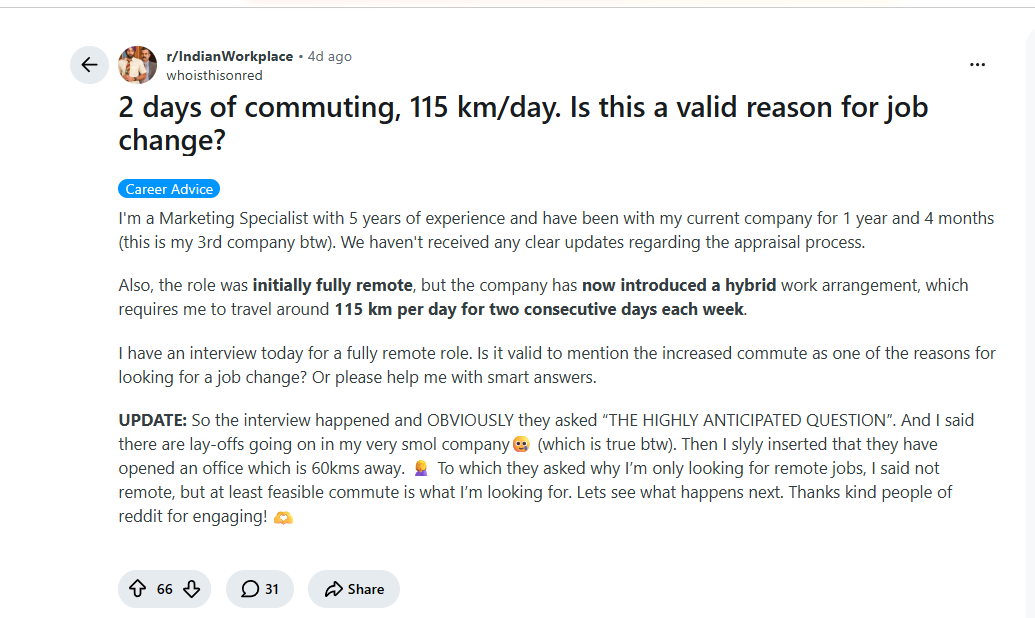
What happens when the job you accepted no longer resembles the one you signed up for? That question has resonated with thousands of professionals after an employee shared an increasingly familiar workplace dilemma online. Hired for a fully remote position, the marketing professional found the arrangement altered after the company shifted to a hybrid work model, turning what was once a home office into a demanding 115-km daily commute for two consecutive days every week.The change has not only added hours on the road but has also forced the employee to rethink career priorities. Combined with uncertainty surrounding appraisals and growth opportunities, the situation has prompted the professional to begin searching for a new role, raising a question many employees grapple with: How do you explain such a decision in a job interview without sounding like you’re running away from inconvenience?
A changing workplace, a changing career plan
The employee, a marketing specialist with five years of professional experience and more than a year at the current organisation, explained on Reddit that the original employment agreement offered complete work-from-home flexibility.That changed when the employer introduced a hybrid attendance policy requiring employees to report to the office on two consecutive days every week. The daily commute, as stated by the employee, is approximately 115 kilometres, resulting in longer travel times, increased costs, and greater fatigue.However, it was not the only issue. The employee also brought up confusion regarding the company’s system of evaluation, leaving no room for speculation about future promotion possibilities. Since there was no certainty regarding either flexibility or future development, the professional decided to look elsewhere for job offers.
Preparing for the interview question everyone expects
Before attending an interview for another fully remote role, the employee turned to an online community for advice.The concern was straightforward but important: Would citing the long commute be viewed negatively by recruiters?Like many job seekers, the employee worried that focusing on travel might make it appear that convenience, not professional ambition, was driving the decision to switch jobs.The employee sought suggestions on framing the answer in a way that reflected practical concerns while still demonstrating commitment to work and long-term career goals.
What happened during the interview
The anticipated question eventually surfaced during the interview. Asked why a new opportunity was being considered, the employee explained that the current organisation had been experiencing layoffs. The employee also mentioned that the recently opened office was located around 60 kilometres away from home, making the commute difficult to sustain.When the interviewer asked why only remote positions were being explored, the employee clarified that the preference was not exclusively for remote work. Instead, the priority was finding an organisation with a practical and manageable daily commute, allowing a healthier work-life balance without compromising productivity.
The internet weighs in
The discussion quickly attracted varied opinions, reflecting the broader debate around hybrid work that continues to evolve across industries.Several users noted that lengthy commutes between Delhi, Gurugram, and Greater Noida have become commonplace for thousands of professionals. From that perspective, they argued, the employee’s travel burden was unfortunate but not unusual in metropolitan regions.Others, however, warned against assuming that a new remote job would necessarily remain remote indefinitely. As more organisations revisit workplace policies, today’s fully remote role could also transition to a hybrid arrangement in the future.One commenter suggested asking prospective employers whether they would be willing to include a contractual clause guaranteeing permanent remote work. On the other hand, hesitation to give such an assurance may be an indication that the organization might eventually reconsider their work model.The second piece of advice was to look at this transition as an opportunity for development and not just for the ease of commuting, urging candidates to show that they are really interested in the organization’s work and not just in location convenience.A third user had yet another approach to the issue, suggesting that two commutes of 115 kilometers per week equal to 900 kilometers monthly, which is equivalent to the average daily commuting of 40 kilometers five times a week.
A growing workplace conversation
This individual’s case is just one in a string of changes taking place in offices all around the world.As companies develop new policies concerning work post-pandemic, many individuals hired through remote means have had to adapt to hybrid expectations. As employers tend to justify the need for going to the office through reasons like collaboration and teamwork, the employees in turn consider if the added effort, cost, and travel make sense for their careers and lifestyles.While there are various other factors involved in a career decision, there is a new trend where it has become essential for a candidate to justify their career moves professionally. While the motive of having more flexibility at work is not something to be ignored, the better way to go about it, according to many recruiters, is to justify the move in terms of sustainable work methods and career growth.This case helps in understanding how career decisions usually have a lot of motives attached to them. Travel, organizational stability, career progression, and the work culture play important roles in every decision we make regarding our career.