



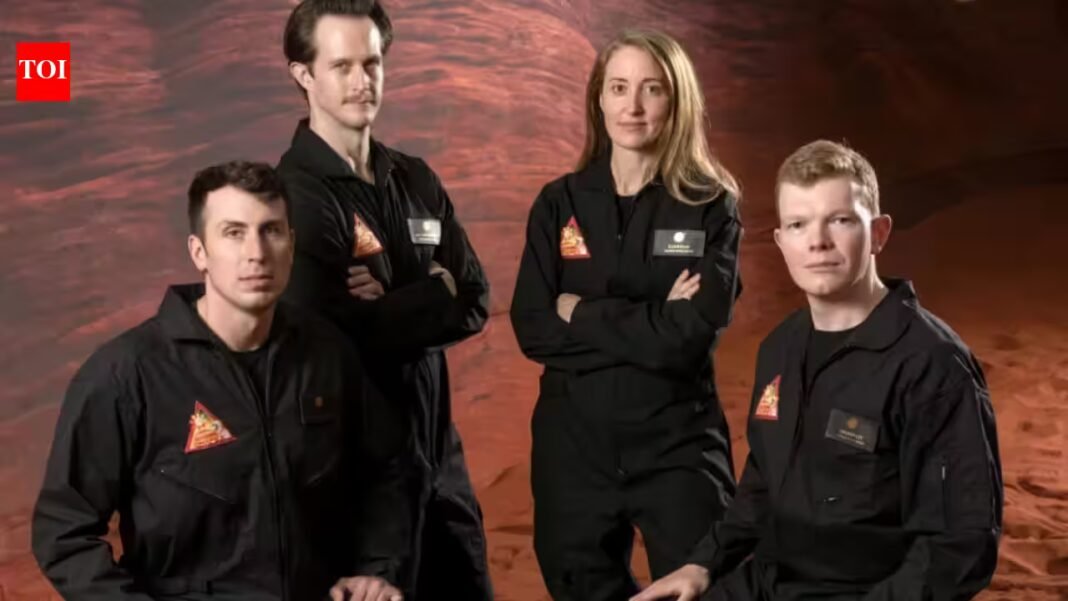
Four crew members who spent 378 days in isolation as part of a simulated mission to Mars have emerged from their habitat at Nasa’s Johnson Space Center in Houston, marking the end of an experiment designed to prepare astronauts for future long-duration missions to the Red Planet.The crew stepped out of the 1,700-square-foot (158-square-metre) 3D-printed habitat on Saturday after spending more than a year living under conditions designed to replicate some of the challenges of a Mars mission.“It’s been a hell of a year, analog astronauts living in captivity of our own free will,” Ellen Ellis, the mission’s medical officer told Reuters, after emerging with her three crewmates.The four members entered the habitat on October 19, 2025, as part of Nasa’s Crew Health and Performance Exploration Analog (CHAPEA) mission.During their stay, they carried out tasks such as growing crops in simulated Martian soil, maintaining the habitat and communicating with Nasa officials through delayed exchanges designed to mimic the time lag in communications between Earth and Mars.The crew comprised mission commander Ross Elder, science officer Matthew Montgomery, flight engineer James Spicer and medical officer Ellis.Elder said the challenges of a human mission to Mars were significant but believed the goal could be achieved.“For Mars, the risks are great,” he said.“But through seeking understanding, strong vision and leadership, creativity, fortitude, hard work and incredible foundation, the goal of putting humans on Mars is not only achievable, but rather inevitable,” he added.Nasa is studying how astronauts adapt to the routines and demands of living beyond Earth for extended periods. The agency hopes the findings will help keep future crews healthy, productive and connected during missions far from home.The crew will now undergo two weeks of post-mission evaluations and debriefings with Nasa scientists.This was the second CHAPEA mission conducted by Nasa. The first four-person crew spent 378 days in isolation between 2023 and 2024.Nasa has been exploring Mars with robotic rovers and orbiting spacecraft, while working towards the possibility of sending astronauts to the planet as early as the 2030s. Before that, the agency plans to return humans to the Moon for the first time since 1972.