



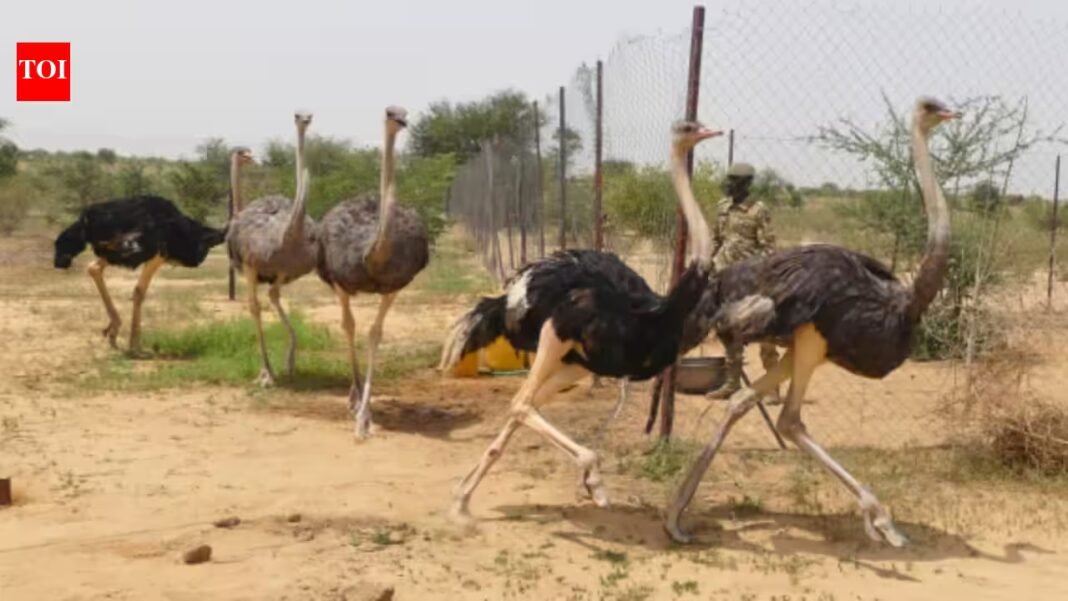
Niger has released eight North African ostriches into the wild, bringing the species back to an area where it had disappeared decades ago. On 2 September 2026, 5 females and 3 males were released into the Gadabedji Biosphere Reserve, marking the first reintroduction of the species there. The move follows years of captive breeding and preparation involving Nigerien authorities, conservation organisations and local communities. Sahara Conservation said the release begins a new phase in efforts to establish a self-sustaining wild population of the North African ostrich in Niger.
Why were North African ostriches released into the wild in Niger
The release is part of a wider effort to restore the North African ostrich to parts of its former range. The species, also known as the red-necked ostrich, once lived across large areas of the Sahara and Sahel. However, its numbers fell sharply because of hunting, egg collection and the loss and degradation of its habitat.Sahara Conservation explains that the species has disappeared from most of its former Sahelo-Saharan range, apart from a few small savanna populations. In Niger, the species became extinct in the wild in 2004. The organisation has been working to produce enough birds through captive breeding so that small groups can eventually be returned safely to natural habitats.The Gadabedji Biosphere Reserve was selected as the starting point for this work because it formed part of the ostrich’s historical range. Sahara Conservation’s September 2026 news release says the reserve had not seen a wild North African ostrich since 1955.

Official ostrich reintroduction ceremony. Image Credit: Sahara Conservation
How the population was prepared for its return
The return to the wild was not the result of a single release. It followed years of breeding, animal care and preparation in Niger.According to Sahara Conservation, the organisation began working with the Saint Louis Zoo, the AZA Struthioniformes Taxon Advisory Group and the Nigerien NGO CERNK in 2007. The partnership helped establish a breeding programme at Kellé in central Niger. Since 2011, Sahara Conservation has managed the site, while training and employing Nigerien staff to care for the birds.A second breeding site at Mainé-Soroa in southern Niger received support from Sahara Conservation from 2017. Improvements at the breeding facilities included better infrastructure, diets, enclosures and animal care. These changes helped increase survival and breeding success.The work also involved moving birds and eggs between breeding sites. This helped maintain genetic diversity and reduce the risk of inbreeding, according to the Kolmården Foundation.
Preparation before the 8 birds were released
Preparation for the Gadabedji release had already begun several years earlier. Sahara Conservation states that its first transfer of North African ostriches to a protected area in Niger took place in 2020, when birds were moved to the Gadabedji Biosphere Reserve with the intention of eventually returning the species to the wild.The Kolmården Foundation reports that 11 ostrich chicks were moved to an acclimatisation pen at Gadabedji in 2021 and 2022. The birds were therefore given time in a controlled environment before the wider reintroduction effort moved forward.At the breeding centres, the birds received regular health checks, while staff monitored their behaviour and access to food and water. Kolmården also says both natural and artificial hatching methods were used to increase the number of surviving chicks. Chick vaccination, including protection against Newcastle disease at Kellé, was another part of the programme.
How will the released ostriches be monitored
The 8 birds released in September form what Sahara Conservation describes as the first founder group. Their release is only an early stage of the wider recovery programme.Teams will monitor the ostriches to see how they adapt to the reserve, survive and move through their new surroundings. Over time, monitoring will also look for reproduction. The goal is not simply to increase the number of birds released, but to establish a population that can survive and reproduce without continued dependence on captive breeding.Before the release, Sahara Conservation and the Gadabedji Protected Area Management Unit also worked with local administrative and traditional authorities to explain the project to nearby communities. Almost 260 people from 9 villages attended information meetings covering the ostrich, its role in the ecosystem, the purpose of the reintroduction and ways people and wildlife can live alongside one another.
A new stage in Niger’s wildlife recovery
The release gives the North African ostrich a new opportunity to occupy part of its former habitat in Niger. Kolmården says the species is currently found in Cameroon, the Central African Republic, Chad, Senegal and Tunisia, while Niger lost its last wild bird in 2004.Niger has had a national strategy for conserving the North African ostrich since 2016. Kolmården says the strategy includes breeding birds with the eventual goal of releasing them into the wild. At the time described on its project website, 3 breeding centres held around 50 ostriches in the country.Sahara Conservation said the longer-term aim is to build a viable wild population in Gadabedji that can contribute to restoring the species across its historical range in Niger.