



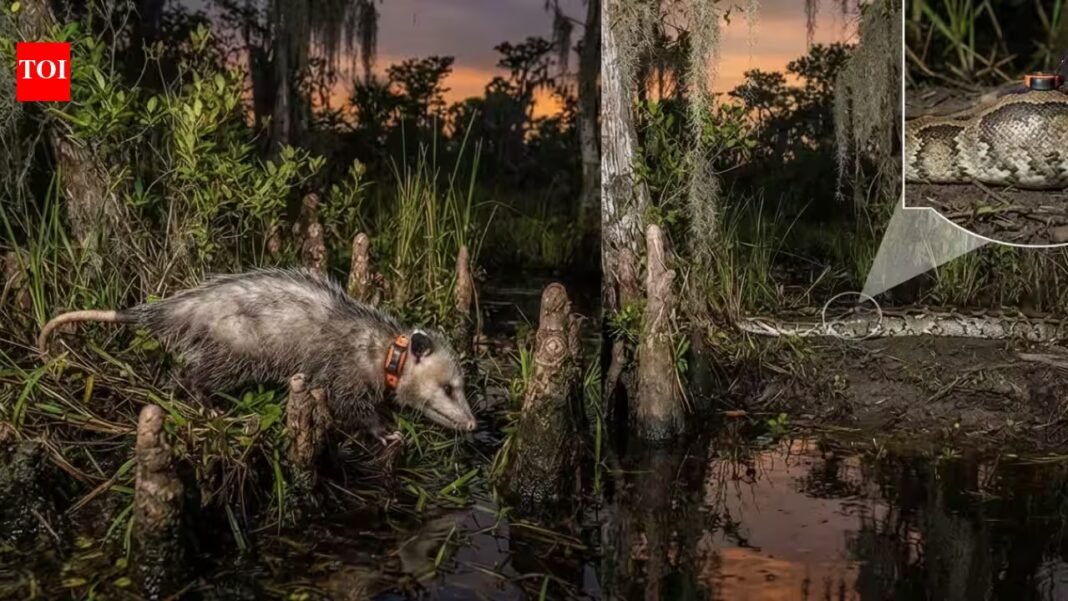
Opossums fitted with GPS collars are helping wildlife researchers in Florida track an animal that is notoriously difficult to find. The collars were originally meant to follow the movements of small mammals, but scientists noticed something unusual while examining the location data. Some devices stopped moving for hours before turning up at a different location. The explanation was unexpected. Burmese pythons had swallowed the opossums, carrying the still-functioning collars inside their bodies. Researchers are now using these signals to follow the invasive snakes through the Everglades, where their growing population has affected several native wildlife species.
How GPS collars turned into an unexpected python-tracking tool
In 2022, scientists studying the movements of small mammals along Florida’s southern coast placed tracking collars on opossums and raccoons. The devices were intended to record where the animals travelled and how they used their surroundings.The data began revealing an unusual pattern. Occasionally, a collar would remain in one place for hours before moving again. Rather than indicating that the animal had recovered from a period of inactivity, the change suggested that something had happened to it. Scientists realised that some of the collars were still transmitting after their original wearers had been eaten by Burmese pythons.Since these snakes swallow their prey whole, the tracking equipment can remain inside their digestive systems and continue sending location signals. What began as a way to understand small mammal behaviour had developed into a method of finding an elusive predator.
How GPS collars help scientists locate pythons after they swallow opossums
The collars offer scientists a way to follow Burmese pythons without having to spot the snakes themselves. When an opossum remains in the same place for more than four hours, the team gets an alert. This could mean the animal has been killed. If the collar begins moving again, there is a possibility that a python has swallowed the opossum and carried the device away. Researchers can use the new location readings to follow the snake and work out where it has gone.The approach also takes advantage of the relatively slow digestive process of Burmese pythons. The tracking equipment does not immediately stop functioning after the animal is eaten, giving scientists time to identify the snake’s movements and reach the area. Once located, the python is euthanised as part of the invasive species control effort. The collar can then be recovered, cleaned and prepared for use again.
Scientists expand the programme as tracking costs fall
As reported by The Washington Times, biologists A.J. Sanjar and Michael Cove, who work at the Crocodile Lake National Wildlife Refuge in Key Largo, have helped develop the programme since its early discovery. The project has become easier to expand as the price of the tracking equipment has fallen.Earlier collars cost approximately $1,500 each. Their price has since dropped to around $190, making it possible for the team to fit more animals with the devices without the same financial burden. Researchers have equipped 32 opossums so far and are aiming to increase that number to at least 40 by the summer of 2026, as reported.The programme is particularly relevant in areas where pythons are difficult to spot.
Why Burmese pythons are a growing concern in the Everglades
Burmese pythons are native to South and Southeast Asia but have established a breeding population in South Florida. Their presence has become a major concern for wildlife managers because they prey on a wide range of native animals, including mammals and birds.The snakes are particularly difficult to control because of their size, ability to remain hidden and capacity to consume relatively large prey. Their expansion has coincided with sharp declines in several mammal populations across parts of the Everglades.A 2012 study published in the Proceedings of the National Academy of Sciences, titled ‘Severe mammal declines coincide with proliferation of invasive Burmese pythons in Everglades National Park’ documented sharp declines in sightings of several mammals in Everglades National Park. Nocturnal road surveys recorded a 99.3% drop in raccoon observations, a 98.9% decline in opossum sightings and an 87.5% fall in bobcat observations between the pre-2000 period and 2003–2011. The researchers found that these animals were more frequently encountered in areas where Burmese pythons had only recently appeared, suggesting a link between the snakes’ spread and the decline in native mammals.The impact is not limited to the animals that pythons eat. The disappearance of medium-sized mammals can affect other parts of the food web, changing the availability of prey for native predators and disrupting ecological relationships that developed over long periods.In Key Largo, biologists began documenting the presence of Burmese pythons in 2007. Their growing numbers have since been accompanied by declining observations of native mammals, including opossums, woodrats and cotton mice.
Florida’s Burmese python problem dates back to the first sighting in 1979
Burmese pythons have been present in South Florida for decades. One of the earliest recorded wild sightings in the region dates to 1979, when a snake was reported in Everglades National Park. Their population subsequently became established, with the animals spreading into additional parts of the state’s southern landscape. The scale these reptiles can reach has added to the difficulties faced by wildlife teams. In 2022, a biologist working with the Conservancy of Southwest Florida captured an 18-foot-long python weighing approximately 215 pounds near Naples. It was reported as the heaviest Burmese python captured in Florida at the time.A longer specimen was captured in July 2023, measuring more than 19 feet. Such examples demonstrate why locating individual snakes can be challenging, particularly when they are moving through areas with thick vegetation and limited visibility.The US Geological Survey has documented the continued expansion of Burmese pythons across southern Florida, including Everglades National Park and Big Cypress National Preserve. The snakes have also been associated with the introduction of harmful non-native parasites, adding another concern for native wildlife.
Are GPS-collared opossums being put at risk to help catch Burmese pythons
Using opossums as part of a tracking system has attracted criticism because the animals can be eaten by the very predators scientists are trying to locate. The programme relies on the natural relationship between Burmese pythons and their prey, but fitting an animal with a GPS collar means researchers can follow the consequences of that interaction.Scientists involved in the work have maintained that the project does not deliberately introduce opossums into dangerous situations. The animals are already part of the Everglades food web, where Burmese pythons hunt them naturally. As reported by The Washington Times, Jeremy Dixon, manager of the Crocodile Lake National Wildlife Refuge, has explained the distinction between creating a threat and documenting an existing one.“We’re not putting these animals out there and in harm’s way,” Dixon said. “Harm’s way is there. We’re just documenting what’s happening.”