



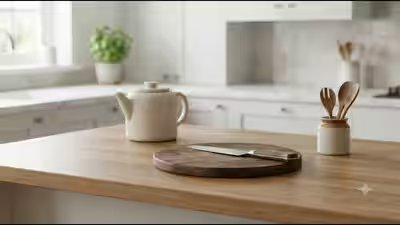
Think of a Sunday morning in a kitchen where the counter is bare except for a kettle and a chopping board. Then think of the same morning with a toaster, three jars, a fruit bowl, a pile of post and a half-read newspaper. The recipe is identical, but the mood isn’t. Psychologists have been studying why for years, and the answer says a lot about how people cook.
The brain notices more than it admits
A 2011 study from the Princeton Neuroscience Institute found that objects in view compete for attention in the brain’s visual system, and that clutter can make it harder to focus. Nobody consciously reads every item on a counter, yet the eyes keep taking them in. A clear surface gives the mind fewer things to sort, which many people experience as relief.
Calm is not the same as empty
Open counters don’t have to mean a cold, showroom kitchen. William Morris, the designer, advised having nothing at home that isn’t useful or believed to be beautiful. Dieter Rams, the German industrial designer, put it as “less, but better.” Both ideas are about choosing carefully, not owning nothing. A single wooden spoon jar can feel warmer than a dozen gadgets.
Stress can hide in the mess
A 2010 study by UCLA researchers Darby Saxbe and Rena Repetti looked at how women described their homes. Those who used words like “cluttered” or “unfinished” tended to show a flatter daily drop in the stress hormone cortisol than women who described restful spaces. The sample was small and the link isn’t proof of cause. Still, it suggests that a home’s look and a person’s stress may be tied together.
How organisation shapes cooking habits
Professional chefs call it mise en place, meaning everything in its place before cooking starts. A home kitchen can borrow the idea. When the board is within reach and the counter is free, chopping an onion takes no preparation first. Cooking from scratch can then feel doable on a tired Tuesday, when a takeaway menu might otherwise win. Space helps in a practical way too, because spills, hot pans and sharp knives are easier to manage with room to work.
A small experiment worth trying
Everything on the counter that hasn’t been used this week can be put away for seven days. What stays out is what the household really uses. Many people find the kitchen feels different within a few days, and the exercise shows which items earn their spot.Open counters won’t suit everyone. Some people feel more at ease when favourite things are in sight, and that preference is just as valid. The point is that a kitchen works best when it matches how its owner thinks and cooks.Disclaimer: This article is for general information and reflects broad findings from psychology and design. Individual responses to home environments vary, and nothing here is professional or medical advice.