



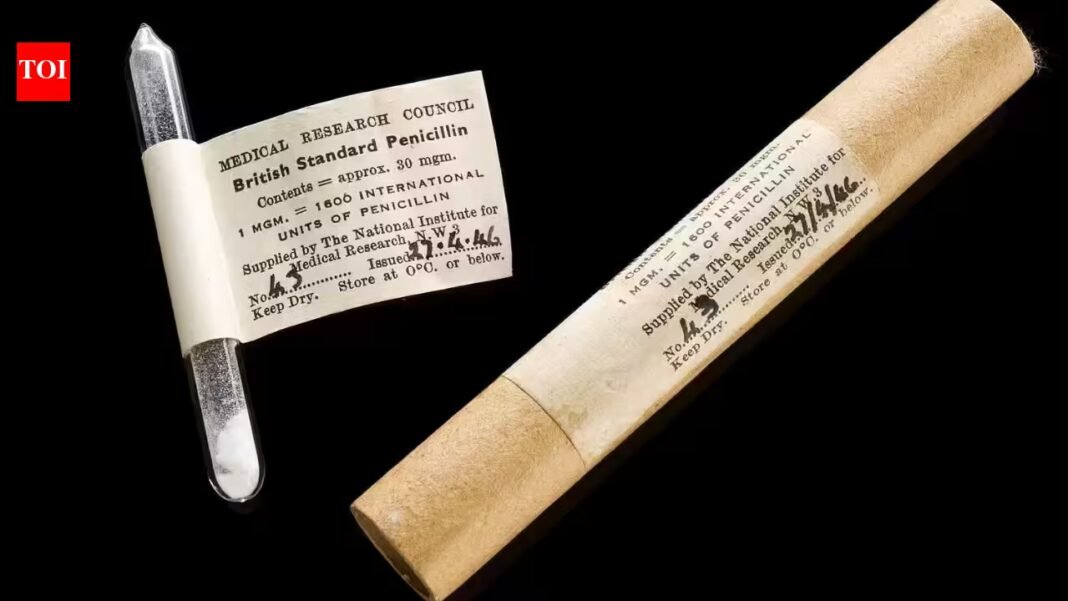

The discovery of penicillin transformed modern medicine, but scientists have continued to investigate how nature builds the antibiotic’s essential chemical structure. Researchers from the University of Oxford and international collaborators have now captured previously unseen stages in the process that produces penicillin.The team captured the reaction with ultrafast X-ray free-electron laser experiments, observing how an enzyme called isopenicillin N synthase (IPNS) converts a linear peptide substrate into the ring system that forms the core of penicillin.According to research titled ‘Unanticipated intermediates during isopenicillin N synthase catalysis identified by time-resolved X-ray free-electron laser studies’, published in Nature Catalysis by University of Oxford-led researchers, the findings resolve a long-standing question about this complex chemical reaction.
How scientists captured the hidden stages of penicillin formation
Researchers captured several stages of the reaction that forms penicillin’s structure. The enzyme IPNS converts a linear peptide substrate into the ring system found in penicillin. Among the observed stages was a thioaldehyde intermediate, formed just before the β-lactam ring appears.The team also captured a monocyclic β-lactam, the first ring-shaped structure on the path towards the penicillin scaffold. These stages had been too difficult to observe. The findings provide the clearest picture yet of how IPNS assembles the penicillin scaffold and resolve a mechanistic question that had remained unanswered for more than four decades.
How ultrafast X-ray experiments recorded the molecular movie
The researchers used ultrafast X-ray free-electron laser (XFEL) experiments to follow the reaction in real time, rather than relying only on static X-ray crystallographic structures. They placed tiny droplets containing anaerobic enzyme microcrystals onto a moving tape measuring 2 millimetres wide. As the tape entered a chamber filled with oxygen, the gas rapidly diffused into the crystals and started the reaction across the sample.By carefully controlling the tape’s speed, the team determined how long each crystal reacted before reaching the point where it was exposed to an XFEL pulse. Each pulse recorded an atomic-resolution snapshot. The researchers combined thousands of snapshots to reconstruct the reaction frame by frame, capturing intermediates that exist for only tiny fractions of a second.
Molecular movie reveals the role of water in penicillin formation
The molecular movie showed that water molecules inside the enzyme help guide the reaction. Subtle movements throughout IPNS help direct the chemical steps, showing that its shape and chemistry work together during penicillin formation with remarkable precision. The researchers could connect enzyme motion, iron chemistry, and water-mediated proton transfer by capturing structural snapshots over milliseconds to seconds of reaction time.The experiments also allowed the team to observe the reaction at atomic resolution under physiological temperature and pressure. These details provide a richer view of how IPNS controls a difficult chemical transformation.
Why the findings matter for future antibiotic development
Penicillin was developed into a clinically useful antibiotic at Oxford during the Second World War by Nobel Prize-winning scientists Howard Florey and Ernst Chain, and colleagues. In 1945, Oxford chemist Dorothy Hodgkin first solved penicillin’s structure using X-ray crystallography.The study builds on that history while examining how nature constructs the antibiotic’s β-lactam ring. This ring interferes with bacterial cell wall synthesis, causing the wall to fail and bacteria to die. The study may also have relevance beyond antibiotics because IPNS belongs to a large family of iron-dependent oxygenase enzymes involved in human biology, including processes that allow the body to sense and respond to changes in oxygen availability.