



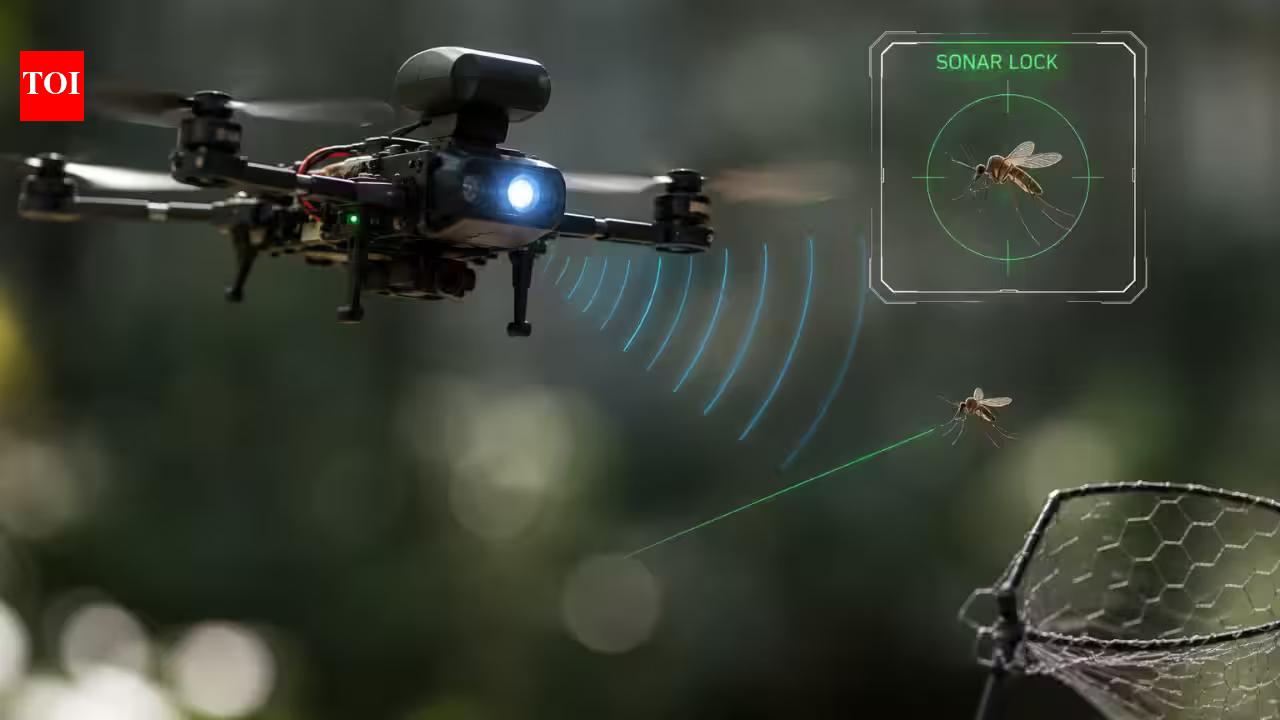
Mosquitoes are among the world’s deadliest animals, spreading diseases such as malaria, dengue, Zika and yellow fever that affect hundreds of millions of people every year. While traditional mosquito control relies on insecticides, bed nets and habitat management, researchers are now exploring a high-tech alternative. An experimental autonomous drone uses ultrasonic phased-array sonar, artificial intelligence and real-time flight control to detect mosquitoes in mid-air, identify them using their unique wingbeat signatures and intercept them without using chemical sprays. Although the technology is still in development, it could eventually become a new tool for controlling disease-carrying insects in homes and regions where mosquito-borne illnesses remain a major public health challenge.
How ultrasonic sonar allows the drone to detect mosquitoes
Unlike conventional drones that depend on optical cameras, Tornyol’s system is built around ultrasonic phased-array sonar, the same physical principle used in bat echolocation, but implemented using modern electronics.The drone emits ultrasonic pulses through an array of transmitters. These sound waves reflect off nearby objects and flying insects before being captured by hundreds of highly sensitive MEMS microphones. The returning echoes are processed in real time using custom digital signal processing (DSP) algorithms and an onboard FPGA processor to construct a three-dimensional map of the surrounding environment.According to the developers’ official technical information, this phased-array sonar system enables the drone to detect insects even in darkness or poor lighting, conditions where conventional camera-based vision systems often struggle. As reported by AOL, the prototype uses this acoustic sensing approach to continuously monitor the air around it while searching for airborne targets.
Every mosquito has its own wingbeat ‘fingerprint’
One of the technology’s most innovative features is that it does not identify insects by appearance. Instead, it analyses the acoustic signature created by rapidly beating wings.Every mosquito species generates a characteristic wingbeat frequency and harmonic pattern. By combining Doppler analysis with artificial intelligence, the system can distinguish mosquitoes from many other flying insects and is designed to identify specific targets before pursuing them. This selective detection could allow the technology to avoid indiscriminately targeting beneficial insects, making it more precise than many conventional pest-control methods.
Hunting mosquitoes without insecticides
Once the onboard software confirms a mosquito’s location, the drone calculates its flight path and autonomously moves to intercept it.Rather than using pesticides, lasers or electric grids, the drone eliminates mosquitoes through direct physical interception using its rapidly spinning propellers. According to AOL, the developers have already demonstrated successful autonomous interceptions of flying insects during prototype testing, marking an important step towards creating an automated mosquito-hunting system.Because the technology relies on mechanical interception instead of chemical insecticides, researchers believe it could complement existing mosquito-control strategies while reducing concerns over pesticide resistance and environmental contamination.
Could this technology help reduce mosquito-borne diseases ?
The long-term goal is to deploy autonomous drones capable of patrolling homes, gardens and, eventually, malaria-endemic regions where mosquitoes remain a major health threat.However, the technology is still experimental. While early demonstrations have shown that the sonar-guided system can detect and intercept flying insects under controlled conditions, scientists have not yet demonstrated that fleets of autonomous drones can significantly reduce mosquito populations or lower disease transmission in real-world environments.Large-scale field testing, independent scientific validation and regulatory approval will all be required before such systems can be used as part of public health programmes.
A new frontier in precision pest control
The sonar-guided drone represents an emerging approach to insect control that combines robotics, acoustics and artificial intelligence. Instead of relying on broad-spectrum insecticides, it seeks to identify individual mosquitoes in flight and eliminate them with remarkable precision.If future trials prove successful, the technology could offer a new, environmentally friendly addition to existing mosquito-control measures. While it is unlikely to replace conventional methods entirely, it demonstrates how advances in autonomous systems are opening new possibilities in the global effort to combat mosquito-borne diseases.