



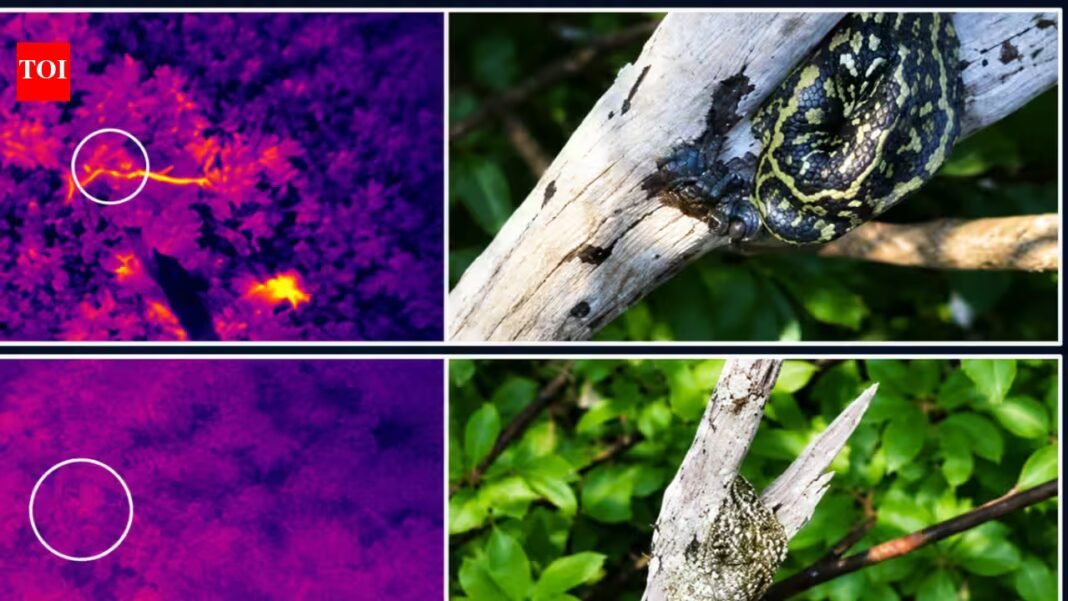
Scientists have used thermal-imaging drones to detect snakes hiding high in Australian forest canopies for the first time, recording 20 sightings of carpet pythons and green tree snakes across three different forest systems in eastern Australia. The research, published in the journal Australian Zoologist on August 13, 2026, demonstrates how aerial thermal technology could help scientists locate reptiles that are difficult to observe through conventional ground-based surveys. Researchers used drones equipped with infrared cameras to identify temperature differences between the snakes and surrounding vegetation. The findings offer a new approach to studying arboreal reptiles, providing opportunities to investigate their behaviour, habitat use and distribution in forest environments that are often difficult for researchers to access.
Thermal drones detect snakes in three forest systems
The study, titled Thermal drone detection of cryptic arboreal snakes across rainforest and sclerophyll canopies in eastern Australia, covered tropical rainforest, subtropical rainforest and sclerophyll forest environments. Researchers recorded sightings of two species: carpet pythons (Morelia spilota) and green tree snakes (Dendrelaphis punctulatus).The surveys were conducted across locations in Queensland and New South Wales. In Queensland, researchers flew drones over a 30-hectare rainforest area in the Atherton Tablelands, conducting three hours of afternoon surveys. The canopy generally reached heights of 20 to 30 metres, with some taller trees extending to approximately 40 metres.The drones detected snakes at distances ranging from 15 to 90 metres. In New South Wales, additional nocturnal surveys conducted between 2022 and 2025 recorded carpet pythons resting in elevated positions within forest canopies.
How infrared cameras identified cold-blooded snakes
The technology works by detecting infrared radiation and identifying differences in temperature between objects. However, locating snakes through thermal imaging presents a particular challenge because they are ectothermic animals, meaning their body temperatures depend largely on external environmental conditions.Unlike mammals, snakes do not maintain a consistently elevated internal body temperature. Researchers found that larger carpet pythons could nevertheless appear warmer than surrounding vegetation because of their thermal inertia. Their substantial body mass and relatively low surface-area-to-volume ratio allow them to retain heat for longer than leaves and branches.During the Queensland surveys, detected snakes were between 2.2°C and 5.5°C warmer than the surrounding vegetation. This temperature difference allowed researchers to distinguish their thermal signatures against the forest canopy.The team used DJI Matrice 4TD and DJI Matrice M30T drones, both equipped with thermal imaging cameras. High-resolution visible-light cameras and spotlights were also used to examine potential sightings and confirm the identity of the animals.
Pythons spotted resting in tree hollows and ferns
Among the observations, researchers recorded 11 carpet python detections and one green tree snake detection during the Queensland surveys. They identified five individual carpet pythons and one individual green tree snake through distinctive body patterns and GPS positions.One carpet python was discovered resting inside a staghorn fern (Platycerium bifurcatum), a plant that grows on tree trunks and branches. Other snakes were observed resting on canopy leaves and branches, demonstrating the variety of elevated locations they occupy.The New South Wales surveys also produced interesting observations of carpet pythons resting near the tops of trees and inside tree hollows. Seven detections involved snakes in coiled positions within or just below the canopy.One particularly notable observation took place on September 30, 2025, at approximately 10.15 pm. Researchers detected two carpet pythons inside a hollow in a living scribbly gum eucalyptus tree, around six metres above the ground. An estimated 50% to 70% of their bodies were visible outside the hollow, while the remaining portions were concealed inside.The researchers observed the two snakes appearing intertwined. During approximately one minute of observation, the larger individual briefly turned its head towards the hollow’s entrance and made contact with the other snake’s snout.
Weather conditions influenced snake detection
The researchers found that environmental conditions played an important role in determining whether the drones could identify snakes. Temperature differences between reptiles and surrounding vegetation changed throughout the day, influencing the visibility of their thermal signatures.In one series of observations involving a carpet python, the animal had no distinguishable thermal signature during early morning observations. Later, it appeared warmer than the surrounding vegetation, with recorded temperature differences of 2.2°C and 2.5°C on separate occasions.The researchers suggested that solar heating followed by the cooling of vegetation could create favourable conditions for thermal detection. Overcast weather could also help because vegetation loses heat relatively quickly when solar radiation decreases, while larger snakes may retain warmth for longer.These findings indicate that the timing of drone surveys and prevailing weather conditions can influence the likelihood of detecting arboreal reptiles.
Technology could help scientists monitor threatened reptiles
The researchers said thermal drones could provide a valuable tool for studying reptiles that are difficult to locate through conventional wildlife surveys. Many arboreal species spend considerable time in elevated vegetation, tree hollows and other inaccessible locations, making population monitoring challenging.The study highlighted the potential application of the technology to the pale-headed snake (Hoplocephalus bitorquatus), a species listed as Vulnerable in New South Wales. These snakes are associated with hollow-bearing trees, making the ability to inspect elevated habitats particularly relevant to their conservation.The technology could also help researchers investigate how reptiles use different forest environments, identify important habitat features and monitor species that are rarely observed from the ground.The authors suggested that future research should examine how factors such as snake size, canopy density, survey altitude, weather and seasonal conditions affect detection success. They also identified improvements in thermal sensors and the use of machine-learning systems as possible ways to enhance the identification of smaller reptiles.