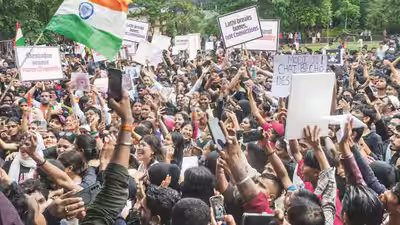



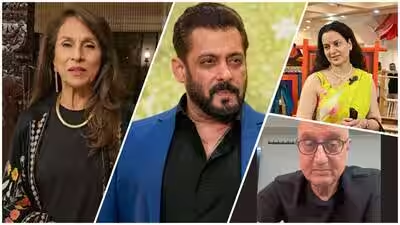

Author and columnist Shobhaa De has sparked a fresh debate with her latest column, where she criticised Bollywood’s response to the Cockroach Janta Party (CJP) protests and questioned whether celebrities still understand the mood of India’s Gen Z audience.In her piece published in ThePrint, De specifically addressed Salman Khan‘s social media message to activist Sonam Wangchuk, while also taking aim at comments made by Kangana Ranaut, Hema Malini and Anupam Kher during the youth-led movement. She argued that several Bollywood personalities appeared disconnected from the concerns and language of a generation that has found its own way of expressing dissent.
Shobhaa De on Salman Khan’s Sonam Wangchuk post
Salman Khan was among the Bollywood celebrities who spoke about the CJP protests over the alleged NEET-UG paper leak. After expressing support for students demanding accountability, the actor later appealed to Sonam Wangchuk to end his hunger strike after assurances from the government.Sharing a message for Wangchuk, Salman wrote, “Sonam, it’s done bro. Don’t extend this. Keep the spirit for another day if there is a need, which I doubt, and eat something. If u want, I will send u food from home. Students please go back to your homes and to your parents. The PM has said whoever has done wrong will be punished…”Reacting to the post, Shobhaa De said the gesture failed to connect with Gen Z.“Ditto with Salman Khan. Calling Sonam Wangchuk ‘Bro’ and offering him a home-cooked meal from the Khan kitchen to break his fast attracted widespread derision, not praise,” she wrote.She added, “Maybe Salman thought he was being ‘cool’. But Gen Z rewrote the definition of ‘cool’. And this cringe message was anything but.”
‘Bollywood has never looked this uncool’: Shobhaa De
De further criticised Bollywood’s overall response to the protests, claiming that many stars appeared to be out of touch with the younger generation.“Bollywood has never looked this ‘uncool’. This irrelevant,” she wrote.She alleged that some celebrities entered the conversation only after assessing the wider public reaction, describing their posts as “ChatGPT-scripted”. De also wrote that the same stars who depend on young audiences for their films struggled to understand the generation they were addressing.“The very stars whose box-office fortunes depend on Young India suddenly woke up, only to be met with mockery,” she wrote.
De reacts to Kangana Ranaut’s comments on protesters
Kangana Ranaut also faced criticism from De over her remarks about the CJP protesters. The actor-politician had shared multiple Instagram Stories criticising the demonstrations and questioning the behaviour of some participants.Kangana described some protest videos as “puke-inducing” and accused protesters of displaying what she called “ugliness” and “filth”. She later referred to a section of young women as “Generation Gutter” while commenting on their choices and lifestyle.Responding to Kangana’s remarks, De wrote, “While Kangana Ranaut—just this side of ‘Aunty’ status—lost the few Gen Z fans she still possessed with her tasteless remarks.”
Hema Malini and Anupam Kher also mentioned
Apart from Salman and Kangana, De also referred to veteran actors Hema Malini and Anupam Kher while discussing Bollywood’s response to the movement.She suggested that the reactions from senior celebrities reflected a wider generational gap between established public figures and young protesters.
‘Celebrities need Gen Z more than Gen Z needs them’
Summing up her views, De said Bollywood stars should recognise the changing relationship between celebrities and young audiences.“The thing to understand is this: Gen Z does not need celebrity endorsements or heroes. It’s the reverse. Celebrities need Gen Z,” she wrote.She added that Gen Z has created its own style of activism, one that combines protests with humour, creativity and social media storytelling.The CJP protests, which began over the alleged NEET-UG paper leak, later expanded into a wider movement around education reforms and accountability. The agitation included marches, sit-ins and Sonam Wangchuk’s hunger strike, making it one of the most discussed youth movements in recent times.