




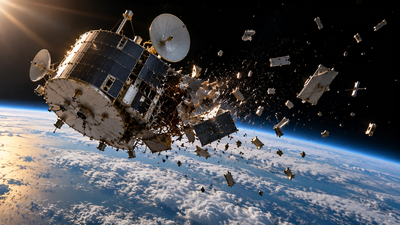
A US Cold War-era spy satellite launched in 1988 to collect electronic intelligence has broken apart in low Earth orbit after nearly four decades circling the planet. Catalogued as USA 32 and identified by analysts as FARRAH III, the spacecraft fragmented on September 13, 2026, at an altitude of about 775 kilometres. US Space Forces-Space confirmed the fragmentation but gave no cause. The satellite was launched on September 5, 1988, aboard a Titan II rocket as part of a National Reconnaissance Office programme designed to gather signals intelligence, including information from Soviet radar systems.
Spy satellite built for Cold War intelligence
USA 32 belonged to the FARRAH series of signals-intelligence spacecraft. Declassified National Reconnaissance Office documents show the programme was designed to detect and analyse radio-frequency emissions across the 2 to 18 GHz range, gathering information about radar and other electronic signals for military users. FARRAH III belonged to a later, larger generation of the programme. It carried a tactical onboard processor and could downlink data directly to users, including mobile ground stations, ships and aircraft, extending a capability the earlier FARRAH satellites had already developed. Space Force’s confirmation referred only to USA 32. The link to FARRAH III and the signals-intelligence mission comes from declassified NRO material as reported by The Space Review.
Why it was called FARRAH III
According to The Space Review, the programme’s managers chose to name the satellites after actresses to avoid hinting at their missions. FARRAH is widely reported to refer to Farrah Fawcett, though the primary documents do not spell this out. Earlier satellites in the family, including RAQUEL and URSALA, followed the same tradition. FARRAH III weighed more than 1,360 kilograms, compared with about 340 kilograms for FARRAH I and II, and had a squat cylindrical shape that has been likened to a large tuna can. It was spin-stabilised, rotating at about 50 revolutions per minute, and carried three high-gain dish antennas covering different frequency bands, along with several other antennas.
Launched on a Titan II rocket in 1988
USA 32 was launched from Vandenberg, California, on September 5, 1988, on a Titan II launch vehicle. It was assigned catalogue number 19460 and international designator 1988-078A. FARRAH III was apparently designed with a nominal lifetime of about three years, yet it remained in orbit for decades. No details have been released about when it stopped operating. It was observed still spinning in orbit in 2021, suggesting it may have remained functional far longer than planned.
The breakup happened on September 13
The fragmentation occurred at approximately 21:13 UTC on September 13, 2026. US Space Forces-Space said all tracked debris was being incorporated into routine conjunction-assessment screening, which is used for spaceflight safety, and that no immediate threats had been identified. Private tracking company s2a systems later recorded fragments that had already dispersed over a wide section of the satellite’s orbital track. Public information does not establish how many fragments were produced.
The cause remains unknown
There is no confirmed explanation for why the satellite broke apart. Independent analysts have pointed to possibilities including the failure of ageing components such as a pressurised tank or battery, residual propellant, or a collision with other debris, but none has been established. There is no public evidence that the satellite was deliberately destroyed or struck by an anti-satellite weapon.
Debris is now being tracked in orbit
The breakup has added objects that must be tracked as they travel around Earth. At about 775 kilometres, atmospheric drag is relatively weak, so debris at this altitude can remain in orbit for a long time. Space Forces-Space said the fragments would be included in routine conjunction assessments, which identify potentially close approaches between objects in space. The number and distribution of the fragments have not been publicly established.
A Cold War spacecraft outlived its planned mission
FARRAH III was designed for a mission measured in years, not decades. Its predecessors, FARRAH I and II, also far outlasted their planned lifetimes, operating until 2004. FARRAH IV failed soon after reaching orbit in 1989, and FARRAH V was launched in 1992. USA 32’s breakup now adds another set of objects to an increasingly crowded orbital environment, almost 40 years after the spacecraft was launched.