




At the start of the new month, confusion has ensued for stock market investors as a new mechanism for closing and revised timings has left traders scrambling to adapt. From August 3, 2026, the closing timings of different segments of the market have seen a split, resulting in key benchmarks Nifty50 and BSE Sensex seeing a rare divergence in the Monday closing session.As per SEBI guidelines, a new Closing Auction Session has been introduced for eligible stocks, where continuous trading will halt at 3:15 PM instead of 3:30 PM. This has altered the final closing price calculation methodology for several stocks, which in turn has impacted the final movement in Nifty50 and BSE Sensex.Why have stock market timings been revised? What is the new final closing price mechanism for some stocks and what does it mean for Sensex and Nifty? We break it down:
Stock market timings: What has changed and why?
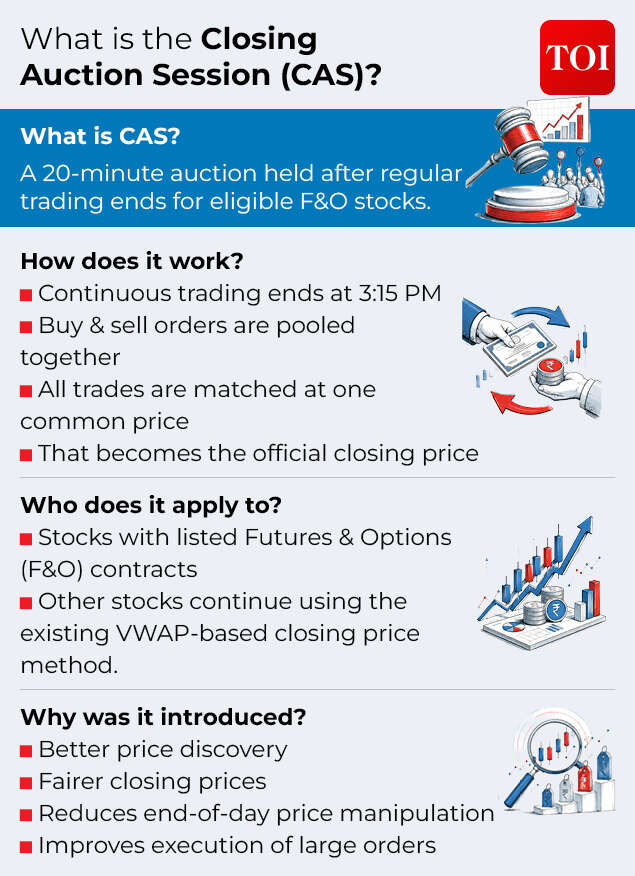
What has been implemented as per SEBI directions is called a Closing Auction Session or CAS. What this essentially does is split the market closing pricing mechanism for stocks, depending on whether they belong to the cash market with derivative contracts segment (futures & options category) or not.
What is Closing Auction Session or CAS?
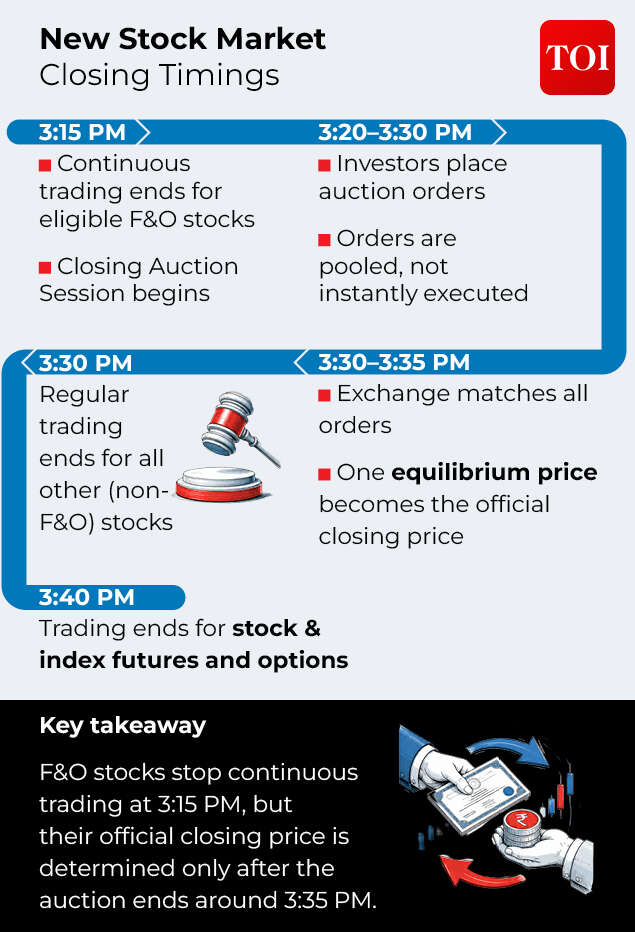
At 3:15 PM every trading session, stocks that belong to the F&O list will stop continuous trading. From 3:15 to 3:35 PM, there will be a 20 minute auction window for these stocks. The auction will use a reference price that will be based on the volume-weighted average price of the stock between 3:00 PM and 3:15 PM with a 3% (plus-minus) price band. The final closing price of the stock will be decided based on the equilibrium price where the maximum executable volume is achieved. The earlier system of volume-weighted average price (VWAP) which made use of the prices in the last 30 minutes has been done away with stocks in the F&O list.According to the National Stock Exchange:
- The first 5 minutes (3:15-3:20 PM) is for Reference price calculation / Transition from CTS to CAS.
- Next 5 minutes (3:20-3:25 PM) is Order entry period – for both limit and market orders.
- Next 5 minutes (3:25-3:30 PM) is for Order entry period only for limit orders. During this time no modification/cancellation for market orders and Random Close in the last 2 minutes (3:28-3:30 PM).
- The order entry session closes randomly anytime between the above mentioned 2 minutes and such random closure is system driven. Subsequent to such random closure, order matching takes place.
What are the new stock market timings effective August 3, 2026?
What the auction process does is simple: it gathers the buy and sell interest in a stock in a single pool of liquidity.According to SEBI, the framework will allow and support a fair settlement of derivatives and indices. It will also help passive funds to transact at closing prices with a lower tracking error.The aim is to improve transparency, price discovery and execution efficiency. The move also brings Indian stock markets closer to global practices. Many large stock markets globally such as the New York Stock Exchange (NYSE), London Stock Exchange (LSE) already make use of the CAS.So what happens to the other stocks that are not eligible for this? They continue with their trading till 3:30 PM under the existing volume-weighted average price-based methodology.
Divergence in Sensex & Nifty: Is it here to stay?
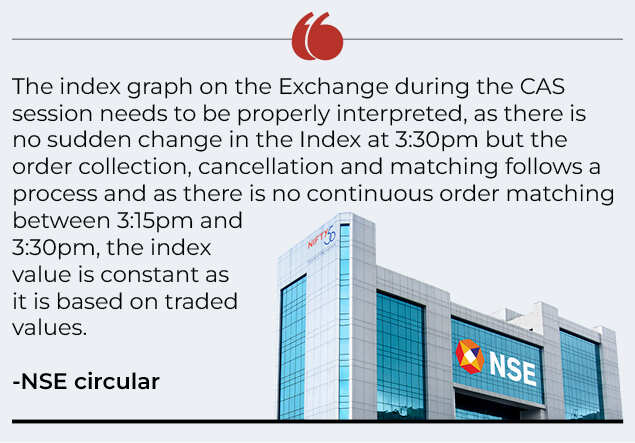
One notable thing that emerged in Monday’s session was the divergence in Nifty50 and BSE Sensex which left traders confused.Nifty50 saw a sharp spike in the final minutes of trading, rising 1.60% at closing, up 0.8% in the last few minutes only. Sensex ended just 0.70% up. Usually the two benchmarks see a 5-10 basis points divergence. According to the National Stock Exchange: The index graph on the Exchange during the CAS session needs to be properly interpreted, as there is no sudden change in the Index at 3:30 PM but the order collection, cancellation and matching follows a process and as there is no continuous order matching between 3:15 PM and 3:30 PM, the index value is constant as it is based on traded values. “However, the indicative values are displayed just besides that quote on the Exchange website, based on the indicative values derived from the equilibrium prices calculated continuously during 3:15 PM and 3:30 PM,” NSE said. “Both the Exchanges have separate order books for CAS sessions similar to the continuous trading session and hence, the prices of the individual stocks are also different. As the index is calculated based on the prices determined of the individual stocks, the index values can also be different,” said National Stock Exchange in a statement on Monday.
What NSE said after first session under the CAS mechanism
Sudeep Shah, Head- Technical and Derivatives Research at SBI Securities explains: The market now derives the closing price from an actual traded auction price rather than a calculated VWAP. The auction mechanism incorporates real-time buy and sell interest, including unexecuted institutional orders, thereby providing a more comprehensive reflection of closing market conditions. In contrast, the VWAP methodology considered only trades that had already occurred and excluded outstanding demand and supply. So how does the new methodology impact benchmark indices such as Sensex and Nifty50?Sudeep Shah says that since benchmark indices such as the Nifty 50 and Sensex are based on the official closing prices of their constituent stocks, their closing values are now driven by auction-discovered prices rather than VWAP-based averages. “This brings India’s closing price discovery process closer to global best practices and enables institutional investors, ETFs, and passive funds to trade at an actual market-determined closing price,” he tells TOI.Sudeep Shah explains this with an example: If significant buying or selling interest emerges in heavyweight index constituents such as HDFC Bank, Reliance Industries, ICICI Bank, Infosys, or Bharti Airtel, their auction-determined closing prices may differ considerably from their levels at 3:15 PM. “Given the substantial weight of these stocks in the Nifty and Sensex, even modest shifts in their auction prices can result in noticeable changes in the benchmark indices. This explains why the Nifty surged by nearly 200 points on the first day of implementation despite showing limited movement during regular trading hours,” he tells TOI.This is further amplified because index futures and options continue trading until 3:40 PM, even as the cash market enters the auction phase. Consequently, after 3:15 PM, the market may reflect three distinct reference points simultaneously: the last traded cash-market level, the auction-derived official closing value, and the fair value indicated by the derivatives market. “On the first day of the new framework, while the official Nifty closing value was around 24,774, futures and synthetic futures indicated a fair value closer to 24,590, suggesting that derivative market participants regarded the auction-determined close as being above prevailing market valuations. Such differences are a natural by-product of the revised market structure and are expected to narrow as liquidity and participation in the auction process deepen over time,” says Shah.Yet another reason for the divergence is that NSE and BSE conduct their closing auctions independently. Each exchange establishes its own equilibrium closing price based on the orders and liquidity available in its respective auction book. “As a result, the same stock can finish with different official closing prices on the two exchanges. This was evident on the first day, when Bajaj Finance declined by about 0.07% on the BSE but gained roughly 1.03% on the NSE. Since the Nifty is calculated using NSE closing prices while the Sensex uses BSE closing prices, differing auction outcomes can cause temporary divergences between the two benchmark indices despite having several common constituents,” Shah says. “Therefore, the divergence observed between the Nifty and Sensex was driven not only by the introduction of the auction mechanism but also by the independent price discovery processes taking place on each exchange,” he adds.
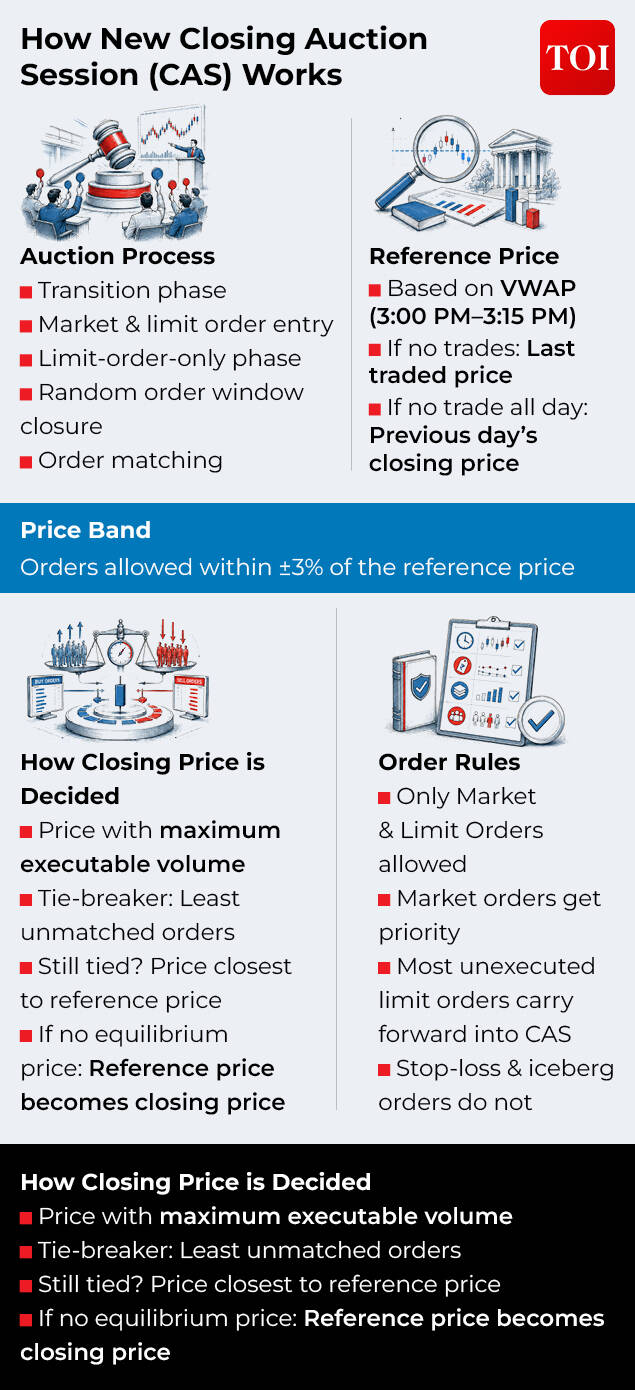
How New CAS System Works – Explained
What does it mean for traders?
Experts note that the market participants will take time to adapt to the new system.“Theoretically the new CAS framework is an improvement over the earlier VWAP-based approach and aligns with international practices. But there will be a period of adjustment as investors accustom themselves to the new dynamics in terms of an early square off of intraday positions by brokers, disparity between 3:15 PM price, and the final settlement price, possibility of large moves in some index constituents during this phase leading to large jump in index,” Anand James, Chief Market Strategist, Geojit Investments Limited tells TOI.Somil Mehta, Head of Retail Research at Mirae Asset ShareKhan cautions that the transition may bring some short-term challenges. “Investors may initially find it confusing that the final Nifty and Sensex closing values differ from the levels displayed at 3:15 PM. Traders executing strategies around the close may also need to adapt to the auction-based process and manage auction-related order risks. Over time, however, the mechanism is expected to align India’s markets more closely with global best practices and strengthen the credibility of official closing prices,” he tells TOI.Going ahead, Goldman Sachs expects the activity in the derivative contracts to pick up. The introduction of CAS saw limited participation on its first day, Goldman Sachs has said, but as institutional investors adapt to the new system, the volume is likely to go up.According to a Goldman Sachs report the median auction volume participation was just 1.7% for eligible stocks on the first day. This is much lower than median 16.3% participation that was witnessed in the last one month when the market was functioning as per earlier timings.“The median auction volume participation of all stocks in the close auction was 1.7% today vs median of 16.3% in the past 1m close. This was also in line with our pad today where most institutional clients opted to stay out of the auction,” the report said.“Considering it was just the first day, we would expect this to pick up over the coming days,” the report noted.Sudeep Shah calls this a long-term constructive reform. In the coming days, he sees particular attention will be focused on weekly index expiries, where auction-derived closing prices now directly influence derivative settlements. “As auction participation and liquidity increase over time, as witnessed in several developed markets, the sharp divergences observed during the initial rollout should become less common. Nevertheless, occasional auction-driven price movements are likely to remain an inherent characteristic of the mechanism rather than a weakness of the system,” he says.(Disclaimer: Recommendations and views on the stock market, or any other asset classes or personal finance management tips given by experts and analysts are their own. These opinions do not represent the views of The Times of India.)