





“He died at 40. She couldn’t even access his digital life.”A wealth adviser recounted the story of a client who did not know her husband’s banking passwords and was “forced into an exhausting battle, navigating government offices, collecting countless documents, and fighting for basic entitlements.”In Kolhapur, a 27-year-old widow allegedly lost access to Rs 70 lakh in insurance proceeds and gratuity after her husband’s death, as she “trusted” her family in financial decisions. Elsewhere, even an established author and retired professor, 75-year-old Alice Stone Nakhimovsky, struggled to understand her family’s finances after her husband’s sudden death, despite their having saved more than $1 million.These examples, different as they are, expose a common vulnerability; when women are excluded from financial decisions or lack access to information about their household’s money, a crisis can leave them struggling to understand, access or protect their own financial future. They are not isolated cases. Situations like these are more common.Although women in India are increasingly participating in the formal financial system. More have bank accounts, are saving, borrowing and using digital payment platforms. But access to financial services does not necessarily mean they understand financial products, feel confident making investment decisions or have control over how their money is used.In many households, women may manage monthly expenses, household budgets and routine transactions, while decisions on investments, insurance, property and long-term savings are left to husbands, fathers or other male family members. Even women who earn an income may not always have an equal say in how it is saved or invested.The gap is not simply about whether women can access financial services. It is also about whether they have the knowledge, confidence and opportunity to make informed financial decisions.The World Bank’s Global Findex 2025 database, based on data collected in 2024 (latest available with the organisation), offers a picture of this divide. Bank account ownership stood at 89.2 per cent among women in India, marginally higher than the 88.8 per cent recorded among men. However, the share of women who saved formally in the preceding year was 22.8 per cent, compared with 31.1 per cent of men. Digital payment use also showed a gap, at 36 per cent among women against 54 per cent among men.These figures measure financial access and participation rather than financial literacy directly. But they indicate that having an account does not automatically translate into equal engagement with formal financial services.There are signs of progress though. A report released in April 2026 by NITI Aayog’s Women Entrepreneurship Platform, TransUnion CIBIL and MicroSave Consulting found that credit penetration among women aged 18 to 64 rose from 1 per cent in 2017 to 36 per cent in 2025.Yet borrowing, saving and making digital transactions are only parts of financial participation. Understanding interest rates, comparing financial products, assessing risk, planning for retirement and knowing how to protect one’s money are equally important.
Why women hesitate
The reasons for the divide go beyond a lack of access to information. Social conditioning, family roles and limited opportunities to participate in financial decisions can shape how women view their own capabilities.Anooshka Soham Bathwal, CEO and founder of Dhanvesttor, believes the issue is rooted in habits developed over generations, rather than an inability to understand money. “This issue relates to habits formed through the course of history, rather than the skills possessed by women.”She said women have traditionally been associated with managing household budgets and running families, while men have often taken the lead in earning and handling investments. This division can leave women capable of managing everyday money but hesitant when making investment decisions.The distinction between earning money and controlling it is central to the problem. “There are two sides to the question – earning money and controlling that money are two entirely distinct aspects.”Women may contribute significantly to household income but have limited involvement in deciding how that money is saved, invested or used to build long-term security. Others may not earn an independent income but manage household budgets and make decisions that affect the family’s financial health.Neither role should exclude women from financial discussions. Financial literacy must involve not only understanding investment options but also developing the confidence to make choices about personal finances.
The March 2026 study by DBS Bank India and Deloitte, which surveyed 1,342 women across different segments, offers some insight into this relationship between financial confidence and decision-making. It found that 69 per cent of the female entrepreneurs surveyed identified themselves as the primary financial decision-makers. The corresponding figures were 60 per cent among rural women earners and 58 per cent among high-net-worth women.
Consequences of being financially unprepared
The consequences of limited financial knowledge or control may become most visible when a household faces a major change: the death of a spouse, separation, divorce, illness, loss of income or an unexpected expense.A woman who has not been involved in decisions about investments, loans, insurance or savings may suddenly have to manage them while dealing with emotional stress or uncertainty. She may also have to establish what assets exist, understand liabilities, access financial documents and determine whether the family’s resources are sufficient to meet future needs.This is not to suggest that women are inherently less capable of managing money. Rather, being excluded from financial decisions can leave anyone less prepared to deal with them independently.Financial preparedness involves knowing where money is held, understanding the family’s income and expenses, being aware of outstanding loans and insurance coverage, and having access to relevant documents and accounts. It also means understanding which financial commitments can be sustained and which may need to change when circumstances shift.As Bathwal emphasised, financial literacy can protect the entire household, not just the woman learning to manage money.
When a woman understands money, the whole family is better protected, especially in emergencies, widowhood or divorce. Financial literacy isn’t a favour to women. It’s a safety net for everyone at home.
Anooshka Soham Bathwal, CEO and Founder of Dhanvesttor
The issue is therefore not simply whether women can make investment decisions on their own. It is whether they have the information and practical familiarity to respond when they need to make those decisions.
Choice, confidence and question of control
Financial decision-making at home can be shaped by the roles people see their parents take, the opportunities they get to learn about money and whether their opinions are taken seriously. While some households share financial responsibilities, others continue to leave key decisions to male family members. The reasons women step back, however, are not always the same.A journalist, who described herself as somewhat confident about independently managing her finances, said financial decisions in her household are made jointly, although she grew up seeing her father or another male family member manage the money. She believes both financial education and traditional gender roles play a part in limiting women’s participation.“The way financial education is introduced to women needs to change. Preconceived notions that often lead women to step back from financial decision-making must be challenged, and financial literacy should be introduced to them from an early age,” she said, adding that women must understand why actively participating in financial decisions is essential to securing their future.Shristi Chaudhari, a senior executive in regulatory intelligence and market research at Bureau Veritas, identified entrenched gender stereotypes as a major barrier, saying they can undermine women’s confidence and restrict their autonomy. “The biggest barrier is the deep-rooted patriarchal mindset that men are naturally better financial planners and decision-makers,” she said, adding that this creates a social stigma that women should accept male family members’ financial choices as binding.Sakshi, a doctor who described herself as not very confident about independently managing her finances, believes women must also take responsibility for changing this dynamic. “Women themselves need to take a greater charge. Society will never encourage women,” she said.Meanwhile, looking at the men’s perspective, if they feel that they have the upper hand in financial decision-making, Durgesh Kumar Jha, a PR consultant, cautioned against assuming that the reasons are the same in every household. While he said male family members usually take the lead in financial decisions at his home and that he was not very confident about managing his finances independently, he argued that responsibility for change must be shared.“True financial independence is not just about earning money, but also about having ownership, control and the confidence to make informed decisions about it,” he said.Amanjeet Singh Rajawat, an SEO manager, offered a different perspective. He said decisions in his household are made jointly and that he grew up seeing his mother or another female family member manage finances. He described himself as very confident about independently managing his money. In his view, women’s participation also depends on the family environment and their willingness to learn. “Traditionally, men have made most of the financial decisions because they have been the primary breadwinners in their households. However, times have changed, and women are now earning and becoming financially independent,” he said.Many others, talking to TOI, also pointed to a combination of family expectations, limited financial education and lack of confidence or experience. Some said women may leave decisions to men themselves, while others stressed that women’s contributions are not always given equal importance because of established gender roles. Several argued that the answer lies in both encouraging women to take initiative and creating an environment where their participation is welcomed.The experiences highlight an important distinction: being involved in household budgeting does not necessarily mean having an equal say in investments, insurance, taxation or long-term savings. Nor does joint decision-making automatically mean that everyone understands the choices being made.Financial independence, therefore, requires more than access to an account or an income. Women need opportunities to learn about money, participate in decisions and have their judgement taken seriously. Families and institutions have a role in creating those opportunities, while financial education can help women build the confidence to use them.
I believe financial education from an early age can play a huge role in improving women’s financial independence. Parents should encourage their daughters to understand money, ask questions and participate in financial decisions rather than leaving it to the men in the family.
Shivani Bisht, a woman working in PR/media industry
Signs of change
There are indications that women are becoming more engaged with financial services, although participation should not be mistaken for a complete measure of financial literacy.The March 2026 DBS Bank India-Deloitte study found that 76 per cent of the rural women earners surveyed felt confident or very confident about their financial decisions. The figure was 67 per cent among high-net-worth women and 58 per cent among female entrepreneurs. The differences highlight the need to understand women’s financial experiences across income groups and circumstances rather than treating them as a single category.A report by NITI Aayog, TransUnion CIBIL and MicroSave Consulting also points to growing engagement among women with their credit health, with the number monitoring their credit reports and scores rising from 19 million in 2023 to 27 million in 2024.Building confidence requires practical experience as well as access to information. Women need opportunities to understand their own income and expenditure, become familiar with bank accounts and investments, compare products and ask questions without feeling that financial matters are beyond their expertise.As Dhanvestor founder Bathwal said, the process need not begin with complicated investment decisions. Women can start by understanding their earnings and expenses, learning about savings and insurance, and gradually exploring investments according to their financial circumstances.
What more
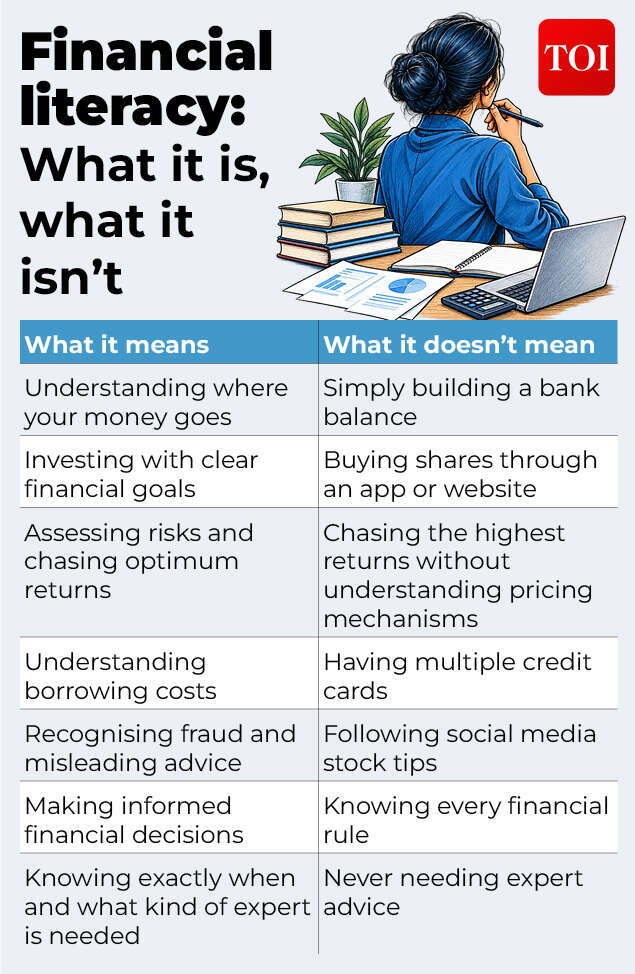
At home, girls can be encouraged to manage their allowances from an early age, while women should be included in discussions about savings, insurance, investments and financial goals. Schools and colleges can teach financial skills as part of life-skills education. Banks and financial firms can explain products in simpler language and engage women directly, rather than addressing husbands or male relatives first. Policymakers can help by making reliable information available in regional languages and improving women’s engagement with formal financial institutions.Women, too, can take small steps towards greater independence: tracking income and expenses, maintaining access to their own accounts, asking questions when they do not understand a financial product and seeking professional advice when required.Women should not wait until they feel completely confident before beginning to learn about money, as confidence often develops through experience, rather than preceding it.Ultimately, financial literacy is not just about knowing which investment offers the highest return or which financial product to choose. It is about understanding the options available, recognising risks, planning for future needs and having the confidence to make informed decisions.For women, the challenge is not only to gain access to financial services but also to have an equal place in the conversations and choices that determine their financial security.