



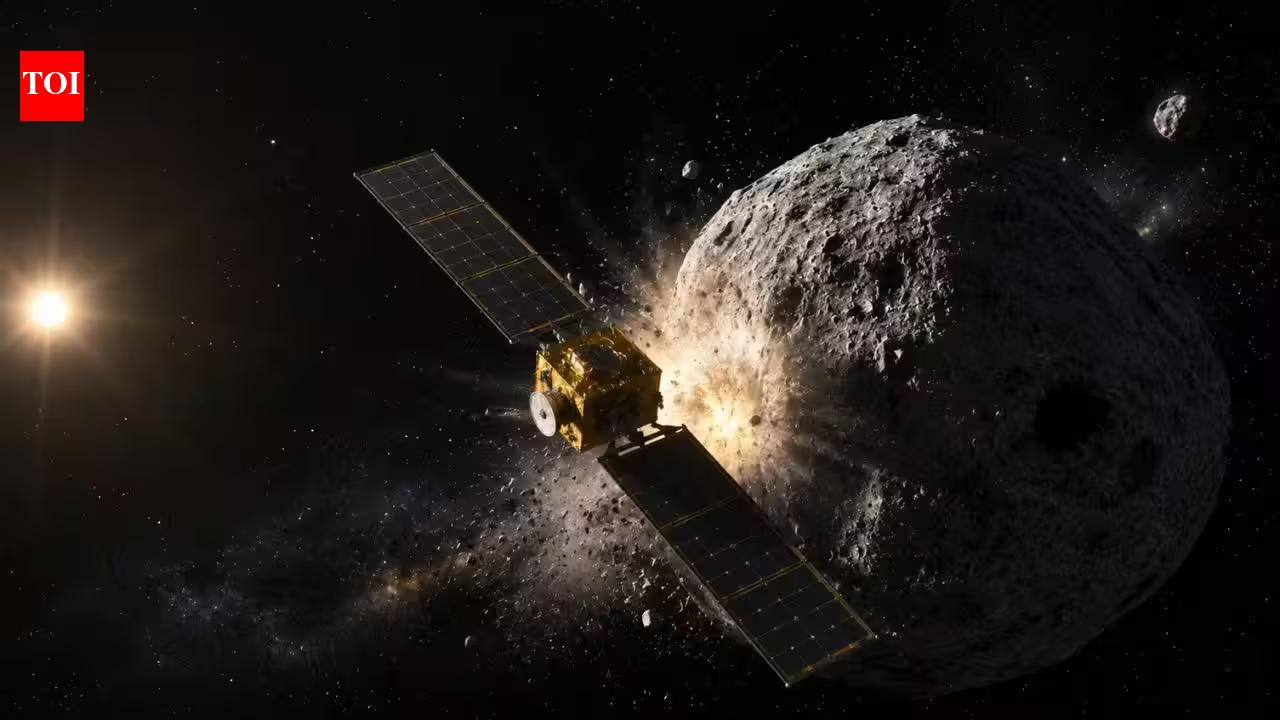
In September 2022, Nasa carried out a mission that had never been attempted before: deliberately crashing a spacecraft into an asteroid to change its path through space. The target was Dimorphos, a small moonlet orbiting a larger asteroid called Didymos. Neither object posed any danger to Earth, which made the pair an ideal testing ground for a technique that could one day protect the planet from a genuine threat. The spacecraft, known as the Double Asteroid Redirection Test, or DART, struck Dimorphos at a speed of roughly 14,000 miles per hour. Two weeks later, astronomers confirmed the results, marking humanity’s first successful demonstration of asteroid deflection technology and a significant milestone for planetary defence.
How Nasa DART used kinetic impact to change Dimorphos’ orbit
DART was built to test a method called kinetic impact, in which a spacecraft transfers its momentum directly into an asteroid to alter its trajectory. Before the collision, Dimorphos took 11 hours and 55 minutes to complete one orbit around Didymos. According to Nasa, mission planners had set a minimum threshold for success: a change in orbital period of at least 73 seconds. Anything beyond that would confirm the technique could work in practice, not just in theory.The asteroid pair sat around 6.8 million miles from Earth at the time of impact, well beyond any risk to the planet. This distance allowed scientists to experiment safely while still gathering data that could inform future planetary defence strategies, should a genuinely hazardous object ever be detected.
Nasa DART impact shortened Dimorphos’ orbit by 32 minutes
Following the collision on 26 September, astronomers turned to ground-based telescopes to track how much Dimorphos’ orbit had shifted. The investigation team used a method involving the eclipsing nature of the two asteroids as seen from Earth, measuring subtle dips in brightness as Dimorphos passed in front of and behind Didymos. Radar facilities in California and West Virginia also contributed to the measurements, adding precision to the findings.The results, announced on 11 October 2022, confirmed that the impact had shortened Dimorphos’ orbit by 32 minutes, reducing it from 11 hours and 55 minutes to 11 hours and 23 minutes. This came with a margin of uncertainty of approximately plus or minus two minutes, and it surpassed the mission’s original success benchmark by more than 25 times.
Nasa’s DART mission shows readiness to respond to future space threats
The scale of the result drew strong reactions from those involved in the mission. According to Nasa, Administrator Bill Nelson described the achievement as a defining moment, stating that the mission demonstrated the agency’s readiness to respond to potential threats from space. He called it a watershed moment for planetary defence and for humanity more broadly. Lori Glaze, director of Nasa’s Planetary Science Division, noted that the result marked an important step towards understanding the full impact of the collision, adding that continued data collection would help scientists assess how a similar mission might be used in future if a hazardous asteroid were ever discovered.
Nasa DART impact revealed how asteroid debris can boost deflection
Attention has since shifted towards understanding the momentum transfer generated by the impact, including the effect of debris ejected from the asteroid’s surface. This ejecta played a substantial role in pushing Dimorphos further off its original course, working alongside the direct force of the spacecraft’s collision. Investigating the asteroid’s physical properties, including the strength and composition of its surface, remains central to fully understanding this effect.Around four years after the DART mission, the European Space Agency’s Hera project is expected to carry out a detailed survey of both Dimorphos and Didymos, focusing on the crater left behind and taking a precise measurement of Dimorphos’ mass. Together, these findings are expected to sharpen scientists’ understanding of how kinetic impactors could be used to protect Earth in the future.