



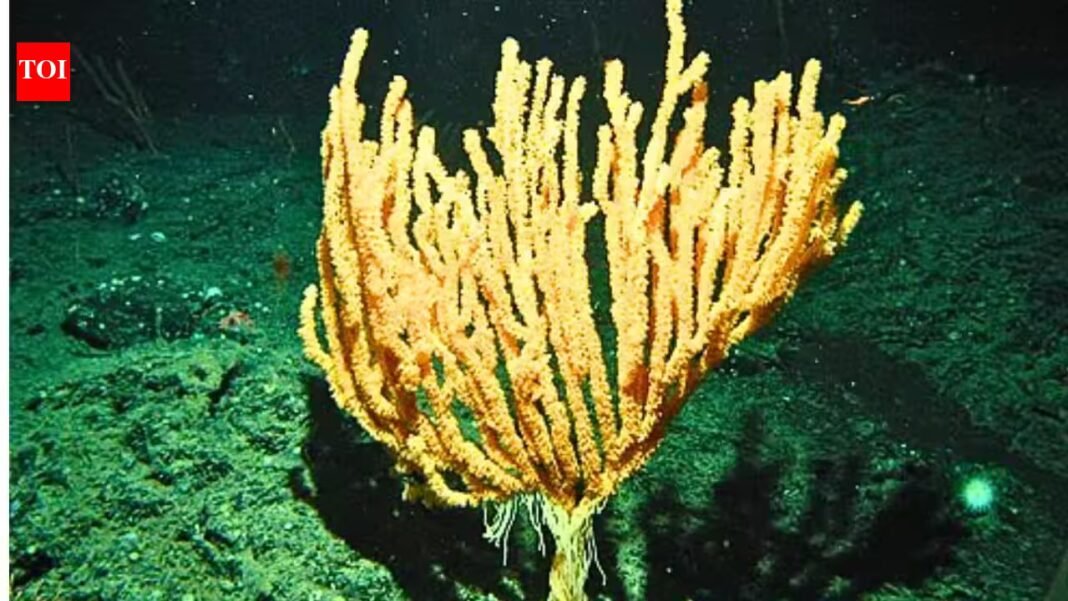
Scientists have discovered a deep-water bamboo coral forest in the South China Sea, where tall, whip-shaped coral colonies grow alongside sea fans, sponges and other marine animals. The forest lies at depths of 1,200 to 1,380 metres near the Xisha Islands, also known as the Paracel Islands. The discovery was made during a research expedition in May 2018 using the manned submersible ‘ShenhaiYongshi’.According to research published in Scientific Reports titled ‘Discovery of Deep-Water Bamboo Coral Forest in the South China Sea’, the coral colonies became denser at shallower depths. The findings provide the first set of observations of deep-water bamboo coral forests in Southeast Asia and open new opportunities to study these ecosystems and their conservation needs.
Deep-water bamboo coral forest discovered near the Xisha Islands
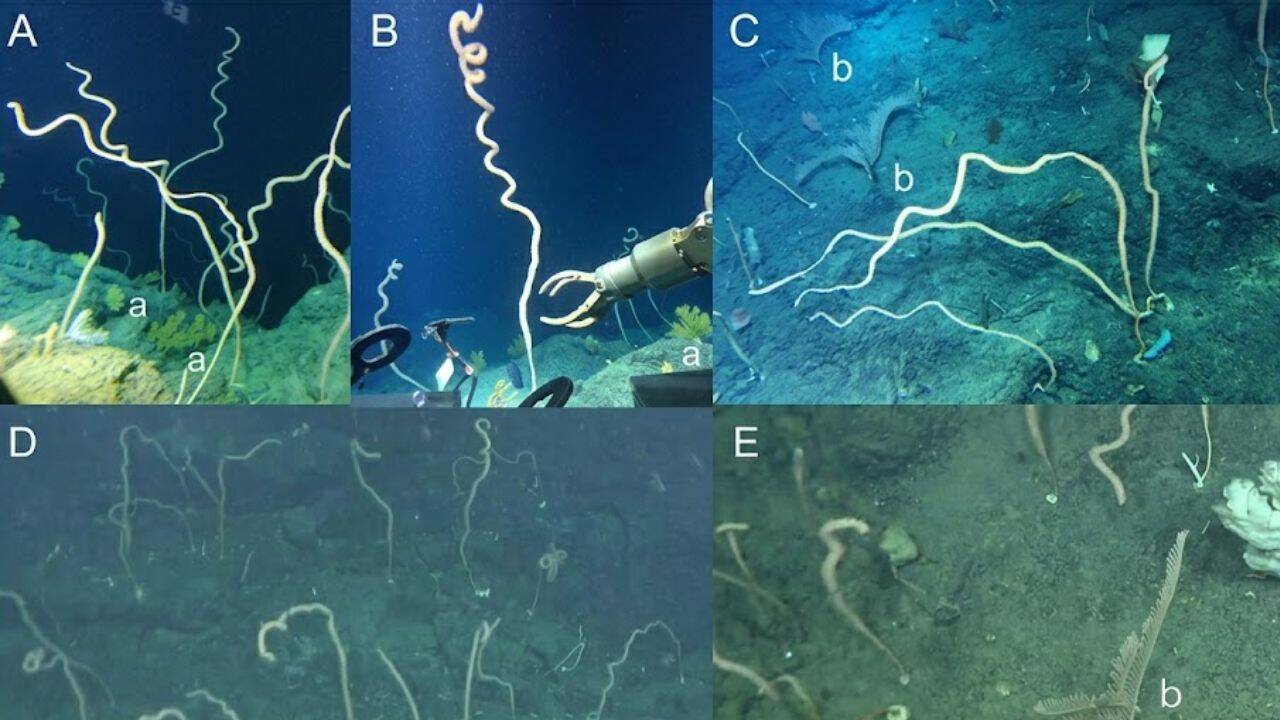
The coral forest was discovered at the foot of the submerged Ganquan reef, near the western edge of the Xisha Islands. During an expedition in May 2018, researchers used the manned submersible ‘ShenhaiYongshi’ to explore underwater areas between 600 and about 1,400 metres deep. The expedition was originally planned to explore drowned coral reefs, so the discovery of a dense bamboo coral forest came as a surprise to the researchers.Researchers spotted patches of tall, slender bamboo corals along the submersible’s route. The colonies often stood more than two metres tall, with their curling upper sections extending their total length to as much as five metres. The discovery marked the first recorded observation of deep-water bamboo coral forests in Southeast Asia.
PC: Scientific Reports
How does the bamboo coral forest support other marine life
The forest is dominated by bamboo corals temporarily identified as ‘Lepidisis sp’. These corals belong to the family Isididae and have whip-shaped, unbranched colonies with articulated skeletons. Researchers also recorded two forms of cold-water gorgonian corals, Anthogorgia sp. and Calyptrophora sp. The Anthogorgia colonies were about 20 centimetres tall, while the broader Calyptrophora colonies reached around 40 centimetres.Sponges were also an important part of the forest, with some areas of the seabed covered by dense groups of sponges. Cirrate octopuses, crinoids and other animals were also observed during the expedition. The researchers noted that the bamboo coral forest appeared to provide habitat for a range of animals living near the seabed.
What did researchers discover about coral density at different depths
Researchers recorded a clear change in coral density along the lower slope of Ganquan reef. Their observations showed that density increased from 24.8 colonies per 100 square metres at a depth of 1,380 metres to 220 colonies per 100 square metres at 1,200 metres. Across 10 dives, the team recorded 638 metres of seabed video, covering an estimated area of 1,856 square metres.The recordings lasted a total of 51.7 minutes. Researchers counted 1,877 coral colonies across 23 video sequences, including bamboo corals, sea fans and other coral forms. The study also recorded a maximum density of 225.6 colonies per 100 square metres at a depth of 1,199 metres on the Ganquan slope.
How do underwater conditions support the growth of the bamboo coral forest
The researchers linked the forest’s presence to the underwater landscape, the submerged reef surface and active currents carrying nutrient-rich water. They also observed intense showers of marine snow, made up of organic material falling from the upper layers of the ocean. These currents were reflected in the movement of the whip-shaped bamboo corals and the orientation of the sea fans.Other deep-water gorgonian corals were found during dives in a canyon at a depth of 2,000 metres and around a mud volcano at about 600 metres. However, the densely populated forest was found only along the Ganquan reef slope during the expedition.