



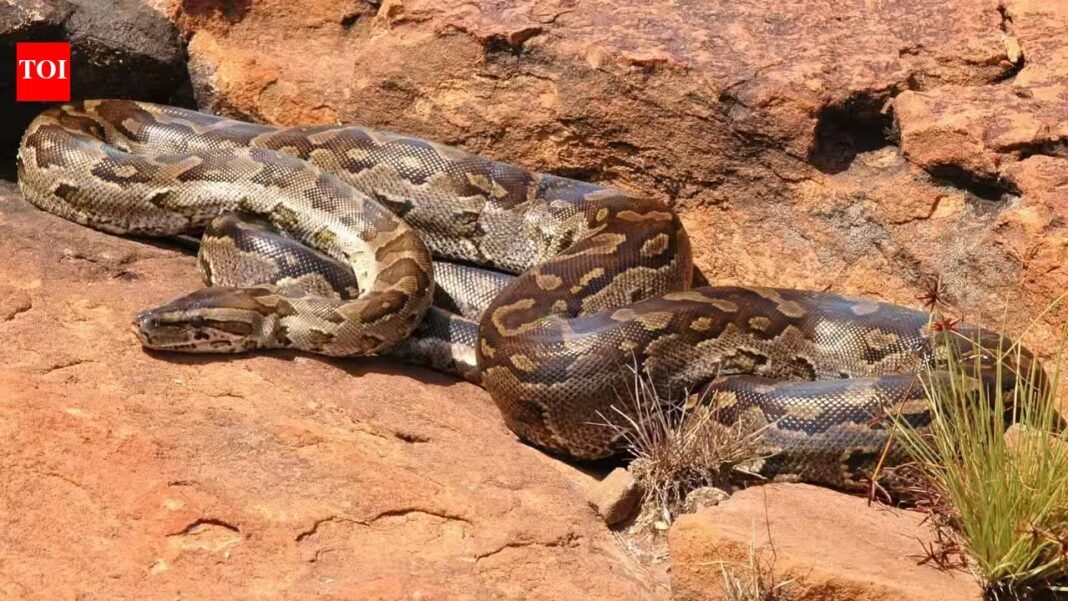
Southern African pythons have been observed using an unusual tail movement to lure potential prey, revealing a hunting technique that had never been formally recorded in the species. The finding grew out of research that combined historical records with social media observations. Videos and photographs posted by members of the public helped scientists identify previously overlooked aspects of the snakes’ behaviour, including a specialised hunting method that offers a fresh insight into how these large reptiles capture food.
Southern African pythons use tail movements to attract prey
The behaviour, known as ‘caudal luring,’ involves a snake moving its tail in a way that resembles something attractive to potential prey. Rather than moving its entire body, the python remains still and uses the tip of its tail to draw an animal closer. The research documenting this behaviour was conducted by Kirsty J Kyle and Colleen T Downs from the University of KwaZulu-Natal in South Africa and published in the journal African Zoology on 8 May 2025.The researchers described one observation they made on a medium-sized southern African python, measuring between 1.5 and 2 meters. The snake was kept in captivity for a short period before being released and the unusual behavior was observed while it was in a large glass enclosure.According to the study, domestic chickens were moving freely nearby when the python adopted an ambush position. It then began moving the visibly marked end of its tail in a repeated, wave-like motion.One of the chickens noticed the movement and approached the tail from several metres away. Throughout the encounter, the python kept the rest of its body completely still, continuing to move only the tip of its tail.The glass enclosure prevented the chicken from becoming a meal, but the researchers considered the behaviour a likely attempt to attract prey. The observation provided the first documented evidence of caudal luring in southern African pythons.
Why is the python’s tail important in this technique
The study explains that southern African pythons have a distinctive colour pattern towards the end of their tails. While the upper surface continues the camouflage pattern found across the rest of the body, the underside has prominent black and white markings.This contrast makes the tail tip particularly noticeable when exposed and moved. The researchers suggested that the combination of its colouring and movement could help attract animals within striking distance.Caudal luring is not entirely new to science. Some other snake species are already known to use their tails to attract potential prey. However, the behaviour had not previously been formally documented in southern African pythons.The researchers also noted that these snakes were already known to use their tails defensively. Photographs and videos collected through social media showed individuals displaying their tails when threatened by predators. The new observation suggested that the same distinctive tail features could serve more than one purpose.
Social media helped scientists understand python behaviour
The discovery formed part of a wider investigation into the feeding habits and hunting strategies of southern African pythons. In their study, Kyle and Downs combined information from historical scientific literature with observations collected from social media platforms.The researchers examined Facebook, YouTube, Instagram and iNaturalist, looking for photographs and videos showing the snakes feeding or interacting with potential prey. They collected records posted up to 1 May 2024 and manually checked the material to identify the snakes and their prey as accurately as possible.The social media investigation produced 238 feeding observations. Of these, 219 could be identified to species level, giving researchers a wealth of information about the python’s diet.Facebook accounted for 84.5% of the collected social media records, while YouTube contributed 6.3%. Instagram and iNaturalist provided the remaining observations.
What did the study reveal about the python’s diet
The investigation found that southern African pythons consume a much wider variety of animals than earlier records suggested. The researchers identified 104 vertebrate species eaten by the snakes.These included 36 mammalian species, 41 bird species and two reptilian species in the social media records, alongside additional prey identified through other sources.They also found that the python’s food preferences seem to change as it grows. Smaller individuals were more often recorded eating birds, and larger snakes were more often associated with mammals.Among the recorded feeding incidents involving pythons measuring less than 1.5 metres, 89% involved birds. In comparison, birds accounted for only 6.1% of the feeding records involving the largest snakes, which measured more than 3 metres.Records of mammalian prey were especially common for impala, with 44 incidents identified in the study. But they said that bigger pythons may be more able to take on larger mammals because they provide a bigger meal.
What do the findings mean for future python research
The study also highlighted how southern African pythons adapt their hunting strategies to the availability and behaviour of prey. Some individuals were repeatedly observed using the same trees and locations to catch birds.One python recorded through a live webcam was seen on 9 occasions taking different birds from the same branch of a dead tree. Another was observed visiting the same tree in a residential area over 7 months, where it fed on 6 different bird species. These observations suggested that the snakes could make use of locations where potential prey regularly gathered rather than relying entirely on chance encounters.