



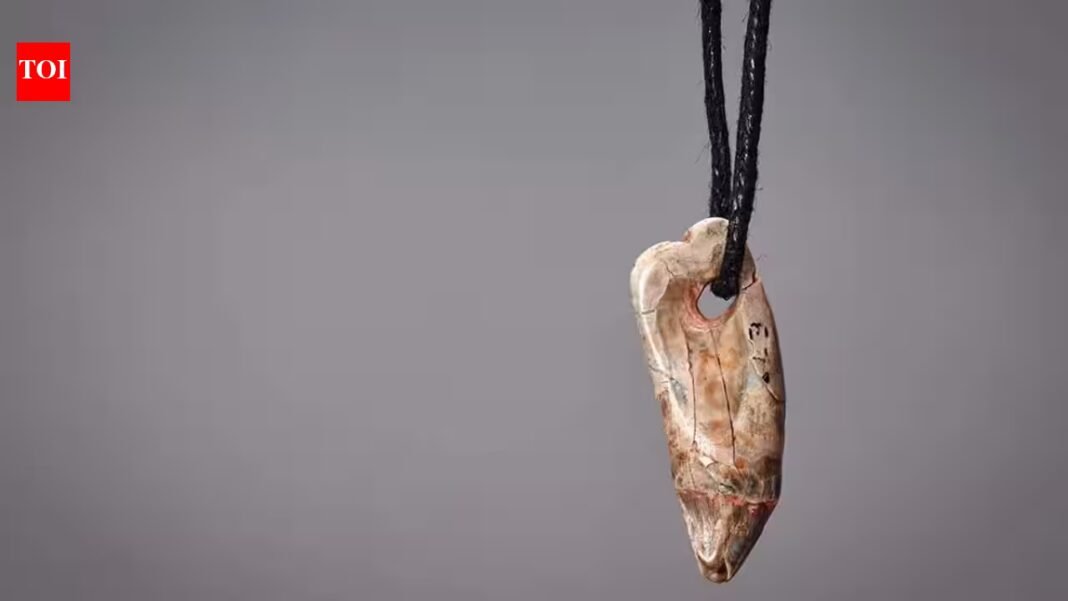
An unidentified object recovered from a British cave during a 19th-century archaeological excavation has finally been recognised as a prehistoric piece of jewellery. Researchers have identified the artefact as a pendant made from the tooth of a grey seal, dating back approximately 15,000 years. The discovery, made at Kents Cavern in Devon, is offering fresh insights into how people living towards the end of the last Ice Age created personal ornaments, travelled across long distances and maintained connections with communities beyond their immediate surroundings.
15,000-year-old seal-tooth pendant remained unidentified for more than a century
The unusual artefact was originally discovered in 1867 during excavations at Kents Cavern in Torquay, Devon. The archaeological work was led by William Pengelly, whose investigations between 1865 and 1880 helped establish more systematic methods of recording archaeological discoveries in Britain.Despite being recovered alongside other prehistoric finds, the small tooth-shaped object did not attract much attention. It was initially believed to have come from an animal such as a badger, wolf or beaver. Its actual identity remained uncertain for more than 150 years.According to the Natural History Museum, renewed examination of the museum’s archaeological collections eventually brought the overlooked object back into focus. Researchers from the Natural History Museum and University College London (UCL) revisited the artefact using modern scientific techniques to understand its origin and purpose.Their investigation established that it was made from the tooth of a grey seal, scientifically known as Halichoerus grypus. The research, published in the journal Quaternary Science Reviews, places the pendant at approximately 15,000 years old.The discovery is particularly important because objects made from seal teeth are extremely uncommon in prehistoric Britain.
What did researchers discover about the pendant’s manufacture
Researchers also examined how the tooth had been modified and whether it had actually been worn by someone.As explained by UCL, the team used non-destructive techniques, including high-powered microscopy, 3D-modelling and micro-CT scanning. These methods allowed them to study the object’s surface, internal structure and manufacturing marks without damaging the fragile artefact.The examination revealed that the tooth had been deliberately shaped. Much of its root had been scraped or ground away, making it thinner and smoother than its original form.A small hole had also been drilled through the remaining root. According to the Natural History Museum, the markings suggest that a pointed flint tool was repeatedly turned against the tooth while it was held in place. This would have required considerable care because the root could easily have split during the process. The hole provided space for a cord to pass through, allowing the tooth to hang from a necklace or bracelet.Researchers also cited evidence of long-term use. The surface had been rubbed smooth, polished, and the originally circular hole had slowly changed to an oval shape from the friction of a cord inside. These details indicate that the pendant was worn for a long time.
Why does the inland discovery matter for understanding ancient connections
One of the most interesting aspects of the discovery is the location where the pendant was found.Kents Cavern is situated well inland, and the coastline was much farther away when the ornament was made. According to UCL, the ancient shoreline was up to 125 kilometres from the cave around that period. This raises questions about how an object made from a marine animal reached a location so far from the sea.Researchers have suggested two possible explanations. The pendant owner may have traveled a long way, perhaps following migrating animals or between different areas. The ornament could also have been exchanged between communities.The Natural History Museum says ancient people were not always confined to the immediate vicinity of their settlements. The movement of animal remains, ornaments and other materials indicates that communities were able to keep up links over great distances. The pendant provides evidence of how objects and cultural practices may have travelled between groups during the Upper Palaeolithic period.
Similar discoveries reveal wider cultural links across Europe
The Devon discovery also fits into a broader pattern of prehistoric ornament-making across Europe.According to the Natural History Museum, the period between approximately 21,000 and 13,000 years ago saw an increase in the use of bones and teeth from marine mammals to produce decorative objects.Archaeological discoveries at Las Caldas in Spain, for example, include several artefacts made from seals and whales. The site is located more than 40 kilometres inland, suggesting that marine animal materials were transported away from coastal areas.Researchers have also identified representations of marine mammals at Gönnersdorf in Germany, where seals were engraved into rocks hundreds of kilometres from the sea. Another nearby site, Andernach, contains a similar engraving alongside a whale-bone artefact.UCL notes that the newly identified Devon pendant is the first confirmed example of a Magdalenian-style seal-tooth pendant in the British Isles. Similar objects have been identified at archaeological sites in France and Spain.The Natural History Museum’s human evolution expert Dr Silvia Bello, who co-authored the research, has suggested that the pendant may have had a social or symbolic role. It could have represented the identity of its owner or indicated an association with a community familiar with coastal environments.Only 4 other seal-tooth pendants from this period are currently known, making the Devon example particularly unusual.