



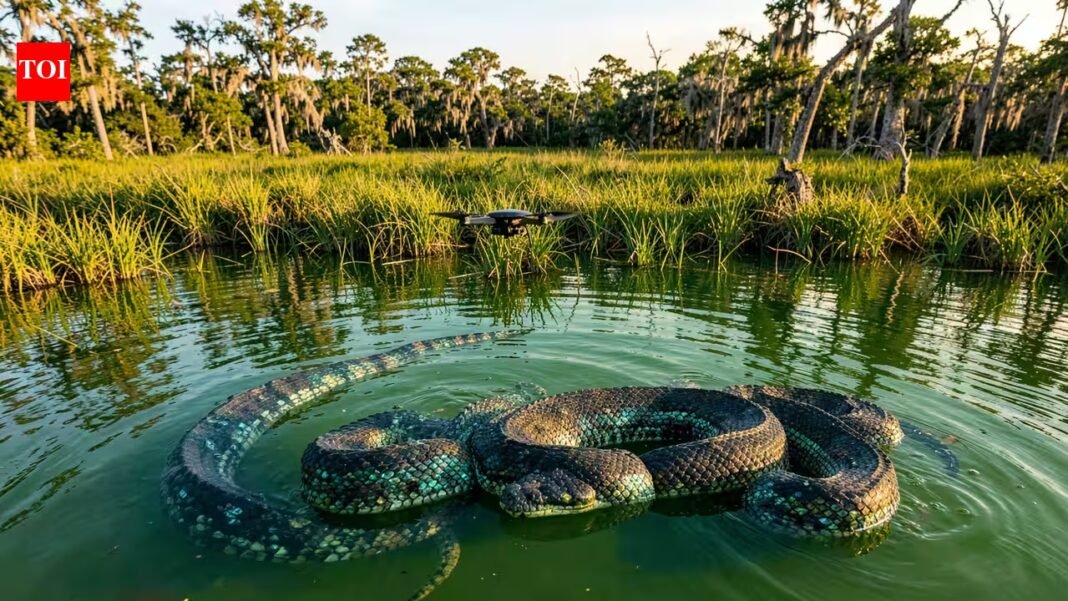
A 16-foot Burmese python weighing 147.9 pounds was included in a US Geological Survey test of drone technology being evaluated for tracking invasive snakes in the Greater Everglades Ecosystem. In material published September 23, 2026, the USGS said biologists operated a small uncrewed aircraft system, or sUAS, while University of Florida interns released the newly radio-tagged female python. The sUAS can be fitted with radio-tracking equipment or a camera and is being evaluated as a way to improve python detection and tracking, enhance research data collection and reduce the labour and operating costs associated with traditional field-based monitoring. The technology is being tested to determine whether aerial methods can make it easier to locate pythons across the difficult terrain of the Greater Everglades.
USGS scout snake programme: how radio-tagged pythons help researchers find others
The drone test is part of a broader USGS research programme that uses radio telemetry to study Burmese pythons in the Greater Everglades. The programme includes a year-round scout effort in which selected male and female pythons are fitted with radio transmitters and tracked by USGS researchers and interns from the University of Florida’s Everglades Invasive Reptile Internship Program. During the breeding season, following scout snakes can help researchers locate aggregations in which several males gather around a single female, allowing additional pythons to be found and removed and new individuals to be added to the study.The approach has previously helped researchers find large numbers of pythons. In a July 2020 release, USGS reported that scout-python tracking efforts during the 2019–2020 breeding season, as part of a multi-agency effort in southern Florida, resulted in the removal of 86 adult pythons weighing approximately 5,000 pounds combined. The group included 53 reproductive females carrying more than 2,500 developing eggs.
Why researchers track Burmese pythons in the Everglades
Burmese pythons are an established invasive species across the Greater Everglades Ecosystem and pose a serious threat to native wildlife. USGS research has documented Burmese pythons consuming native prey including the federally endangered Key Largo woodrat and other native wildlife such as wood storks, limpkins, and round-tailed muskrats. Because the snakes are difficult to detect and move through a large and complex landscape, understanding their movements and breeding behaviour is important for developing strategies to manage their population.USGS researchers use radio transmitters implanted in pythons to collect location data over time. Those data can be used to study where individual snakes move, how much space they use and how their movements change between breeding and non-breeding periods. The information also helps researchers understand habitat use and identify areas where control efforts could be targeted.
Testing drones for python tracking across difficult terrain
The sUAS experiment is intended to address some of the logistical difficulties involved in locating radio-tagged snakes across the Everglades. USGS says the new radio-tracking technology mounted on small uncrewed aircraft systems is being tested to locate pythons more frequently while improving research data, efficiency and staff safety. Field-based monitoring can require researchers to navigate wetlands, prairies and dense vegetation to locate radio signals, making large-scale tracking difficult across the Everglades.The USGS is still evaluating whether the technology is feasible in the complex habitats of the Everglades. The agency says that, if successful, the approach could strengthen invasive-species management and contribute to restoration efforts across the Greater Everglades. The broader research programme remains active, with a USGS data release published in September 2026 containing spatial locations from Burmese pythons tracked between 2005 and 2026 in Everglades National Park and Big Cypress National Preserve.