



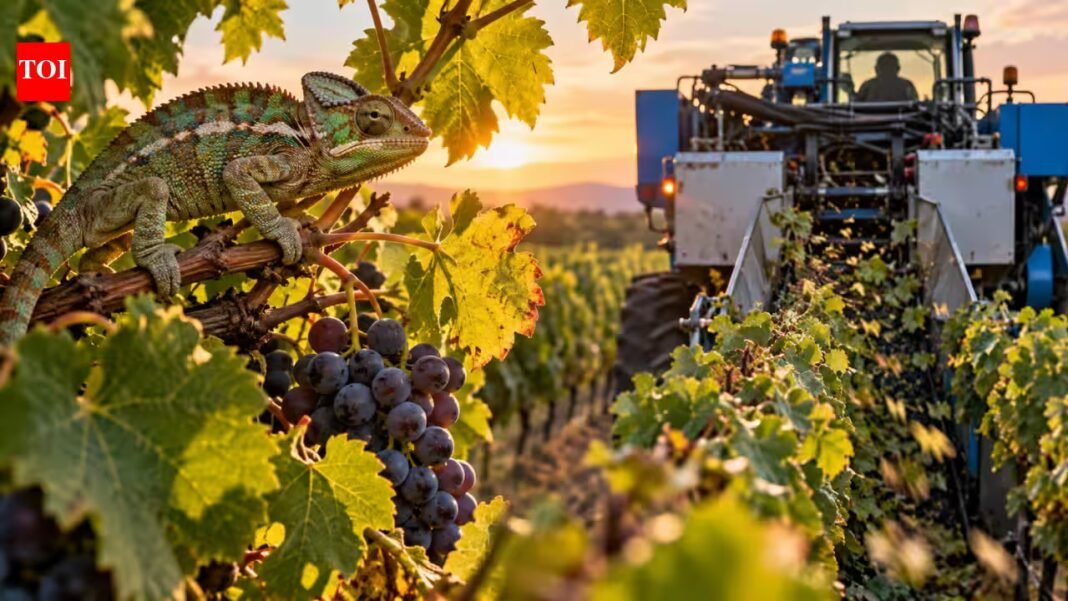
Farmland is often welcomed as wildlife habitat, but a January 2026 study in Global Ecology and Conservation found reptiles collected during mechanical grape harvesting. Researchers examined a central Israeli winery’s waste container over four nights and found 105 reptiles, most of them dead. According to the study published in ScienceDirect, titled ‘Extensive chameleon mortality in mechanised harvest of grapes suggests that wildlife biodiversity in the agricultural matrix may be a double-edged sword’, 72 were Mediterranean chameleons. At least 47 per cent of the 60 dead chameleons had eaten grapes, and all but one female contained unripe eggs.
How can vineyards become ecological traps for chameleons
Agricultural land use has grown by six per cent since the start of the 21st century and now occupies around 37 per cent of global land area, based on figures from the Food and Agriculture Organisation. The authors state that planting cover crops, agroforestry and reducing pesticide use are among the methods intended to bring more natural fauna into farmed landscapes. Policymakers also tend to regard farmland as an ecological corridor, linking natural patches and allowing gene flow between separate populations.The researchers explain that animals rely on environmental cues to judge the quality of a habitat, and those cues may stop being reliable in farmed settings. When animals choose a habitat that lowers their fitness, the paper describes the result as an ecological trap. The authors separate two types. In an equal preference trap, animals cannot tell that a habitat is poor and are as likely to choose it as any other. In a severe trap, animals actively prefer the low-quality habitat, which the study says can create strong source-sink dynamics and cause neighbouring populations in good habitat to collapse. The paper cites earlier work on wheat fields, which drew skinks from adjacent patches, after which the whole skink population disappeared from the field at harvest.
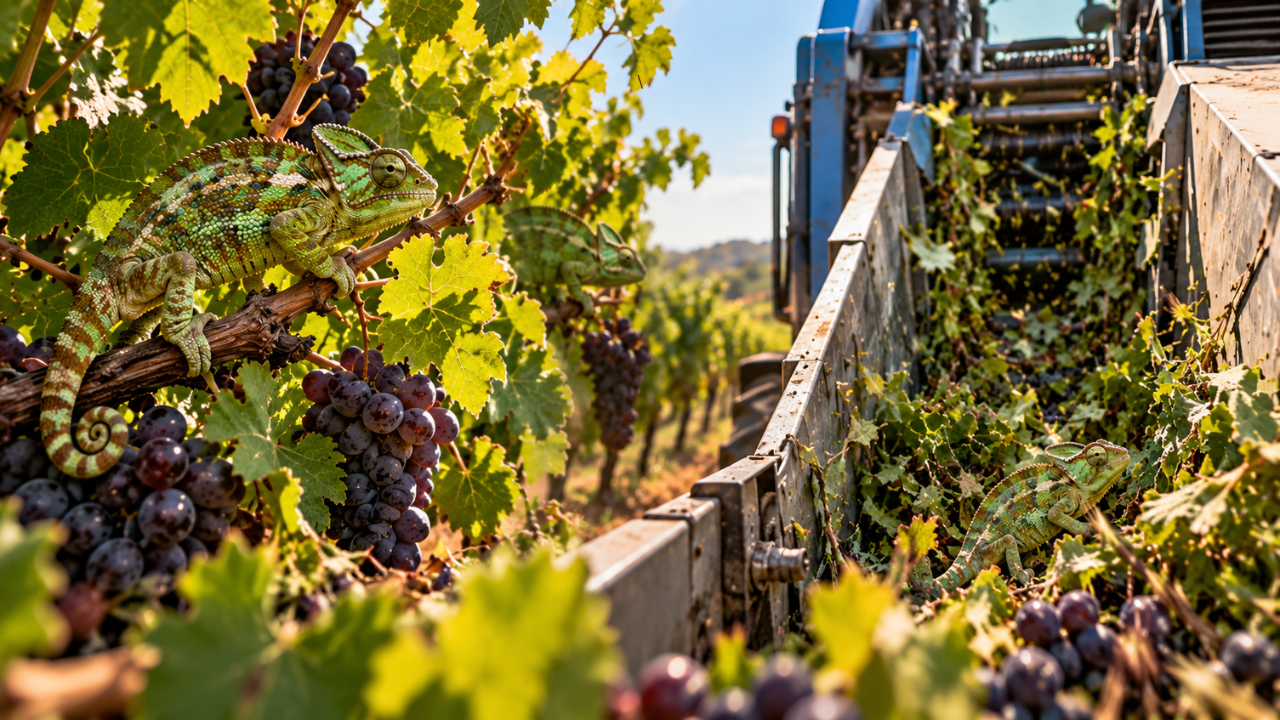
Image AI generated
How many reptiles were found in the winery waste
The team examined the organic waste container of a medium-sized winery in central Israel over four nights, two in September 2021 and two in September 2023. According to the study, the winery receives grapes from across the country, from the Negev Desert to the Upper Galilee, and the grapes are mainly harvested mechanically, typically at night. Machines shake the vines to dislodge the fruit, which is carried on a conveyor belt. At the winery, the grapes are destemmed, and the waste is discarded into the container. Two or three observers stood inside the container with flashlights, scanning the waste as it arrived and collecting any vertebrates they found.Over the four nights, the researchers found 105 reptiles and three Savigny’s tree frogs. According to the paper, 72 of the reptiles were Mediterranean chameleons, followed by 28 Egyptian rock agamas, two Lebanon lizards, two Mediterranean thin-toed geckos and one dice snake. The abstract states that chameleons made up 69 per cent of the reptiles. Most animals were found dead, apart from 13 chameleons and three agamas that survived the automated harvest and were released the following day under instructions from the Israel Nature and Parks Authority. The study reports that the density of animals collected ranged between 0.42 and 6.2 individuals per hectare for chameleons, with an overall figure of 1.9 per hectare, and between 0 and 7 per hectare for agamids, with an overall figure of 0.8.
What did the researchers find in the chameleons’ stomachs
The researchers dissected the chameleons to examine their stomach contents and reproductive status. Although chameleons are generally considered carnivorous, the study found grapes in the stomachs or intestines of 28 individuals. The paper reports that at least 47 per cent of the 60 dead chameleons had eaten grapes shortly before they were collected, and describes the estimate as highly conservative because animals with only purple residue in their digestive tracts, and no seeds, were not counted. In some animals, grapes made up the only component of the gut contents.Almost all of the female chameleons contained eggs. According to the study, 404 eggs were counted in 24 females, with an average of 16.8 per female and a range of three to 28. Excluding three females whose clutches could not be reliably compared, the average clutch size was 17.4, larger than the average of 13.8 reported for chameleons in Spain, with a p-value of 0.02. The authors note that this species lays its eggs towards the end of summer, shortly after the harvest, whereas the Egyptian rock agama lays between April and July. They also state that it has been suggested that these chameleons reproduce only once in their lifetime. Of the chameleons collected, all but one female contained unripe eggs.
What evidence suggests vineyards may be severe ecological traps
The authors compared the winery chameleons with earlier data to test whether the animals had been pushed into vineyards by competition. According to the paper, the larger clutch sizes, together with body condition scores, do not support the idea that the chameleons were inferior competitors excluded into the vineyards. Females from the winery scored higher on the scaled mass index than those surveyed previously in Israel, while males scored lower. The authors caution that the comparison involves different localities, years and seasonal timings, and that the data come from a different time of year than the earlier study. They also state that they could not obtain body condition data for the same subspecies from natural habitats in September.According to the study, hand harvesting, used mainly in small vineyards, is unlikely to cause high mortality of arboreal reptiles, and a possible mitigation is to warn certain species with noise, vibrations, light or scents before harvest begins. The researchers also state that the problem is unlikely to be limited to chameleons or vineyards, since any permanent crop harvested by shaking the whole tree could cause high mortality among tree-dwelling species. Between 2000 and 2021, the study notes, land used for permanent crops rose by 40 per cent, compared with 12 per cent for temporary crops.