


For most of human history, the atmosphere was something felt rather than measured. People knew that air moved, pushed against sails and filled the lungs, but its physical weight was harder to demonstrate. In 17th-century Italy, that began to change. Evangelista Torricelli, a mathematician and physicist from Faenza, was working on a problem that had puzzled scientists for years: why could water only be raised to a certain height by a pump? His answer led to a simple glass tube, mercury and one of the most important instruments in the history of atmospheric science. The device did more than produce a measurement. It offered a new way of thinking about the invisible air surrounding Earth.
How Evangelista Torricelli used mercury to measure atmospheric pressure
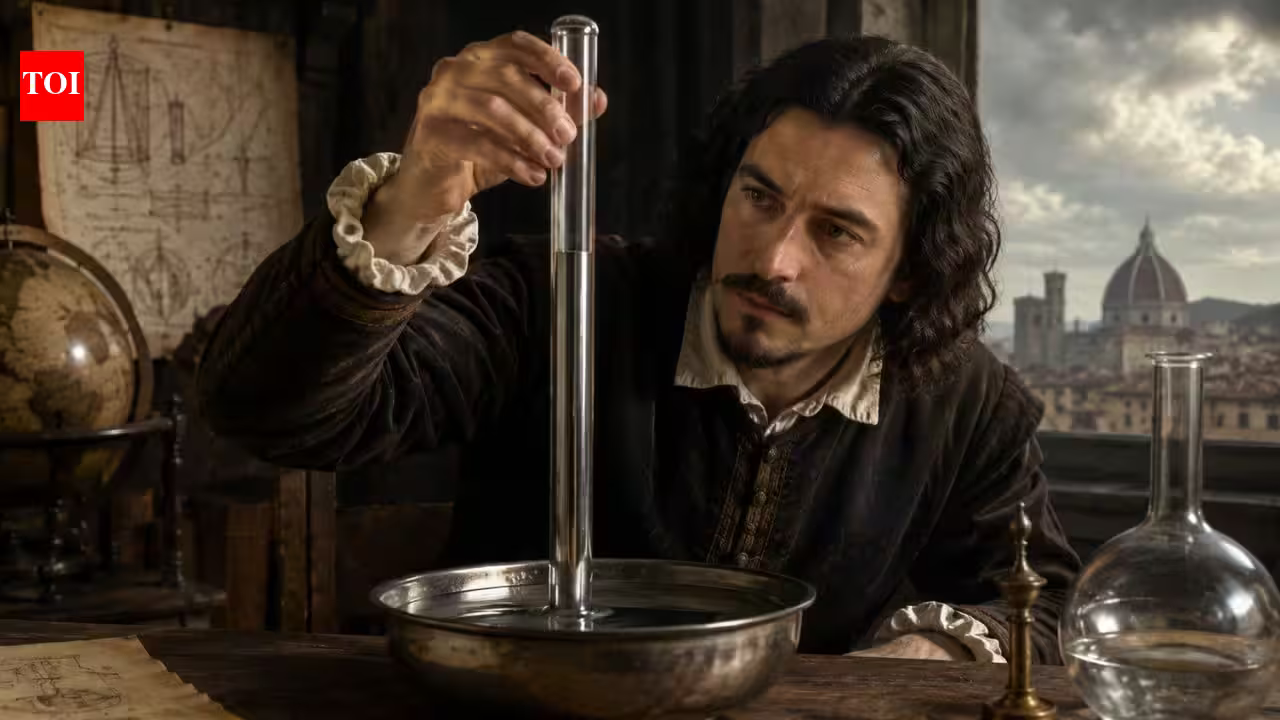
Torricelli’s breakthrough came after earlier attempts to understand why water would not rise indefinitely in a pump. Galileo had considered the problem and had explained the limit in terms of the force of a vacuum. Gasparo Berti had also carried out a striking experiment using a long tube filled with water, in which the water fell and left an apparent space above it. But neither had established that the atmosphere itself was responsible for supporting the liquid column.Torricelli approached the problem differently. He used mercury instead of water, which meant he could work with a much shorter tube. According to the study published in the National Library of Medicine, titled ‘Torricelli and the Ocean of Air: The First Measurement of Barometric Pressure’, he used a glass tube roughly 110–120 centimetres long, filled it with mercury and inverted it into a basin containing more mercury. The liquid dropped, but it did not all leave the tube. A column roughly 76 centimetres high remained standing above the mercury in the basin.The empty-looking space at the top of the tube became an important part of the experiment. Torricelli argued that it was a vacuum and that the vacuum was not pulling the mercury upwards. Instead, the air outside the tube was pressing down on the mercury in the basin. That pressure supported the column inside the tube.He later described the idea in a letter to Michelangelo Ricci, writing that humans live at the bottom of an “ocean of the element air”. The phrase captured the physical picture behind the experiment: the atmosphere was not weightless or passive. It had mass, and its weight exerted pressure.Torricelli’s letter of 11 June 1644 describes the barometer itself as the first successful instrument for measuring barometric pressure. This distinction matters when placing the invention precisely in the timeline of the 1640s.
How Torricelli’s barometer revealed the link between atmospheric pressure and altitude
The mercury tube gave scientists something they had previously lacked: a visible indication of atmospheric pressure. The height of the mercury column could be observed and compared. Pressure was no longer simply an idea inferred from what happened to water pumps or other apparatus. Torricelli also recognised that atmospheric pressure should not be identical everywhere. In his letter, he suggested that air became less dense at higher elevations and that pressure would therefore be lower on mountains than near the Earth’s surface. He had not yet supplied the definitive demonstration, but the implication was already present in his reasoning.That prediction was tested a few years later by Blaise Pascal. His brother-in-law, Florin Perier, carried a mercury barometer up the Puy-de-Dôme in France while another instrument remained at lower elevation. The measurements differed substantially.The barometer at the summit stood at about 625 mmHg, compared with roughly 710 mmHg in the garden below. Perier repeated the ascent and found the same general result.The experiment made the relationship between height and pressure much harder to dismiss. Even a smaller ascent produced a measurable difference: Perier recorded a fall of around 5 mmHg when the barometer was taken up the cathedral tower in Clermont. The atmosphere, it became clear, behaved differently depending on how much air was above the observer.
Why Torricelli’s discovery led to new experiments with atmospheric pressure
Torricelli’s work did not remain confined to the question of water pumps. Once pressure could be measured and altered, other scientists had a way to investigate what happened when air was removed. In 1654, Otto von Guericke demonstrated just how much force atmospheric pressure could produce. He constructed two copper hemispheres, joined them together and pumped air from the space inside. Once the pressure within was greatly reduced, the surrounding atmosphere pressed the hemispheres together with enough force to make separation extremely difficult. The study calculates that, under idealised conditions, the force could have been around 46,000 pounds-force, or about 10,300 newtons.The demonstration helped draw attention to the possibilities of controlled low-pressure experiments. Robert Boyle, after learning about von Guericke’s air pump, saw that such equipment could be used to study the behaviour of air under reduced pressure. Working with Robert Hooke, Boyle developed an air pump capable of evacuating a glass vessel, allowing experiments that were not possible with von Guericke’s sealed metal hemispheres.The consequences reached beyond the original question that Torricelli had been trying to answer. Pressure could be measured, changed and compared. The behaviour of gases could be investigated experimentally. The work also became relevant to understanding conditions at altitude, helping lay part of the groundwork for what would later become high-altitude physiology.
Why Torricelli’s mercury barometer changed the study of the atmosphere
The barometer was a modest-looking invention, but its importance came from what it allowed scientists to observe. A column of mercury could rise or fall, turning the otherwise invisible weight of the atmosphere into a physical measurement. Torricelli’s insight also helped shift scientific thinking away from the idea that a vacuum itself was responsible for holding liquids in place. Earlier experiments had shown that strange things happened when water was placed in very long tubes, but the explanation remained uncertain. Torricelli connected the effect to the atmosphere pressing on the liquid outside the tube.That idea became part of a wider chain of experiments across Europe. Pascal linked pressure with altitude, von Guericke demonstrated the force produced by atmospheric pressure, and Boyle used reduced-pressure environments to investigate the properties and effects of air. What began with a glass tube and a column of mercury therefore became part of a much larger change in the study of fluids, gases and the atmosphere. Modern weather instruments are vastly more sophisticated, but the principle behind the old mercury barometer remains easy to picture. Air has weight. Its pressure can change. And by measuring that pressure, scientists gained one of their earliest practical ways of observing the atmosphere itself.