



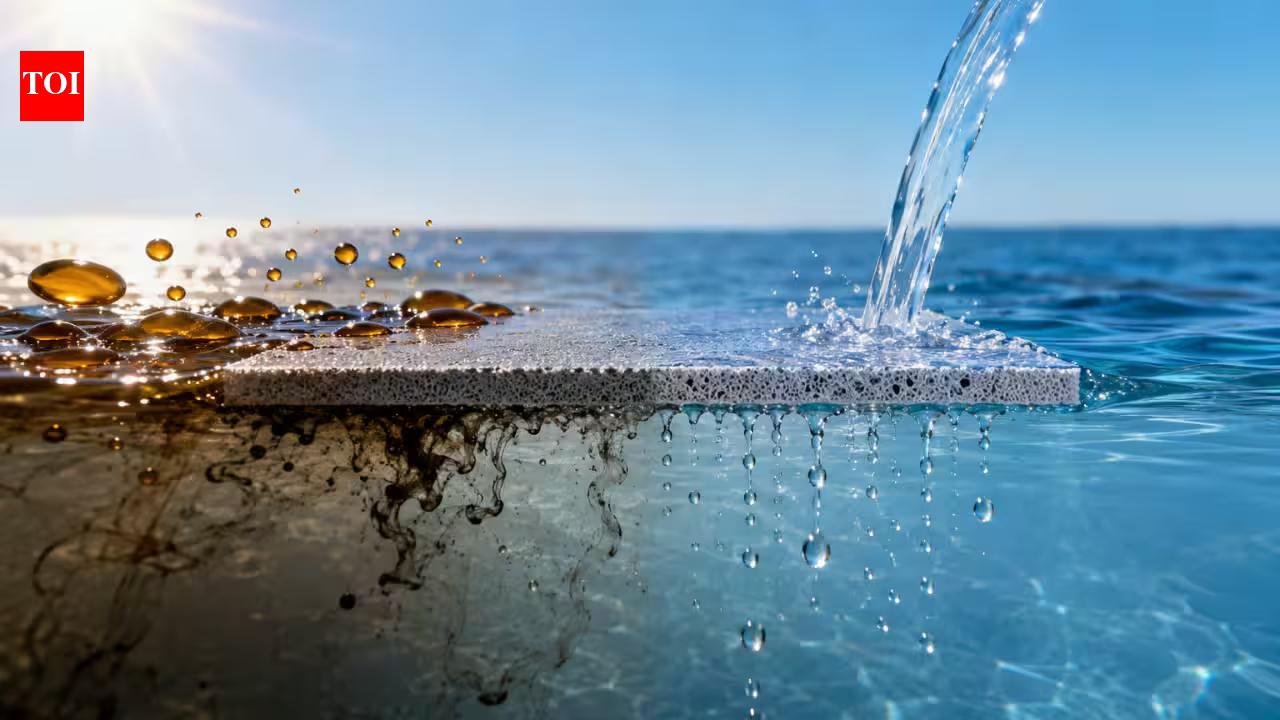
As freshwater shortages intensify around the world, scientists are searching for technologies that can do more than simply desalinate seawater. One of the biggest challenges is treating oil-contaminated seawater, where conventional desalination systems often fail because oil clogs membranes, blocks water transport and reduces efficiency. Researchers have now developed a multifunctional Janus hydrogel membrane that tackles both problems simultaneously. The new material removes more than 99.99% of oil from contaminated seawater while using solar energy to produce fresh water, combining oil-water separation and solar-driven desalination in a single device. The breakthrough is reported in the peer-reviewed paper ‘Dual-functional asymmetric CuO@NC-based Janus hydrogel membrane for integrated oil-water separation and solar-driven desalination for sustainable use,’ published in the journal Desalination.
Why oil-contaminated seawater is so difficult to desalinate
Conventional desalination technologies work well with relatively clean seawater but struggle when oil is present. Oil droplets stick to membrane surfaces, clog microscopic pores and interrupt the movement of water through the system. Over time, this fouling dramatically lowers freshwater production while increasing maintenance costs.According to Siyoung Byun, Jiha Shim, Sejeong Seo and colleagues in their Desalination study, oil contamination is one of the major barriers preventing solar-driven desalination from being widely deployed in real-world environments, particularly near ports, offshore platforms and industrial coastlines where oily wastewater is common.
How the Janus membrane separates oil and produces fresh water at the same time
This problem was solved by designing an asymmetric Janus hydrogel membrane, inspired by the two-faced Roman god who had one side doing a different task than the other.The hydrophobic side of the membrane consists of CuO@NC nanoparticles encased in a nitrogen-doped carbon shell and is embedded in a PVDF layer. This side repels oil but attracts and captures sunlight effectively and uses it to generate heat.The other side of the membrane is made of hydrophilic chitosan-polyvinyl alcohol hydrogel, which has a very high capacity for absorbing water and naturally repelling oil under water. In this way, the membrane can separate the oil from seawater before the water comes in contact with the evaporation surface and the sunlight is used to convert the water into water vapour that can then be collected back in liquid form.This architecture has been designed in such a way that the distinct functions of oil rejection, water transport, and solar heating have been allocated to different layers of the design.
The membrane removed more than 99.99% of oil while boosting evaporation
Laboratory testing showed impressive performance under realistic oily seawater conditions. The membrane achieved oil rejection exceeding 99.99% across a range of contaminated water samples, effectively preventing oil from penetrating the evaporation layer. Under standard one-sun solar illumination, it reached a surface temperature of about 45°C, producing an evaporation rate of 1.29 kilograms of water per square metre per hour.The study also reported a solar-to-vapour conversion efficiency of 86.4%, while the Janus design improved evaporation performance by approximately 2.8 times compared with conventional single-function solar desalination systems.Byun and fellow researchers further demonstrated that the membrane maintained stable performance over repeated operating cycles, suggesting that the design can withstand prolonged exposure to oily seawater without significant deterioration.
Why combining two water treatment technologies matters
The current systems either separate oil-water or use solar desalination, which involves two different processes that have to be performed separately.This newly created membrane can do both simultaneously. The oil is separated before getting into contact with the surface, and the process of creating fresh water using solar power can continue without stopping. The new system may lead to simpler, smaller and more convenient treatment systems for remote coastal areas or even offshore platforms.According to the scientists who invented this new system and published their work in the journal Desalination, the asymmetric membrane allows for less heat loss as the photothermal heating is concentrated in the evaporating surface with the continuous production of fresh water.
A promising step towards sustainable freshwater production
While more testing needs to be done outside the lab before widespread implementation can take place, this research shows how multifunctional membranes can solve two water problems at once: oil contamination and freshwater shortage.As explained by the research team headed by Siyoung Byun and overseen by Sanghyun Jeong, the combination of photothermal materials with asymmetric wettability offers an effective system that can generate fresh water even from highly contaminated seawater.The results of this study imply that future desalination devices might be able to withstand more contamination, consume less energy and treat even more complex wastewaters through sunlight alone.