



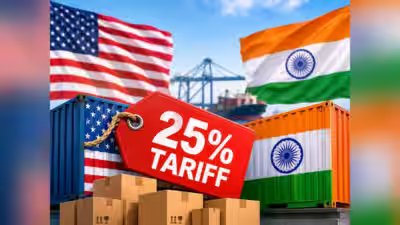
The United States is questioning India’s manufacturing support initiatives, including the Production Linked Incentive (PLI) scheme and Make in India, even as it uses tariffs to protect its own manufacturing interests, Ajay Srivastava, founder of the Global Trade Research Initiative (GTRI), has said.His remarks come after the Office of the United States Trade Representative (USTR) proposed tariffs of up to 25% on Indian goods, citing structural excess manufacturing capacity. The proposed rate could be 17% if a trade deal is signed.Speaking to news agency ANI, Srivastava said Washington was criticising India’s manufacturing policies because they could make domestic production more competitive and reduce demand for American goods.“For India also, they listed all the schemes which India is using, and they are saying they are all hurting US manufacturers. So anything good you are doing in your country is hurting US manufacturing because, if you are making things in your country, US goods will sell less,” he said.Srivastava argued that India was not the only country facing such scrutiny, with the US action covering 16 economies, including the European Union and China.“They are targeting 16 economies. When I say economies, they target the European Union also, which has 27 countries. So almost all the big trading partners of the US have been targeted with high tariffs,” he said.Referring to Cambodia, he said the USTR had also criticised its economic policies, labour laws and efforts to promote manufacturing.
GTRI calls excess capacity claims a pretext for trade deals
Srivastava alleged that Washington was using concerns over excess manufacturing capacity to push countries towards trade agreements that favour the US.“Excess capacities are just a pretence for an extractive one-sided trade deal,” he said, arguing that the proposed tariffs were being used to pressure countries, including India, into signing trade agreements.He urged the Indian government to use the consultation period to present its case and explain why the country does not have structural excess capacity. According to Srivastava, the US has opened a window for consultations extending until January.He also asked India to highlight subsidies provided by the US to its agricultural sector while responding to the allegations.“If you talk about agriculture, it is the US which subsidises its agriculture, so they have the most excess capacity. They have to look back into what they are doing also instead of accusing,” he said.
India says it has no structural excess capacity
The Union commerce and industry ministry has said India does not have structural excess capacity in any sector.The ministry said the USTR notice was under examination and that India had engaged constructively throughout the investigation.“In response to the Notice of Initiation and in subsequent proceedings, the department of commerce stated that India does not have structural excess capacity in any sector,” the ministry said.The proposed tariffs follow an eight-month investigation under Section 301 of the US Trade Act of 1974, which examined alleged unfair trade practices involving 16 trading partners.India has also maintained that trade-related concerns should be addressed through the ongoing negotiations for the India-US Bilateral Trade Agreement (BTA).“India and the United States are engaged in negotiations for a Bilateral Trade Agreement. It has been India’s position that any trade-related concerns should be addressed within the framework of these negotiations,” the ministry said, reiterating the government’s commitment to an early conclusion of the pact.
Labour-intensive exports among those at risk
Srivastava estimated that around 50-52% of India’s exports to the US could be affected by the proposed tariffs. These include labour-intensive sectors such as textiles, leather, garments, handicrafts and some auto components.However, around 40% of India’s exports, including diesel, petrol, generic medicines and iPhone-type products, would continue to enter the US at zero tariffs, he said.Steel, aluminium and copper, along with some auto components, would continue to face tariffs higher than 25%, currently at 50%. These products account for around 7-8% of India’s exports to the US, according to Srivastava.The proposed tariffs cover economies including India, China, Bangladesh, Cambodia, the European Union, Indonesia, Japan, South Korea, Malaysia, Singapore, Switzerland, Taiwan, Thailand and Vietnam, among others.